


Roof heat loss accounts for roughly 25% of total energy loss in a typical home, making the attic and roof assembly one of the most significant weak points in a building’s thermal envelope. The primary culprits are inadequate insulation, unsealed air leaks, and thermal bridging through framing, all of which allow heated air to escape during winter months and enter during summer. Spray foam insulation addresses these problems simultaneously by creating a continuous air barrier, delivering high R-value per inch, and sealing the gaps, cracks, and penetrations that traditional insulation materials like fiberglass batts and blown cellulose simply cannot reach.
TL;DR
- An estimated 25% of residential heat loss occurs through the roof and attic, driven by poor insulation, air leaks, and thermal bridging.
- The EPA estimates homeowners save an average of 15% on heating and cooling costs by air sealing and adding insulation to attics and basements.
- Nine out of ten homes in the United States are under-insulated according to ENERGY STAR.
- Closed-cell spray foam delivers approximately R-6.5 to R-7 per inch, while open-cell spray foam delivers approximately R-3.5 to R-3.9 per inch.
- Spray foam applied to the underside of the roof deck creates an unvented conditioned attic, bringing HVAC ducts inside the thermal envelope and eliminating duct losses.
- Ice dams form when heat escapes through the roof assembly, melts snow, and refreezes at the colder eaves, a problem directly tied to insulation and air sealing gaps.
- Building Science Corporation research confirms that spray foam roof assemblies can dry out sufficiently after minor leaks when installed correctly on dry sheathing.
The Root Causes of Roof Heat Loss
Understanding what drives heat loss through the roof is the first step toward fixing it. The mechanisms fall into a few distinct categories, and most homes suffer from more than one at the same time.
Conduction Through Inadequate Insulation
Heat moves through solid materials by conduction. When insulation levels are too low, heat travels from the warm interior of a home through the ceiling, framing, and roof sheathing to the cold exterior. The ENERGY STAR recommended R-values vary by climate zone, ranging from R-30 in warmer zones up to R-60 in colder zones for uninsulated attics. Most older homes fall far short of these targets, and even newer homes may have insulation that was compressed, poorly installed, or shifted over time.
Convection and Air Leakage
Air leakage is often the larger problem. Warm interior air rises by stack effect and finds every crack, gap, and penetration in the ceiling plane. Common leak paths include recessed light housings, plumbing stacks, electrical wire penetrations, chimney chases, attic hatches, and the gaps around ductwork. According to ENERGY STAR, if you added up all the leaks and holes in a typical home’s envelope, it would equal leaving a window open year-round. This uncontrolled air movement bypasses whatever insulation is in place and carries significant amounts of heat (and moisture) directly into the attic.
Thermal Bridging Through Framing
Wood studs, rafters, and truss heels conduct heat more effectively than the insulation cavities between them. In a standard attic floor insulated with fiberglass batts, every ceiling joist and truss bottom chord represents a thermal bridge where heat flows more easily. These bridges are especially problematic at truss heels where insulation depth is limited, and at complex roof geometries where framing is dense.
Ice Dams as a Symptom of Heat Loss
Ice dams are one of the most visible consequences of roof heat loss. According to Building Science Corporation’s research on ice dams, the fundamental cause is a temperature difference across the roof surface, where the upper portion is warm enough to melt snow while the lower eaves remain cold. That warmth comes from heat escaping through insufficient insulation and unsealed air leaks from the living space below. When meltwater reaches the cold eaves, it refreezes, forming a ridge of ice that traps further water behind it. This standing water can work its way under shingles and into the wall cavities below, causing structural damage, mold growth, and interior staining.
How Spray Foam Insulation Addresses Each Problem
Spray foam insulation works differently than conventional materials because it expands on application to fill cavities, seal gaps, and adhere to surrounding surfaces. This combination of properties makes it uniquely effective against every major heat loss pathway.
Air Sealing and Convection Control
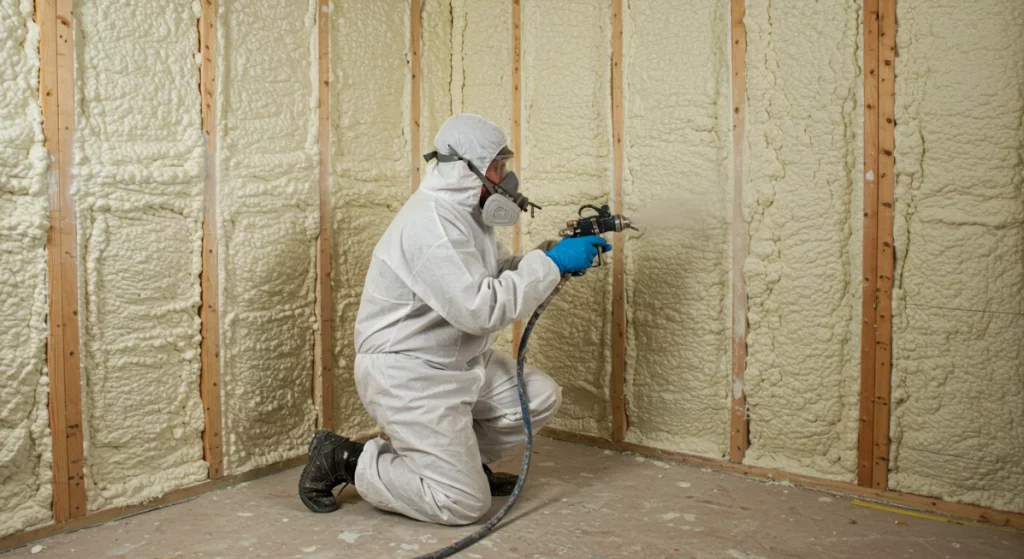
Unlike fiberglass batts or blown cellulose, spray foam insulation benefits create a continuous air barrier when applied. Closed-cell foam is itself an air-impermeable material, and open-cell foam, while vapor-open, still provides an effective air seal when applied at sufficient thickness. This means that when spray foam is installed along the roof line, it simultaneously insulates and air seals in a single step. The foam expands into cracks around framing, seals around electrical penetrations, and fills irregular cavities that would be impossible to address with rigid boards or batt insulation.
High R-Value per Inch
Spray foam delivers substantially more thermal resistance per inch than most competing materials, which matters in applications where cavity depth is limited such as cathedral ceilings, low-slope roofs, or retrofit situations where every inch counts.
| Insulation Material | R-Value per Inch | Air Barrier | Vapor Barrier | Best Application |
|---|---|---|---|---|
| Closed-cell spray foam | R-6.5 to R-7 | Yes | Yes (Class II) | Roof decks, crawl spaces, flood-prone areas |
| Open-cell spray foam | R-3.5 to R-3.9 | Yes | No (vapor-open) | Wall cavities, interior roof decks with vapor retarder coating |
| Fiberglass batts | R-2.9 to R-3.8 | No | No | Standard wall cavities, attic floors |
| Blown cellulose | R-3.1 to R-3.8 | No | No | Attic floors, enclosed wall cavities |
| Rigid foam board (XPS) | R-5.0 | Varies | Yes | Continuous exterior insulation |
Eliminating Thermal Bridges
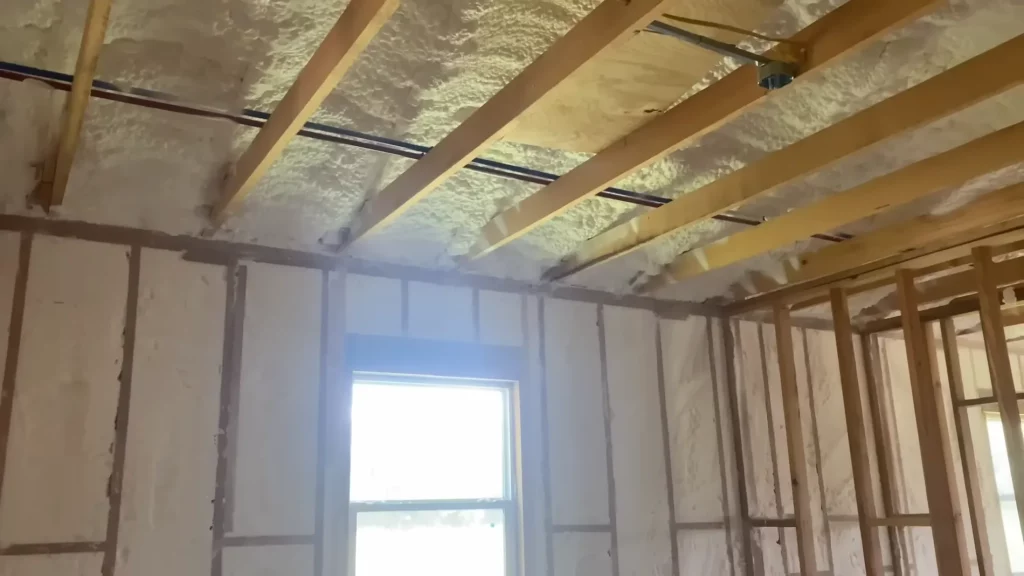
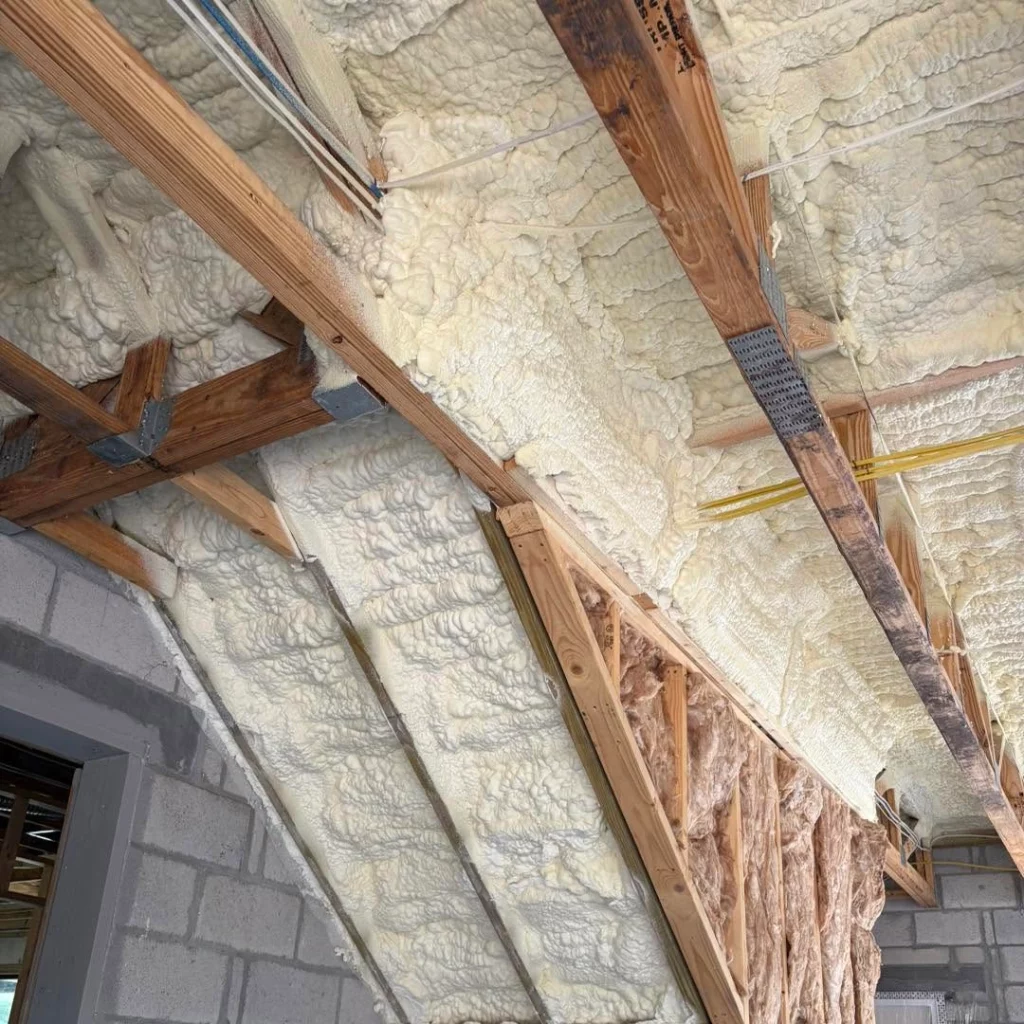
When spray foam is applied directly to the underside of the roof deck, it covers the framing members as well as the cavities between them. This continuous application eliminates the thermal bridges that plague conventionally insulated assemblies. Every rafter, truss chord, and blocking piece gets encapsulated in foam, preventing heat from finding a preferential path through the wood.
Creating an Unvented Conditioned Attic
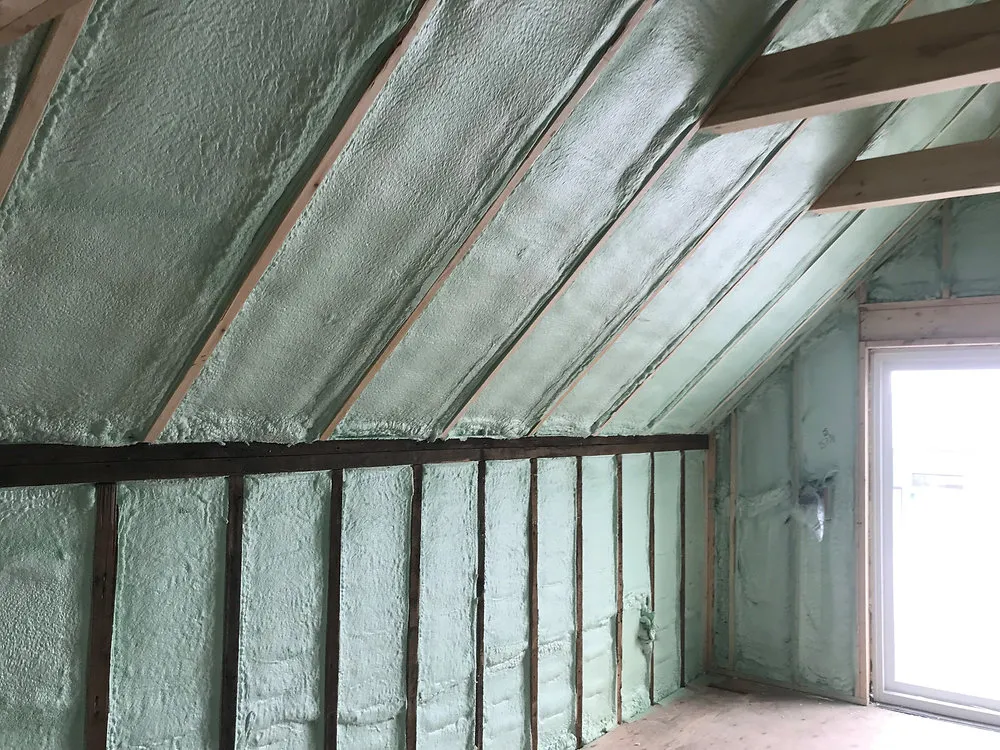
One of the most impactful applications of spray foam is the creation of an unvented conditioned attic. Instead of insulating at the attic floor and venting the attic space, spray foam is applied directly to the underside of the roof sheathing. According to the Building America Solution Center, this approach moves the thermal envelope, air barrier, and vapor control layers to the roof line, which brings several benefits. HVAC equipment and ductwork that would otherwise sit in a vented, unconditioned attic are now inside the thermal envelope. That means duct losses that previously escaped to the outdoors now contribute to conditioning the living space. For homes with complex ceiling planes, numerous recessed lights, and service penetrations, sealing the roof line is often far more practical than trying to air seal hundreds of individual penetrations at the ceiling plane below.
Preventing Ice Dams at the Source
Because spray foam applied to the roof deck eliminates both conductive heat loss and air leakage through the ceiling plane, it addresses the two primary causes of ice dams. The roof sheathing stays at a temperature much closer to the exterior air, reducing or eliminating the differential that causes snowmelt and refreezing. In cathedral ceiling assemblies where traditional venting is difficult or impossible, closed-cell spray foam applied to the underside of the sheathing provides both the insulation and the air sealing needed to keep the roof surface cold.
Insulation Type Comparison for Roof Assemblies
Choosing between open-cell and closed-cell spray foam depends on the specific conditions of the project, including climate zone, cavity depth, moisture exposure, and budget. Both types have distinct advantages for roof assemblies.
| Factor | Closed-Cell Spray Foam | Open-Cell Spray Foam |
|---|---|---|
| R-value per inch | 6.5 to 7.0 | 3.5 to 3.9 |
| Air barrier | Yes (inherently) | Yes (at sufficient thickness) |
| Vapor control | Yes (Class II vapor retarder) | No (requires coating in cold climates) |
| Density | High (approximately 2 lb/ft³) | Low (approximately 0.5 lb/ft³) |
| Structural rigidity | Adds shear strength to assembly | Does not add structural support |
| Water resistance | Resists bulk water intrusion | Can absorb and hold water |
| Cavity depth needed | Less depth for equivalent R-value | Greater depth needed for same R-value |
| Cold climate suitability | Preferred in Zones 4-8 | Requires Class II vapor retarder coating in Zones 5-8 |
Research from Building Science Corporation on spray foam under roof sheathing found that both open-cell and closed-cell systems performed well in field evaluations, with all sampled roof assemblies showing moisture contents well within the safe range for wood sheathing. However, closed-cell foam is generally preferred in colder climates and in situations where moisture exposure is a concern, because it acts as both an air barrier and a vapor retarder.
Real-World Scenarios
The following scenarios illustrate common roof heat loss problems and how spray foam insulation resolved them.
| Scenario | Home Type | Problem | Solution | Outcome |
|---|---|---|---|---|
| Cathedral ceiling heat loss | 1990s two-story with vaulted ceilings | R-19 fiberglass batts compressed between 2×8 rafters with visible gaps and air leaks at every electrical box | Closed-cell spray foam applied to 2 inches (R-13 to R-14) directly against roof sheathing, supplemented with R-15 mineral wool in remaining cavity | Eliminated drafts, resolved condensation on ceiling surfaces, homeowner reported noticeable improvement in winter comfort |
| Ice dam damage | 1970s ranch with vented attic | Chronic ice dams causing water staining on bedroom walls, insulation settled to R-11 in attic floor, unsealed penetrations around plumbing stacks | Open-cell spray foam applied to underside of roof deck to R-28, attic converted to conditioned space | Ice dams eliminated within first winter after installation, HVAC ducts moved inside thermal envelope |
| Duct losses in attic | 2005 two-story with all HVAC equipment in attic | Leaky, uninsulated ductwork in 130-degree summer attic driving up cooling bills, R-30 blown fiberglass on attic floor | Closed-cell spray foam at roof deck to R-19, creating conditioned attic for HVAC equipment | Measurable reduction in cooling energy use, more even temperatures throughout the home |
| Complex coffered ceiling | Custom home with multiple coffered ceiling sections | Nearly impossible to air seal the intricate ceiling plane with traditional methods, significant air leakage at every intersection | Closed-cell spray foam applied along roof line to bring entire attic inside conditioned envelope | Single application sealed all leak paths, avoided the need for individual penetration sealing at hundreds of ceiling joints |
| Retrofitted older home | 1960s cape cod with shallow attic | Minimal insulation (R-7), multiple knob-and-tube wiring penetrations, active air leaks at chimney chase and attic hatch | Spray foam applied to roof deck to code-required R-value, knob-and-tube areas addressed per safety requirements | Attic brought within thermal envelope, stack-effect air leakage dramatically reduced |
Actionable Strategies for Roof Heat Loss
These steps outline what we recommend for homeowners and builders looking to address roof heat loss with spray foam insulation.
1. Assess the Current Assembly Before Deciding on Approach
Before any insulation work begins, our team evaluates the existing roof assembly, including the type and condition of the sheathing, the framing depth, the current insulation level, and any signs of moisture damage or air leakage. This assessment determines whether insulating at the attic floor or moving the insulation to the roof line makes more sense.
2. Verify Sheathing Moisture Content
Research by Building Science Corporation found that spray foam failures in roof assemblies are most commonly linked to installation over wet sheathing. We measure the moisture content of the wood before applying any foam and confirm it is below 19%, as recommended by both the Building America Solution Center and spray foam manufacturers. Applying foam to wet OSB or plywood prevents proper adhesion and traps moisture against the wood.
3. Seal All Attic Floor Penetrations When Keeping a Vented Attic
If the project involves insulating at the attic floor rather than the roof line, we seal every penetration through the ceiling plane before adding insulation. This includes plumbing stacks, electrical penetrations, chimney chases, recessed light housings, and the attic hatch. Air sealing must precede insulation because insulation alone does not stop air movement.
4. Apply Foam Directly to the Underside of the Roof Deck
When creating an unvented conditioned attic, the spray foam goes directly against the roof sheathing with no gaps. This creates the continuous air barrier, thermal control layer, and (with closed-cell foam) vapor control layer that the assembly needs to function properly. We ensure consistent coverage across the entire roof plane, including the gable end walls that separate the new conditioned attic from exterior conditions.
5. Address Ventilation and Moisture Control for Conditioned Attics
Unvented conditioned attics require a moisture removal strategy. Options include exhausting air from the attic peak with a fan ducted to the exterior, installing a heat recovery ventilator (HRV) or energy recovery ventilator (ERV), adding a dehumidifier, or directly coupling the attic space to the home’s HVAC system with supply and return ducts.
6. Use the Right Foam Type for the Climate Zone
In climate zones 5 through 8, building codes require that any air-impermeable insulation under the roof sheathing be a Class II vapor retarder or have a Class II vapor retarder coating. Closed-cell spray foam inherently meets this requirement. Open-cell spray foam is vapor-open and must be paired with a Class II vapor retarder coating applied directly to its interior surface in these colder zones.
7. Verify Code Compliance and Inspect the Installation
After installation, we visually inspect the foam to confirm it meets the specified depth with no gaps, voids, or areas of thin coverage. The installation must comply with the International Residential Code requirements for unvented attic assemblies, which include keeping the attic completely within the building thermal envelope and not installing Class I vapor retarders on the ceiling side.
Factors That Affect Spray Foam Performance on Roofs
Several variables determine how well spray foam insulation will perform in a specific roof assembly.
Climate zone. Colder zones demand higher R-values and stricter vapor control. The DOE recommends R-49 to R-60 for attics in zones 4 through 8, and the choice between open-cell and closed-cell foam depends on meeting both thermal and vapor control requirements.
Foam thickness and R-value achieved. The installed thickness of the foam directly determines the R-value. In cathedral ceilings where cavity depth is limited by rafter size, closed-cell foam is often the practical choice because it delivers more R-value per inch.
Installation quality. Spray polyurethane foam is essentially manufactured on-site during application. The temperature of the substrate, the ambient conditions during spraying, the component ratios, and the lift thickness all affect the final product quality. Our installers are trained to control these variables.
Substrate condition. The roof sheathing must be clean, dry, and free of dust and debris for proper foam adhesion. Moisture content should be verified before application.
Existing roof condition. For retrofit projects, the condition of the roofing above the sheathing matters. If there are active leaks, they must be repaired before foam is installed. A leak behind closed-cell foam can be difficult to detect and repair.
Ventilation strategy. In unvented conditioned attics, a planned moisture removal strategy is necessary. Without ventilation or dehumidification, humidity can accumulate in the sealed attic space, particularly in humid climates.
Schedule Your Roof Insulation Assessment
At Raleigh Excel Spray Foam Insulation, our team specializes in diagnosing and resolving roof heat loss problems for homeowners throughout the Raleigh area. We evaluate your existing attic assembly, identify specific air leakage pathways and insulation deficiencies, and recommend the spray foam solution that fits your home’s needs and your local climate zone requirements. Whether you are dealing with ice dams, high energy bills, uncomfortable temperature swings, or a roof assembly that simply is not performing the way it should, we have the experience and training to get it right.
Contact us at [email protected] or call (919) 301-9435 to discuss your project.
Frequently Asked Questions
Can spray foam insulation be installed over existing attic insulation?
In most cases, spray foam is applied to the underside of the roof deck to create a conditioned attic, which is a different approach than adding insulation on top of existing attic floor insulation. The existing insulation can remain in place or be removed depending on the project design, but the spray foam itself should always be applied directly against a clean, dry substrate.
Does spray foam in the attic eliminate the need for roof ventilation?
Yes, when spray foam is applied to the underside of the roof deck, the attic becomes an unvented conditioned space within the thermal envelope. Roof ventilation is not needed in this configuration, but the attic does require a moisture removal strategy such as an HRV, ERV, dehumidifier, or connection to the home’s HVAC system.
How does spray foam prevent ice dams?
Spray foam prevents ice dams by sealing the air leaks that carry warm indoor air into the roof assembly and by providing sufficient R-value to keep the roof sheathing cold. Ice dams form when the upper portion of the roof is warm enough to melt snow while the eaves stay below freezing. By insulating and air sealing at the roof deck, spray foam eliminates the temperature differential that drives ice dam formation.
Is closed-cell or open-cell spray foam better for roof applications?
Closed-cell spray foam is generally the stronger choice for roof assemblies because it provides a higher R-value per inch, acts as a vapor retarder, and adds structural rigidity. Open-cell can be used in warmer climates and in assemblies where a vapor retarder coating is applied, but closed-cell is the preferred option in climate zones 4 through 8 and in any situation where moisture resistance is a priority.
How long does spray foam insulation last in a roof assembly?
When installed correctly over dry sheathing with proper building envelope design, spray foam insulation is a long-term building material that does not settle, sag, or degrade over time like fiberglass or cellulose. Building Science Corporation field evaluations of in-service spray foam roofs found all sampled assemblies performing within acceptable moisture content ranges, confirming long-term durability when installation best practices are followed.
Sources
- ENERGY STAR – Why Seal and Insulate? – EPA estimates on energy savings from air sealing and insulation, including the statistic that 9 out of 10 U.S. homes are under-insulated.
- ENERGY STAR – Recommended Home Insulation R-Values – Climate zone-specific R-value recommendations for attic insulation based on the 2021 IECC.
- Building Science Corporation – BA-1312: Application of Spray Foam Insulation Under Plywood and OSB Roof Sheathing – Hygrothermal modeling and field evaluation research on spray foam roof assemblies, including moisture management findings and failure analysis.
- Building America Solution Center – Unvented Conditioned Attic with Spray Foam Insulation Below Roof Deck – DOE-sponsored guide covering installation procedures, code compliance, ventilation strategies, and climate zone considerations for spray foam conditioned attics.
- Building Science Corporation – BSD-135: Ice Dams – Comprehensive analysis of ice dam causes including insufficient insulation, air leakage, and attic heat sources, along with recommended solutions.

- How Should Raleigh, NC Property Owners Evaluate Insulation for Long-Term Use? - September 23, 2026
- What Factors Affect Insulation Performance Across Different Parts of a Property? - September 23, 2026
- Could Spray Foam Insulation Be Useful Around Uneven Building Sections in Wake Forest, NC? - September 18, 2026