


Greenville homeowners looking to reduce unwanted noise and improve indoor comfort face a growing selection of insulation materials, each with distinct acoustic properties and cost considerations. The right choice depends on your specific noise challenges, whether you are dealing with street traffic, neighbor sounds, or HVAC equipment, along with your budget and energy efficiency goals. This guide evaluates the top-performing materials, their realistic performance ranges, and strategic applications for Greenville’s climate and housing stock, highlighting home insulation performance guide.
TL;DR
- Mineral wool and high-density fiberglass batts consistently outperform other insulation types for airborne noise reduction, with STC ratings between 40 and 55, depending on the wall assembly
- Open-cell spray foam excels at air sealing and mid-frequency sound dampening, but provides less mass-based sound blocking than denser alternatives
- Closed-cell spray foam offers the highest R-value per inch and moderate sound control, making it ideal for spaces where both moisture resistance and noise reduction matter
- Budget-friendly fiberglass insulation remains a solid choice for cost-conscious homeowners, particularly in interior wall applications where extreme soundproofing is not required
- No insulation material alone achieves complete soundproofing; effective noise control requires understanding STC ratings, proper installation, and often a layered approach combining mass, absorption, and decoupling strategies
- Greenville’s humid climate makes moisture resistance a critical factor when selecting insulation, influencing whether spray foam or traditional fibrous materials make more sense for your specific application
- Retrofitting existing walls typically costs 30 to 50 percent more than installing during new construction, so understanding your investment range upfront prevents budget surprises
Understanding STC Ratings and What They Mean for Your Home
Sound Transmission Class (STC) ratings measure how well a wall or floor assembly blocks airborne sound. A higher STC number indicates better noise reduction. Standard unfinished walls with drywall typically rate around STC 35, meaning loud speech can be heard clearly through them. Adding insulation can push that number to 50 or higher, where normal speech becomes inaudible.
The Insulation Institute provides detailed comparisons of how different insulation materials affect both thermal and acoustic performance. Understanding these ratings helps you set realistic expectations before investing in any material.
For a visual resource explaining STC ratings and how different insulation materials affect sound transmission, refer to the Insulation Comparison Chart.
It is important to note that STC ratings apply to complete wall assemblies, not individual products. A wall with mineral wool between studs performs differently than the same mineral wool installed in a different configuration with varying drywall layers or resilient channels.
Comparing the Top Insulation Materials for Noise Control
Mineral Wool
Mineral wool, including products like Rockwool, ranks among the best options for homeowners prioritizing acoustic performance. Its dense fiber structure absorbs sound energy effectively, with NRC (Noise Reduction Coefficient) ratings often exceeding 0.90 in wall cavity applications.
Mineral wool handles a broad frequency range better than most alternatives, making it suitable for blocking both human speech and lower-frequency noise from mechanical equipment or traffic. It also provides fire resistance and maintains its shape over time without settling.
A side-by-side analysis of these materials is available in the Mineral Wool vs Fiberglass Comparison.
The primary drawback is cost. Mineral wool typically runs 20 to 40 percent higher than fiberglass of equivalent R-value. However, for homeowners who live near busy roads or in townhome communities where noise complaints are common, the investment often justifies itself through improved quality of life.
High-Density Fiberglass
Standard fiberglass insulation provides decent acoustic performance at a lower price point, but high-density batts offer better results meaningfully. Products like CertainTeed’s Soundbreak XP feature fibers packed more tightly, increasing both thermal and acoustic resistance, supported by insulation services.
High-density fiberglass works well in interior walls, home offices, media rooms, and bedrooms where noise control matters. It fits standard wall cavities without special tools and costs less than mineral wool while still achieving STC improvements of 10 to 15 points over empty cavities.
The limitation is that fiberglass performs best against mid to high frequencies. Low-frequency bass noise from music or HVAC equipment passes through fiberglass more easily than through mineral wool or dense mass-loaded materials.
Spray Foam Insulation
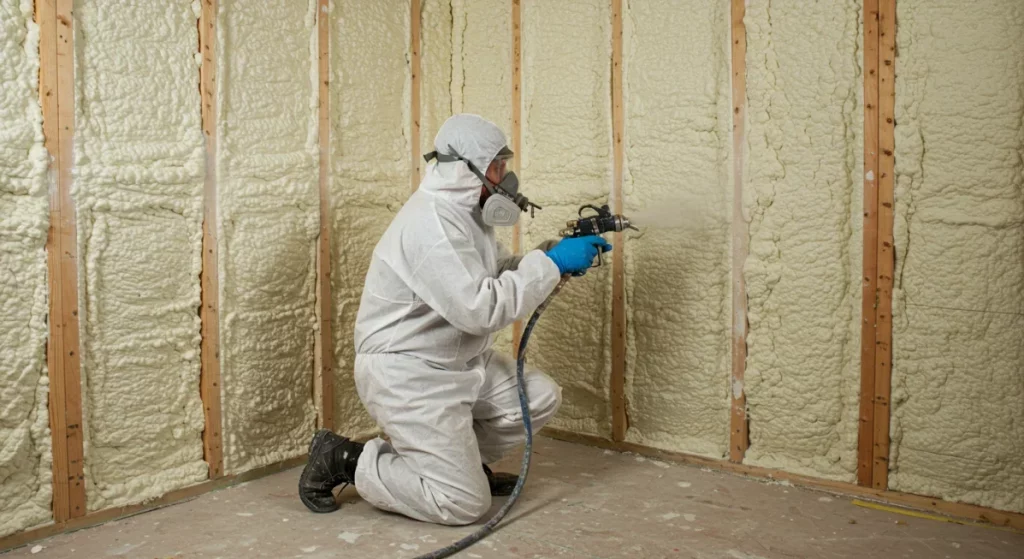
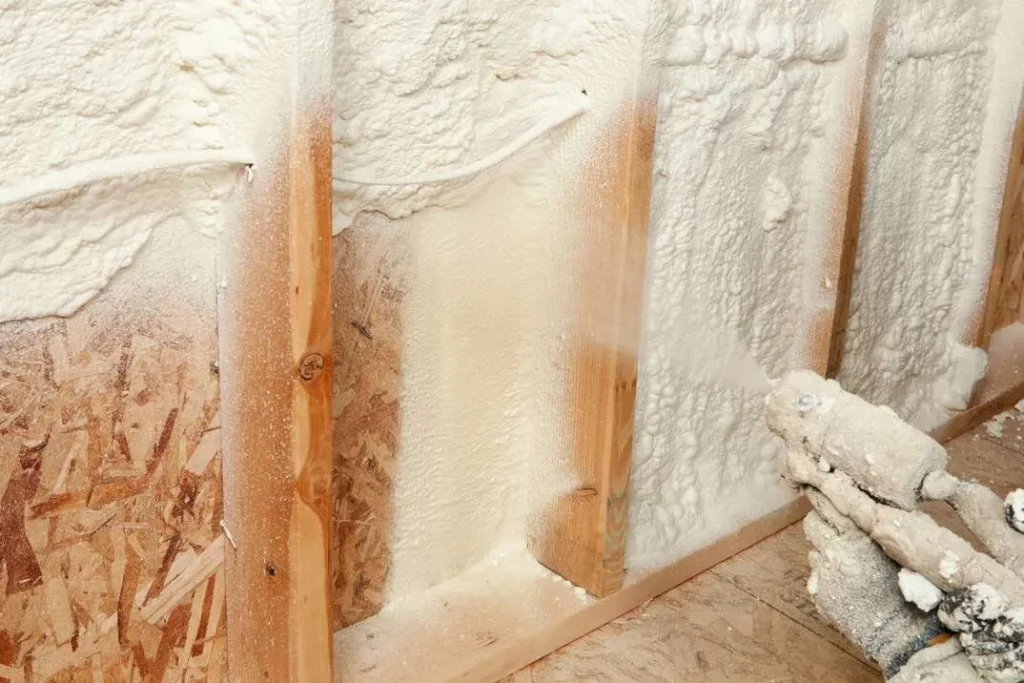
Spray foam insulation operates differently than fibrous materials. Instead of filling wall cavities with porous fibers that absorb sound, spray foam expands to seal air gaps and dampen vibration within the wall assembly. Research from USA Insulation confirms that spray foam reduces noise primarily through air sealing rather than sound absorption.
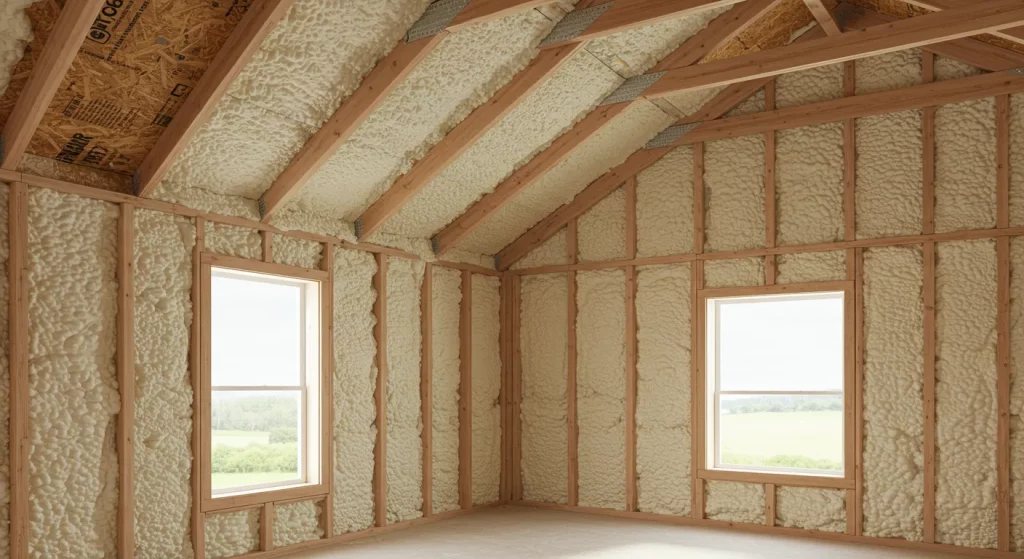
Open-cell spray foam remains softer and more flexible after curing. This flexibility allows it to dampen sound waves more effectively than its closed-cell counterpart, making it the better choice when acoustic performance matters. Open-cell foam also costs less per board foot but provides a lower R-value and minimal moisture resistance.
Closed-cell spray foam delivers a higher R-value (typically R-6 to R-7 per inch) and acts as a vapor barrier. Its rigid structure adds mass to wall assemblies, which helps block sound transmission, but it does not absorb sound as effectively as open-cell foam or fibrous materials. For Greenville homes, closed-cell foam in crawl spaces or rim joists provides both moisture protection and reasonable acoustic benefits.
Spray foam cannot fully soundproof a home on its own, but it significantly reduces noise infiltration through gaps around windows, doors, and utility penetrations where air leakage carries sound.
| Insulation Type | Best For | STC Improvement | R-Value per Inch | Moisture Resistance | Cost Range |
|---|---|---|---|---|---|
| Mineral Wool | High-frequency noise, home theaters, shared walls | +15 to 25 points | R-4.0 to 4.3 | Moderate | Higher |
| High-Density Fiberglass | Interior walls, budget-friendly projects | +10 to 18 points | R-3.7 to 4.3 | Low | Moderate |
| Open-Cell Spray Foam | Air sealing, mid-frequency dampening, attics | +8 to 15 points | R-3.5 to 3.8 | Low | Moderate to High |
| Closed-Cell Spray Foam | Crawl spaces, high R-value needs, moisture zones | +10 to 20 points | R-6.0 to 7.0 | High | Highest |
Strategic Applications for Greenville Homes
Home Offices and Recording Spaces
Homeowners converting spare bedrooms or basements into work-from-home offices face particular challenges with noise from household activity, HVAC systems, and outdoor traffic. Mineral wool batts installed in interior walls provide the most effective solution for blocking sound between rooms and reducing ambient noise infiltration.
Pairing mineral wool with staggered stud construction or resilient channels creates a decoupled assembly where drywall does not directly touch the structural framing. This approach prevents sound vibrations from traveling through the building structure itself, a problem that insulation alone cannot solve.
Exterior Walls Near Busy Streets
Greenville’s growth has brought increased traffic along corridors like Memorial Drive and nearby highways. Homes along these routes benefit most from a combination approach: dense insulation in wall cavities, quality windows with laminated glass, and sealed exterior penetrations.
Closed-cell spray foam works well in rim joist areas and exterior sheathing applications where moisture resistance matters. For the wall cavities themselves, mineral wool or high-density fiberglass typically outperforms spray foam for airborne noise reduction, according to comparison data from Supreme Spray Foam Fresno.
Attached Garages and Utility Rooms
Garages adjacent to living spaces transmit engine noise, door operation sounds, and mechanical equipment vibrations. Adding fiberglass batts with higher density to the garage ceiling and common walls helps, but achieving meaningful reduction often requires mass-loaded vinyl (MLV) barriers or additional drywall layers over resilient channels.
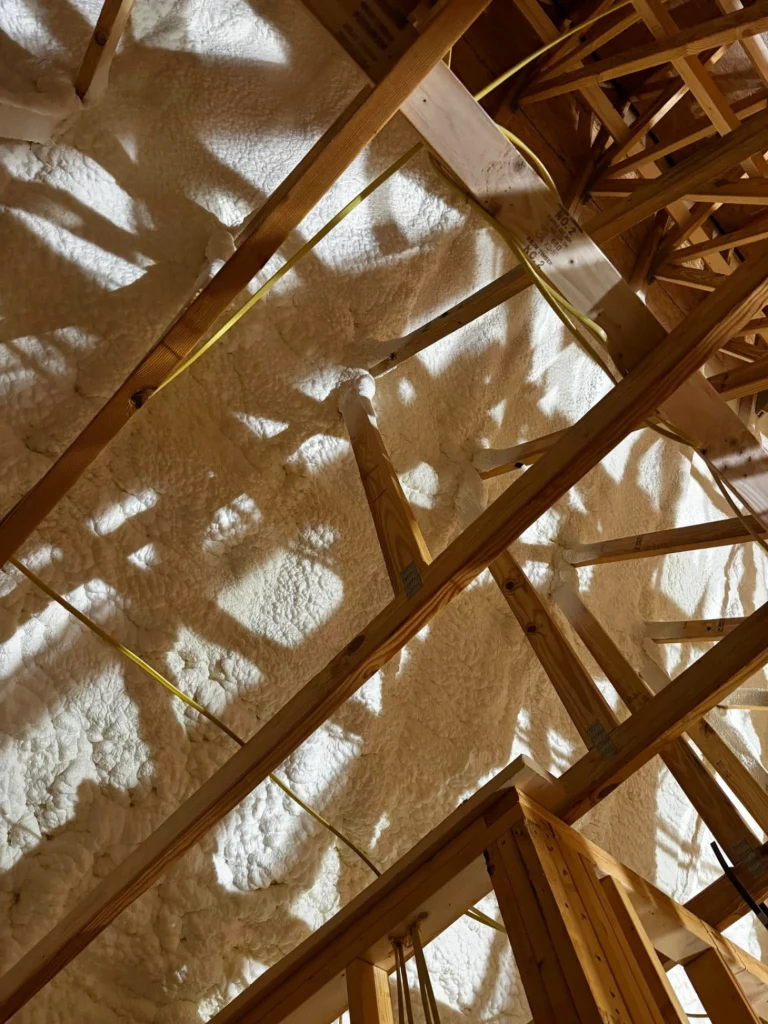
Spray foam in garage ceiling cavities reduces noise while providing thermal separation that keeps conditioned air where it belongs. This application often yields noticeable comfort improvements in the adjacent room.
Real-World Examples from the Greenville Area
Case 1: Townhome in West Greenville A homeowner with shared walls in a townhome community dealt with noise complaints from both sides. Installing high-density fiberglass batts during a bathroom renovation improved their STC rating by approximately 12 points. While not eliminating all sound, the reduction made normal conversations inaudible through the walls, and television noise no longer bothered neighbors.
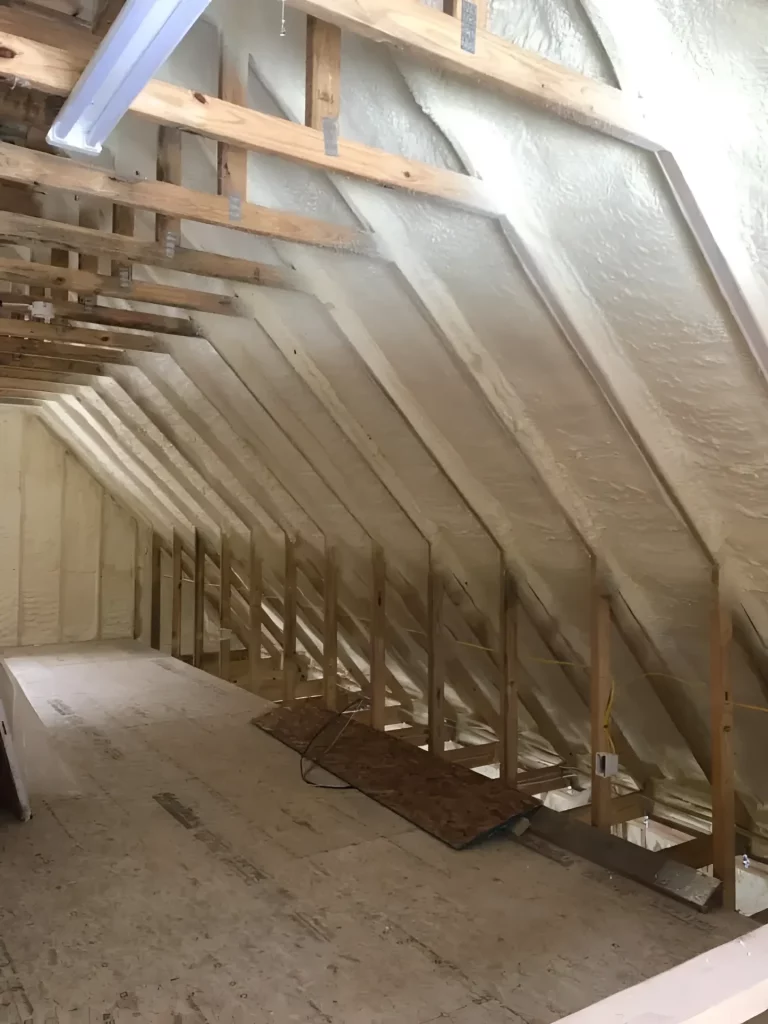
Case 2: Historic Home Near Uptown A 1950s bungalow with minimal insulation suffered from both traffic noise and poor energy efficiency. Combining open-cell spray foam in the attic with dense fiberglass batts in exterior walls achieved meaningful improvements in both comfort and noise levels. The air sealing benefits of spray foam eliminated drafts that carried exterior noise into living spaces.
Case 3: New Construction in Winterville A family building a custom home specified mineral wool in all interior walls for a dedicated home theater space. The investment added approximately $2,400 to their construction budget but delivered STC ratings exceeding 55 in key walls, allowing them to enjoy movie soundtracks at realistic volume levels without disturbing other household members.
| Scenario | Noise Challenge | Solution | Investment | Outcome |
|---|---|---|---|---|
| Townhome shared walls | Neighbor conversations, TV sound | High-density fiberglass batts | $1,800 | +12 STC, reduced complaint calls |
| Historic bungalow | Traffic noise, drafts | Open-cell spray foam + fiberglass | $4,200 | Quieter interior, 18% energy reduction |
| Custom home theater | Movie soundtracks, bass transmission | Mineral wool + staggered studs | $2,400 | STC 55+ walls, realistic audio levels |
How to Evaluate Your Options and Avoid Common Mistakes
Questions to ask before selecting insulation:
- What frequency range of noise am I trying to block? Low-frequency sounds require more mass and often perform better with mineral wool or decoupled assemblies.
- Is moisture exposure a concern in this area? Crawl spaces and rim joists benefit from closed-cell spray foam’s vapor barrier properties.
- Is this new construction, renovation, or retrofit? Retrofit projects face higher labor costs and may require different products.
- What is my realistic budget? Mineral wool outperforms fiberglass but costs more; spray foam adds air sealing benefits beyond noise control.
- Do I need to consider fire safety ratings? Mineral wool provides inherent fire resistance that fiberglass does not.
Common mistakes to avoid:
- Assuming spray foam alone will soundproof a space. It addresses air leakage effectively but does not provide the mass that fibrous materials offer for blocking sound transmission.
- Skipping proper air sealing around penetrations. Gaps around electrical outlets, plumbing, and ductwork let sound through even when wall cavities are well insulated.
- Ignoring the complete wall assembly. Adding insulation to a standard 2×4 wall with a single layer of drywall limits potential STC improvements regardless of material choice.
- Choosing based on R-value alone when acoustics matter. Closed-cell spray foam offers high R-value but does not outperform mineral wool for noise reduction in wall cavities.
- Installing fibrous insulation too loosely. Gaps and compression reduce both thermal and acoustic performance.
Recommendations by Homeowner Profile
First-Time Buyers in Starter Homes Focus on exterior wall insulation in living areas and bedrooms. High-density fiberglass batts provide the best value for noise reduction in this segment. Budget approximately $2 to $4 per square foot for professional installation in existing walls.
Families with Home Office Needs Prioritize interior walls between workspaces and living areas. Mineral wool batts or mineral wool with resilient channels deliver the acoustic isolation that video calls and focused work require. Budget $4 to $7 per square foot for walls requiring retrofit installation.
Luxury Homeowners Seeking Maximum Performance Consider mineral wool in all exterior walls, staggered stud construction in shared walls, and closed-cell spray foam in structural cavities. This combination achieves STC ratings of 55 or higher throughout the home. Budget $8 to $15 per square foot for comprehensive acoustic upgrades.
Historic Home Owners The combination approach works best: open-cell spray foam for air sealing and attic insulation, dense fiberglass or mineral wool for exterior walls where renovation occurs. Historic homes often have significant air leakage that spray foam addresses while fibrous insulation handles cavity filling.
Signs You Have Found the Right Insulation Strategy
- Your insulation contractor explains STC ratings and discusses your specific noise concerns rather than pushing a single product
- The proposal addresses the complete wall or floor assembly, not just the cavity fill material
- Installation details include air sealing around penetrations and proper coverage without compression
- You receive documentation of expected R-value and STC improvements based on your specific assembly configuration
- The cost estimate breaks down material and labor separately so you can adjust scope if needed
Your Next Steps Toward a Quieter, More Comfortable Home
Choosing the right insulation for noise reduction and comfort in Greenville requires balancing acoustic performance, moisture resistance, energy efficiency, and budget. For most homeowners, a hybrid approach combining fibrous insulation in wall cavities with spray foam for air sealing delivers the best overall results, especially when working with Greenville, NC insulation experts.
Our team at Raleigh Excel Spray Foam Insulation brings decades of combined experience evaluating Greenville homes and recommending the right materials for each situation. We assess your specific noise challenges, identify air leakage pathways, and design solutions that genuinely improve your quality of life rather than simply filling cavities.
Whether you are building new, renovating an existing space, or looking to reduce noise in your current home, we provide honest assessments and professional installation that meets Greenville standards. For personalized guidance on your insulation project, contact us directly at (919) 301-9435 or email [email protected]. Our team responds to inquiries within one business day and offers on-site assessments for projects requiring detailed evaluation.
Frequently Asked Questions
Will adding insulation completely soundproof my home?
No insulation material alone achieves complete soundproofing. Effective noise reduction requires a combination of mass, absorption, and sometimes decoupling strategies. Insulation plays a key role, but window quality, door seals, and wall construction also determine final noise levels.
Is mineral wool worth the extra cost over standard fiberglass?
For homeowners with significant noise challenges, mineral wool’s superior acoustic performance and fire resistance often justify the higher price. For basic noise reduction in interior walls, high-density fiberglass provides sufficient performance at a lower cost.
Can spray foam help with the noise from my HVAC system?
Spray foam reduces noise transmission through walls and ceilings primarily by sealing air gaps. It does not absorb sound as effectively as fibrous materials, but air sealing around ductwork and penetrations can meaningfully reduce noise from mechanical equipment.
What STC rating should I target for a home office?
A rating of STC 50 or higher effectively blocks normal speech from being understood in adjacent rooms. For recording spaces or studios, target STC 60 or above by combining dense insulation with additional drywall layers and decoupled construction.
How long does spray foam insulation last?
Professionally installed spray foam insulation maintains performance for decades without settling or degrading. Unlike fibrous materials, it does not absorb moisture or lose R-value over time, making it a long-term investment in both comfort and energy efficiency.
Sources
- Insulation Institute – Insulation Types and Comparing Options – Comprehensive comparison of insulation materials including thermal and acoustic performance ratings for homeowners and contractors.
- USA Insulation – How Insulation Reduces Noise – Educational resource explaining the relationship between spray foam insulation and sound dampening in residential applications.
- Supreme Spray Foam Fresno – Open-Cell Foam vs Traditional Insulation for Soundproofing – Technical comparison of spray foam and traditional fibrous insulation materials for acoustic performance in wall assemblies.
- Acoustical Surfaces – Mineral Wool vs Fiberglass Comparison – Side-by-side analysis of mineral wool and fiberglass batts including R-value, sound absorption ratings, and application recommendations.
- Cloud9 Spray Foam – Insulation Comparison Chart – Visual resource explaining STC ratings and how different insulation materials affect sound transmission in residential construction.

- What Role Does Insulation Thickness Play in Building Durability and Material Performance? - October 23, 2026
- How Can Spray Foam Insulation Improve Coverage Around Irregular Framing? - October 23, 2026
- Why Is Closed Cell Spray Foam Effective Around Moisture-Prone Building Areas in Raleigh, NC? - October 21, 2026