


Advanced spray foam insulation solutions create a complete air barrier by expanding into every gap, crack, and void in a building’s envelope during application, then curing into a continuous, solid layer that blocks uncontrolled air movement. For Raleigh, NC buildings located in Climate Zone 4A, this means conditioned indoor air stays in during humid summers and cold winters, while unconditioned outside air, moisture, and pollutants stay out. The approach works differently depending on whether open-cell or closed-cell foam is used, where it is applied, and how well the installation connects the entire building envelope into one unbroken system. Understanding how spray foam achieves this, what building codes require, and which type suits each part of a structure is what separates a building that performs from one that leaks.
TL;DR
- Spray polyurethane foam (SPF) is applied as a liquid that expands 30 to 60 times its volume, filling cavities and cracks that other insulation materials cannot reach.
- Once cured, both open-cell and closed-cell spray foam form a seamless, continuous air barrier that meets IECC and ASHRAE air permeance requirements.
- Closed-cell foam provides R-6 to R-7 per inch and also acts as a vapor retarder, while open-cell foam provides R-3.5 to R-3.8 per inch and requires additional vapor control in some assemblies.
- Raleigh and Wake County fall under Climate Zone 4A, where the NC Energy Conservation Code mandates specific R-values and continuous air barrier requirements for new construction.
- Air pressure from wind, stack effect, and HVAC systems can drive moisture-laden air through the smallest gaps, making a continuous air barrier more important than R-value alone.
- The IECC 2021 requires blower door testing at 3 ACH50 for residential buildings in Climate Zones 3 through 8, which spray foam helps builders achieve reliably.
- According to the Department of Energy, proper insulation and air sealing can reduce heating and cooling costs by up to 20%.
What Makes Spray Foam Different from Other Insulation
Most common insulation materials, including fiberglass batts and loose-fill cellulose, are designed to resist heat flow through conduction. They do this well when installed perfectly, but they do not stop air from moving through or around them. Fiberglass, for instance, is air-permeable by nature. When air finds a path through gaps, compression points, or poorly fitted cavities, it carries heat and moisture with it, reducing the effective R-value of the entire assembly, which is why many property owners research spray foam for extreme weather conditions.
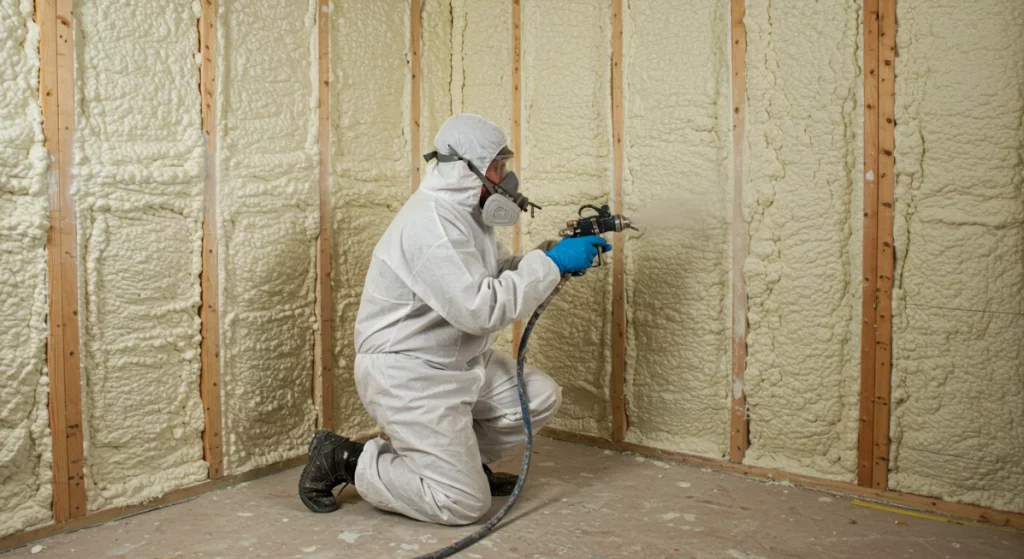
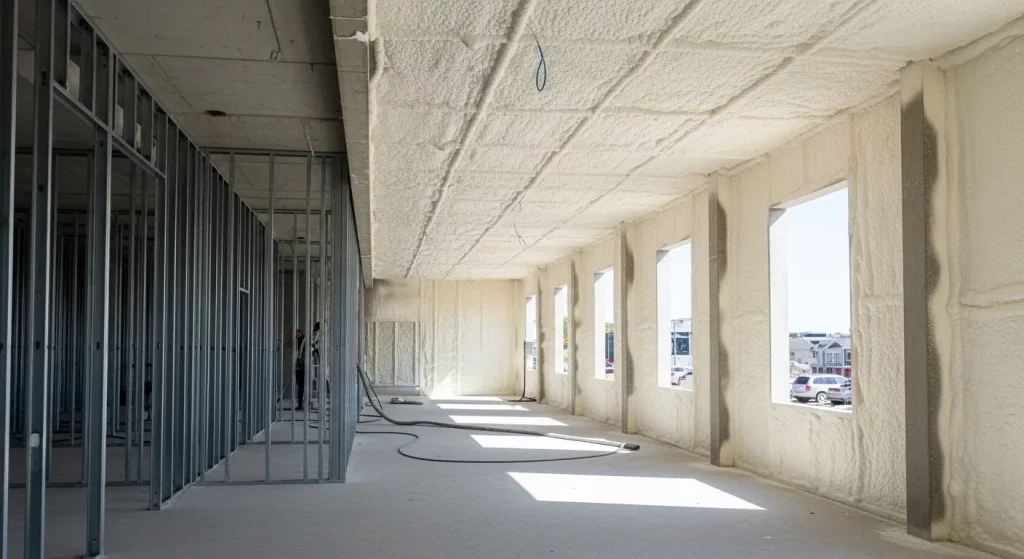
Spray foam works on a fundamentally different principle. It is applied as a two-component liquid mixture sprayed from a pressurized gun. The two liquids react chemically, forming bubbles, and the product expands into a cellular plastic that conforms to the exact shape of whatever cavity it fills. As it expands, it forces itself into cracks, around wires, pipes, framing irregularities, and any small opening that air could pass through. Once cured, the foam adheres directly to the substrate and creates what building scientists describe as a “seamless, semi-rigid thermal and air barrier layer,” according to the Building Science Corporation.
This adhesive bond and the foam’s low air permeance are what distinguish it from every other insulation type. According to the Whole Building Design Guide, materials used as part of an air barrier system must have an air permeance no greater than 0.004 cfm/sf at 1.57 psf, a standard that spray foam meets when applied at the proper thickness, according to the Whole Building Design Guide (WBDG).
The Science Behind Air Leakage and Why It Matters
Air does not stay still inside a building. Three forces constantly push and pull air through the envelope:
- Wind pressure, which pressurizes the windward side of a structure and creates negative pressure on leeward walls and roof edges
- Stack effect, where warm indoor air rises and escapes through upper-level gaps while cooler air is drawn in at the base
- HVAC fan pressure, which can pressurize or depressurize spaces depending on system design
These forces drive air through any available pathway, including gaps around windows, unsealed rim joists, penetrations for plumbing and electrical, and joints between framing members. The WBDG notes that uncontrolled infiltration and exfiltration can add between 10% and 42% to a building’s heating and cooling energy load, depending on climate.
In Raleigh’s mixed-humid climate, the problem cuts both ways. During summer, hot, humid outdoor air infiltrates through envelope leaks, forcing HVAC systems to work harder to remove both heat and moisture. During winter, warm indoor air escapes, carrying with it the energy already spent heating it. In both seasons, moisture carried by air movement can condense inside wall and ceiling cavities, leading to mold growth, wood rot, and premature structural deterioration.
Open-Cell vs. Closed-Cell Spray Foam for Air Barrier Performance
Both types of spray foam create an effective air barrier, but they differ in density, R-value, vapor permeability, and structural properties. Selecting the right type depends on the specific application, climate zone, and building assembly requirements.
| Property | Open-Cell Spray Foam | Closed-Cell Spray Foam |
|---|---|---|
| Density | ~0.5 pcf (low) | ~2.0 pcf (high) |
| R-Value per Inch | R-3.5 to R-3.8 | R-6.0 to R-7.0 |
| Air Barrier | Yes, at 3.5 inches in thickness | Yes, at 1 inch thickness |
| Vapor Retarder | No (vapor permeable) | Yes (at 2+ inches) |
| Expansion | Up to 100x original volume | Up to 30-40x original volume |
| Best Applications | Wall cavities, attics, sound-dampening | Crawl spaces, rim joists, basements, and metal buildings |
Research from Building Science Corporation confirms that closed-cell spray foam applied at thicknesses over 2 inches controls vapor diffusion to safe levels in all climates up to 10,000 heating degree days, while open-cell foam can control diffusion in milder climates when interior relative humidity is managed below approximately 40% during winter.
For Raleigh buildings in Climate Zone 4A, open-cell foam works well in vented attics and interior wall cavities where a vapor-retarder coating or other vapor control strategy is already in place. Closed-cell foam is the better choice for crawl spaces, rim joists, and below-grade applications where moisture resistance and structural rigidity are priorities.
Raleigh’s Climate Zone and What the Building Code Requires
Wake County, where Raleigh is located, falls within IECC Climate Zone 4A. The NC Department of Environmental Quality divides North Carolina into three insulation regions, with the central east-to-west area (including Wake County) classified as Region 4 the NC Department of Environmental Quality. The NC Energy Conservation Code, based on the 2015 IECC with state amendments, establishes specific R-value and air barrier requirements for residential and commercial buildings.
For residential wood-framed construction in Zone 4, the code requires a minimum of R-13 in walls, R-38 in attics, and R-19 in floors over unconditioned spaces. More importantly, the code requires a continuous air barrier throughout the building thermal envelope, with all penetrations, joints, and seams sealed. The 2021 IECC update tightened blower door testing requirements, mandating that new residential buildings in Climate Zones 3 through 8 demonstrate no more than 3 air changes per hour at 50 pascals (3 ACH50) according to the EEBA.
Spray foam helps builders meet both the R-value targets and the air barrier requirement in a single application. Because it insulates and air-seals simultaneously, it eliminates the need for separate caulking, taping, and house-wrap systems at every penetration point where the foam is applied.
Where Spray Foam Creates the Most Impact in Raleigh Buildings
Not every part of a building benefits equally from spray foam. Targeting the right locations maximizes air barrier performance and energy savings.
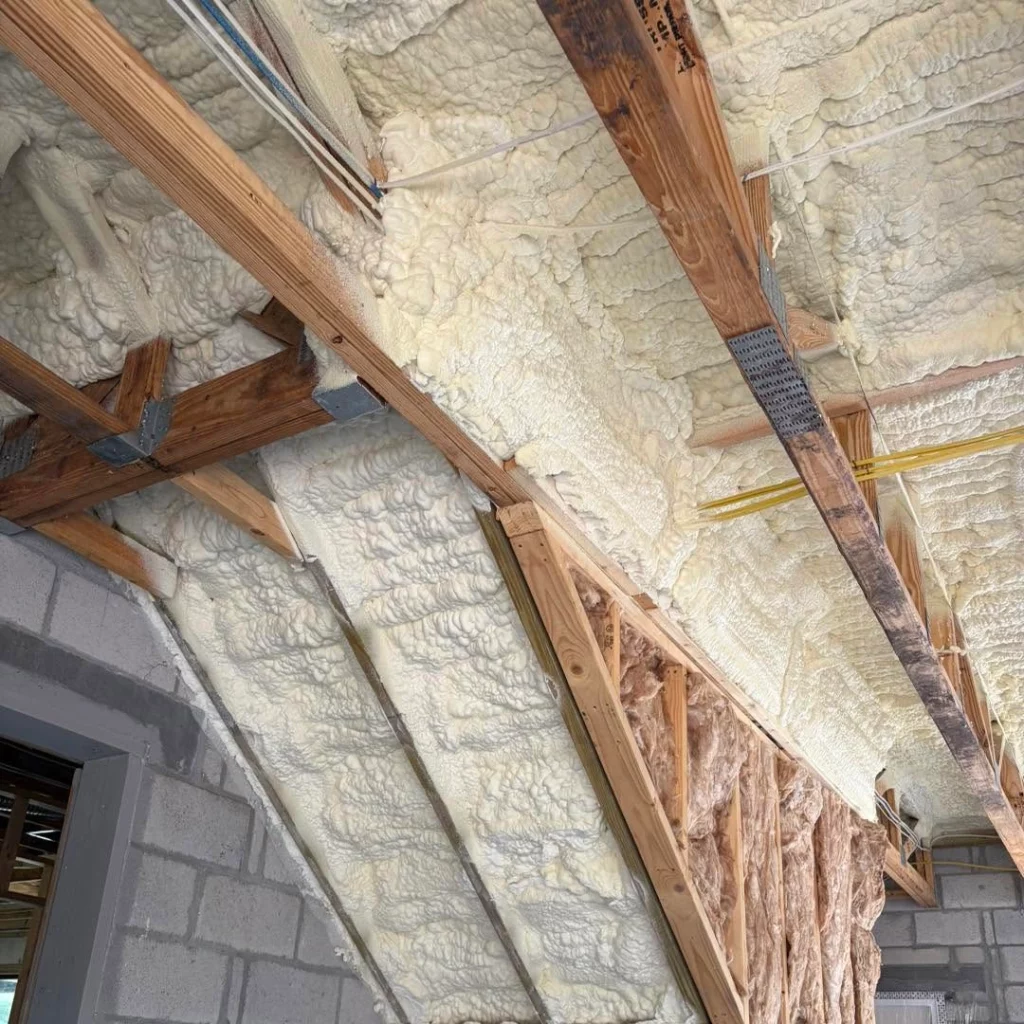
Rim Joists and Band Joists: These areas are notoriously difficult to insulate with rigid materials because of their irregular shape, multiple framing members, and numerous penetrations. Spray foam fills every void and adheres to both wood and concrete, creating an airtight seal that fiberglass batts or rigid foam boards cannot match.
Crawl Spaces: In Raleigh’s humid climate, vented crawl spaces often introduce moisture, mold, and pests into the building. Closed-cell spray foam applied to crawl space walls and the rim joist area seals the space, controls ground moisture, and brings the crawl space into the conditioned envelope.
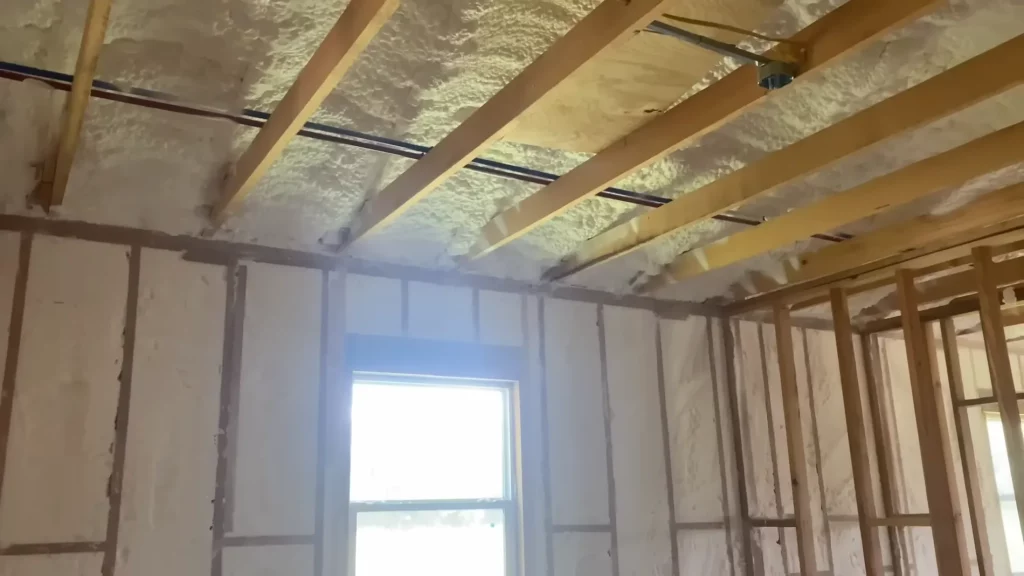
Attics: Whether vented or unvented, attics represent one of the largest sources of air leakage in most buildings. Spray foam applied to the attic floor (in vented assemblies) or directly to the roof deck (in unvented assemblies) eliminates air movement through ceiling penetrations, recessed lights, and framing gaps.
Wall Cavities: During new construction or renovation, spray foam applied in stud bays fills around electrical boxes, plumbing runs, and blocking that would create air leakage pathways with conventional batt insulation.
Application Recommendations by Building Type
| Building Type | Recommended Areas for Spray Foam | Primary Benefit |
|---|---|---|
| New Single-Family Home | Attic, walls, rim joists, crawl space | Code compliance, energy efficiency, and indoor air quality |
| Existing Home Retrofit | Attic floor, rim joists, crawl space | Targeted air sealing with minimal disruption |
| Commercial Building | Roof deck, perimeter walls, and loading dock areas | Reduced HVAC load, condensation control |
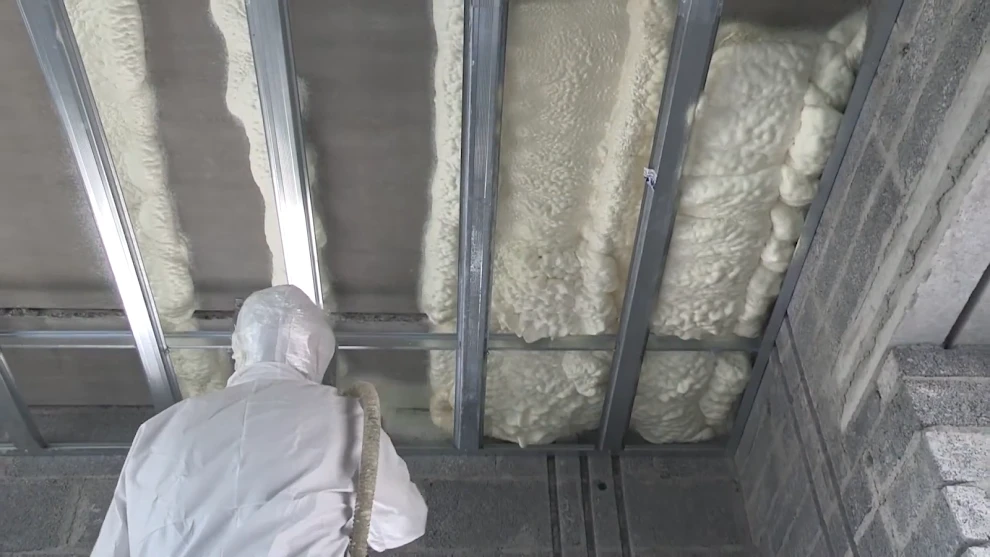
| Pole Barn / Metal Building | Roof deck, walls, and foundation perimeter | Condensation prevention, temperature stability |
Signs You Have Found the Right Spray Foam Installer
A quality air barrier only works if the installation is done correctly. Here are the indicators that separate a professional application from a poor one:
- They identify the air barrier plane before starting. According to EEBA, if the air barrier location is not clearly defined on the plans, the blower door test is likely to fail by design.
- They explain which foam type and thickness suits each assembly. Different areas of the building demand different products and depths based on structural, moisture, and thermal requirements.
- They address continuity between assemblies. The air barrier must connect continuously from the foundation to the roof. Gaps at transitions between foundations, walls, windows, and roof lines are the most common failure points.
- They discuss mechanical ventilation. Tight buildings need controlled fresh air. A knowledgeable installer will raise the topic of ventilation strategy rather than ignore it.
- They provide documentation of installed thickness and R-value. The NC Energy Conservation Code requires that spray polyurethane foam installations include a certification listing the installed thickness and R-value for each area covered.
Energy Savings and Long-Term Performance
The Department of Energy estimates that homeowners can save up to 20% on heating and cooling costs by adding insulation and sealing air leaks throughout the building envelope. Spray foam delivers both of these measures in one step, which is why buildings insulated with spray foam consistently outperform those using traditional insulation alone.
Beyond monthly energy savings, a complete air barrier extends the life of the building. By preventing moisture-laden air from entering wall and ceiling cavities, spray foam reduces the risk of condensation, mold growth, and structural decay. It also reduces the workload on HVAC equipment, which can lead to longer equipment life and fewer repair costs over time.
Get a Professional Air Barrier Assessment for Your Raleigh Building
Understanding how spray foam creates a complete air barrier is the first step. The next step is having an experienced team evaluate your specific building and recommend the right approach. At Raleigh Excel Spray Foam Insulation, our professionals assess every project individually, selecting the correct foam type, thickness, and application method for each area of your building envelope. We serve homeowners, builders, and commercial property owners throughout the Raleigh area with code-compliant installations designed for long-term performance.
Contact our team at [email protected] or call (919) 301-9435 to get started. A tighter building means lower bills, better comfort, and a structure built to last.
Frequently Asked Questions
Q: How thick does spray foam need to be to qualify as an air barrier?
A: Closed-cell spray foam achieves air barrier performance at approximately 1 inch of thickness. Open-cell spray foam requires roughly 3.5 inches to meet the same standard. Both thicknesses exceed the maximum allowable air permeance of 0.004 cfm/sf established by ASHRAE and the IECC for air barrier materials.
Q: Does spray foam eliminate the need for house wrap or other air barrier membranes?
A: In areas where spray foam is applied at the proper thickness and fully adheres to the substrate, it serves as the air barrier. However, other parts of the building envelope that do not receive spray foam, such as certain wall assemblies or roof transitions, still require a continuous air barrier connection using compatible membranes, tapes, or sealants.
Q: Can spray foam be installed in an existing Raleigh home without opening the walls?
A: Yes. Common retrofit applications include attics, crawl spaces, and rim joists, all of which are typically accessible without removing finished surfaces. For existing wall cavities, dense-pack cellulose or injection foam may be more practical than spray foam.
Q: Does a tighter building from spray foam cause indoor air quality problems?
A: A tight building does not cause air quality problems on its own, but it does require mechanical ventilation to bring in fresh air. Without controlled ventilation, pollutants and moisture can accumulate. Any spray foam installation should include a discussion of a ventilation strategy.
Q: How does spray foam perform in Raleigh’s humid summers compared to fiberglass insulation?
A: Spray foam has a clear advantage in humid climates because it blocks both air infiltration and the moisture carried by that air. Fiberglass allows air and moisture to pass through, which can lead to condensation inside wall cavities during hot, humid Raleigh summers. Spray foam eliminates that pathway.
Sources
- Building Science Corporation – RR-0912: Spray Polyurethane Foam and Vapor Retarders – Research report on the air barrier and vapor control properties of open-cell and closed-cell spray polyurethane foam in framed wall assemblies.
- WBDG – Air Barrier Systems in Buildings – Comprehensive federal resource on air barrier design, material requirements, code compliance, and the consequences of uncontrolled air infiltration and exfiltration.
- NC DEQ – Energy Saving Fact Sheet: Insulation Guidelines – North Carolina state publication covering insulation R-value recommendations by region, types of insulation, and climate zone requirements for NC buildings.
- EEBA – Air Sealing Requirements for IECC 2021 – Detailed breakdown of blower door testing requirements, air barrier installation table mandates, and code compliance changes in the 2021 International Energy Conservation Code.
- DOE – Guide to Home Insulation – Department of Energy publication covering R-value recommendations by climate zone, insulation types, cost comparisons, and energy savings potential.

- How Should Raleigh, NC Property Owners Evaluate Insulation for Long-Term Use? - September 23, 2026
- What Factors Affect Insulation Performance Across Different Parts of a Property? - September 23, 2026
- Could Spray Foam Insulation Be Useful Around Uneven Building Sections in Wake Forest, NC? - September 18, 2026