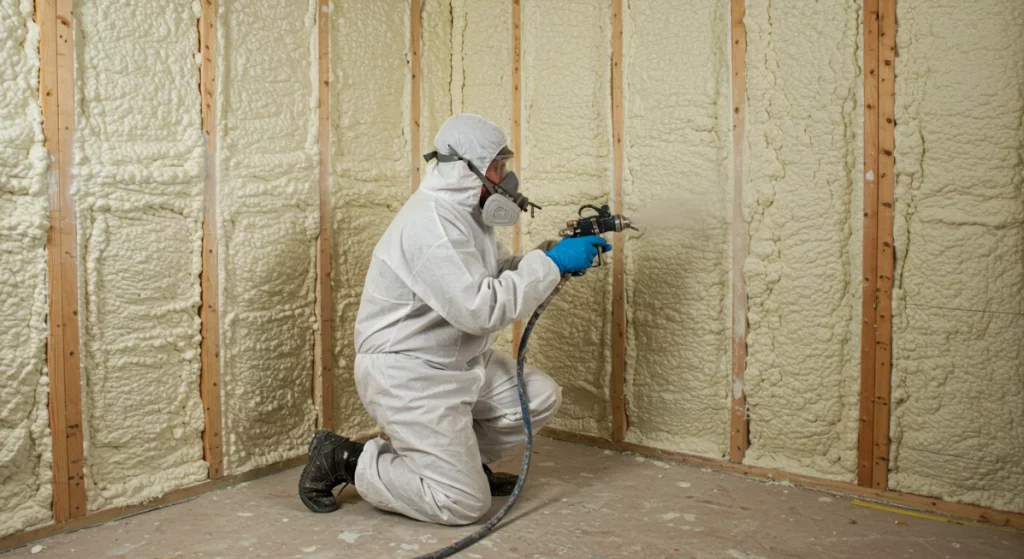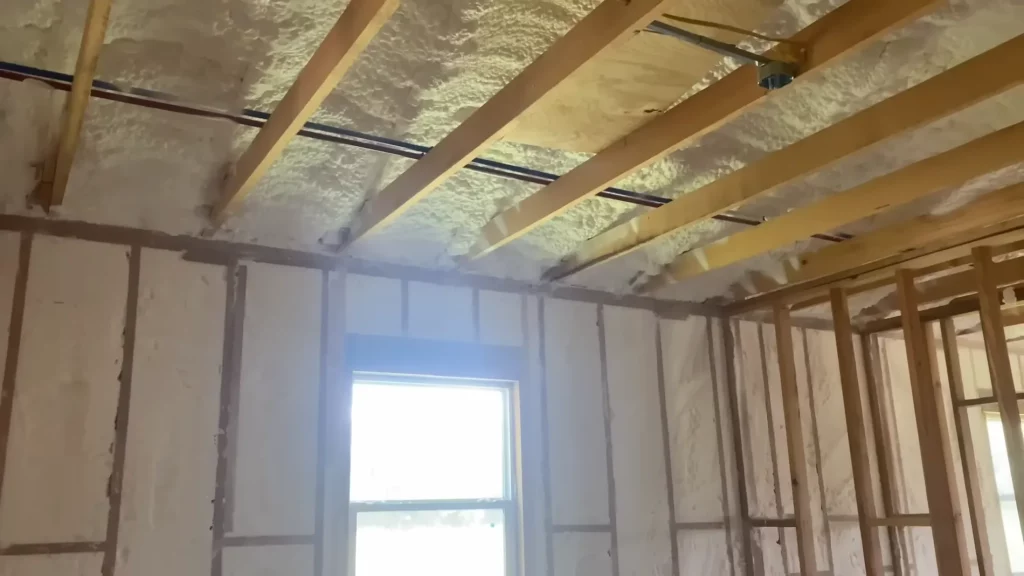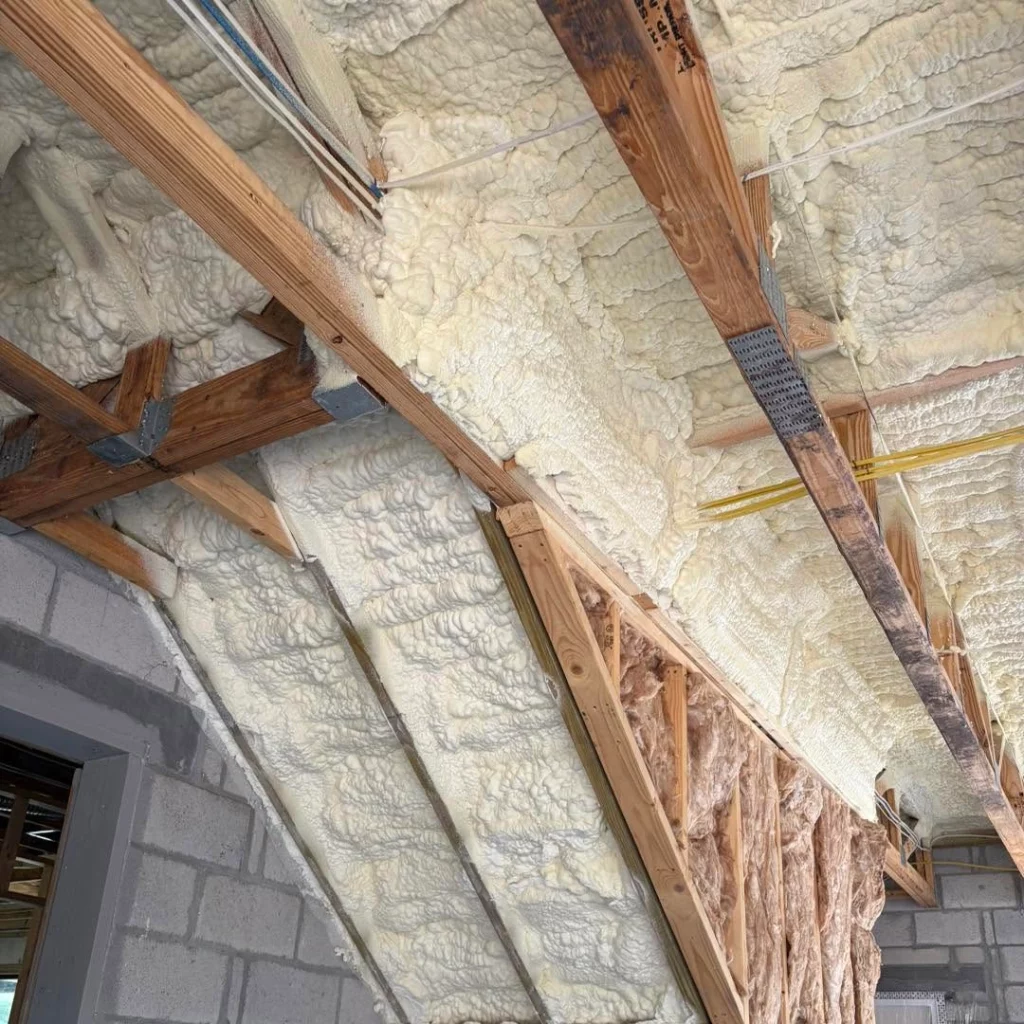



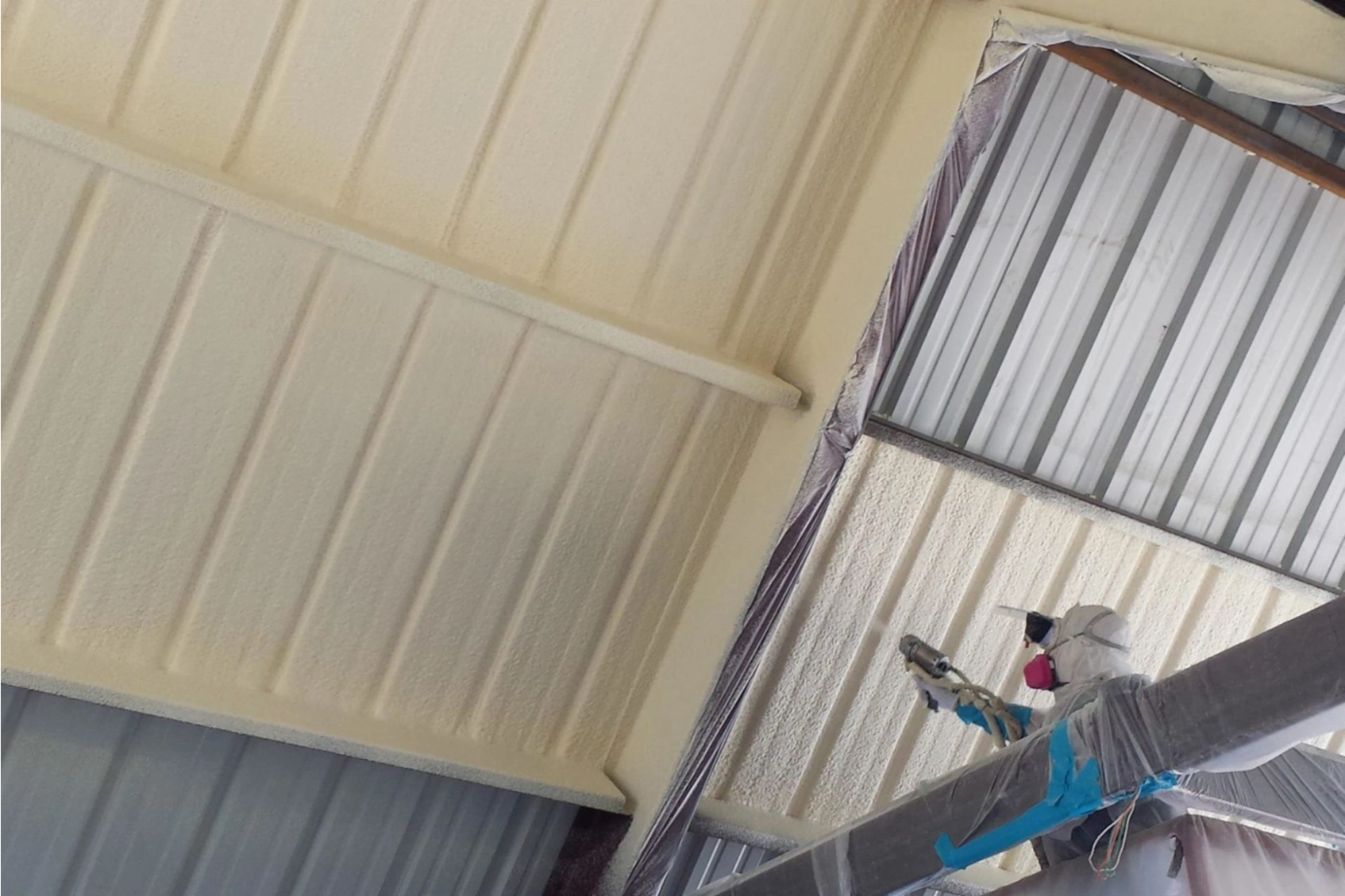
Spray foam insulation outperforms traditional insulation in Pittsboro, NC when the priority is air sealing, moisture control, and long-term energy savings in a humid mixed climate. Traditional fiberglass and cellulose insulation remain the more affordable option up front and can perform well when paired with a dedicated air sealing package. The deciding factor for most properties in Pittsboro comes down to Climate Zone 4A requirements, where hot summers, cold snaps, and high humidity make airtightness as important as the R-value printed on the material.
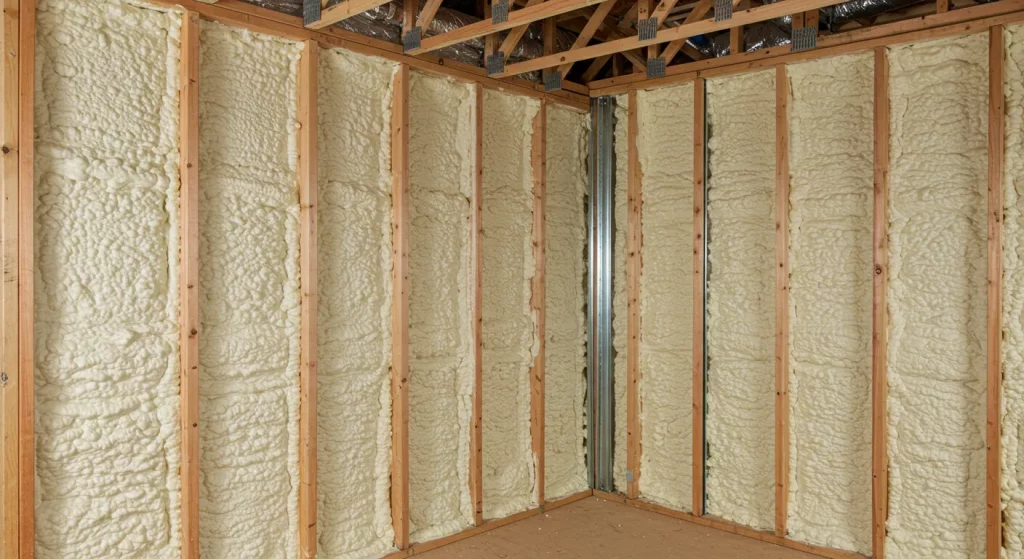
Spray foam insulation creates a continuous air barrier that expands into gaps, cracks, and hard-to-reach cavities, eliminating the air leakage paths that traditional batts and blown-in materials cannot address on their own. Traditional insulation like fiberglass and cellulose rely on trapped air pockets to resist heat flow, but those materials do not stop air movement through the building envelope. For a region like Pittsboro, where summer humidity can drive condensation problems and winter drafts push up heating bills, the air sealing advantage of spray foam gives it a meaningful performance edge.
TL;DR
- Pittsboro sits in IECC Climate Zone 4A (warm-humid), requiring a minimum of R-15 or R-13 with continuous insulation for wood-frame walls and R-38 for ceilings per the North Carolina Energy Conservation Code.
- Spray foam delivers R-6 to R-7 per inch (closed-cell) or R-3.5 to R-3.8 per inch (open-cell), compared to roughly R-2.9 to R-3.8 per inch for fiberglass, according to the U.S. Department of Energy.
- Air sealing is the single biggest differentiator: EPA data shows homeowners can save an average of 15% on heating and cooling costs through proper air sealing and insulation upgrades.
- Traditional insulation is less expensive upfront but requires a separate air sealing package to match the thermal performance of spray foam.
- In Climate Zone 4, the EPA estimates total house energy savings of about 12% and heating/cooling savings of about 17% from comprehensive sealing and insulating.
- Spray foam’s ability to act as an air barrier and vapor retardant in one step gives it a distinct advantage in Pittsboro’s humid climate.
- Thermal bridging through framing reduces real-world performance by roughly 15% regardless of insulation type, making air sealing even more important.
How Pittsboro’s Climate Affects Insulation Performance
Pittsboro and Chatham County fall within IECC Climate Zone 4A, which the North Carolina Energy Conservation Code maps as a warm-humid zone Insulation Institute – NC Code Summary. This means properties face hot, humid summers with temperatures regularly in the 90s, winter lows that can dip into the teens, and year-round moisture that challenges any building envelope.
The WBDG – Air Barrier Systems in Buildings notes that uncontrolled air infiltration carries untreated, humid outdoor air into buildings, which in a warm-humid climate like Pittsboro leads to condensation inside wall and ceiling assemblies. That moisture drives mold growth, wood rot, and premature building deterioration. Traditional insulation like fiberglass does not stop this air movement. Spray foam, by contrast, expands to fill gaps and creates a continuous air-impermeable layer that blocks both air leaks and the moisture carried with them.
The ENERGY STAR – Methodology for Estimated Energy Savings provides modeled savings data broken down by climate zone. For Climate Zone 4, which covers much of central North Carolina including Pittsboro, the estimated savings from proper air sealing and insulation upgrades are 12% on total energy costs and 17% on heating and cooling costs. These numbers represent a composite of typical existing homes and reflect what a properly sealed and insulated building can achieve over baseline conditions.
R-Value Comparison: Spray Foam vs Traditional Insulation
R-value measures thermal resistance, the ability of a material to slow heat transfer. Higher R-values mean better insulating power. However, R-value alone does not tell the full story, especially in a humid climate where air movement and moisture control matter just as much.
| Material | R-Value Per Inch | Air Barrier | Moisture Resistance | Best Application |
|---|---|---|---|---|
| Closed-Cell Spray Foam | R-6.0 to R-7.0 | Yes | High | Walls, crawl spaces, rim joists |
| Open-Cell Spray Foam | R-3.5 to R-3.8 | Yes | Low | Walls, attics (interior) |
| Fiberglass Batts | R-2.9 to R-3.8 | No | Low | Walls, attics, floors |
| Blown-In Cellulose | R-3.2 to R-3.8 | No | Moderate | Attics, existing wall cavities |
| Blown-In Fiberglass | R-2.2 to R-2.9 | No | Low | Attics, floors |
The key distinction is that spray foam combines thermal resistance with air impermeability in a single application. Fiberglass and cellulose only resist conductive heat transfer. They rely on a separate air barrier, such as house wrap, caulk, and drywall sealing, to prevent air leaks.
Why Air Sealing Changes the Conversation
Research from Building Science Corporation, as reported by the Insulation Institute – Air Infiltration and Insulation, found that when walls are properly air sealed on both the interior and exterior with effectively zero air leakage, all insulation types deliver essentially the same thermal performance at the same installed R-value. That means fiberglass can match spray foam in a tightly sealed assembly.
The problem is that achieving that level of airtightness with traditional insulation is difficult in practice. The Insulation Institute – Air Sealing’s Top Hits identified the top five leakage points in residential construction based on over 1,000 measurements:
- Top plate-to-attic joint: 0.29 to 1.6 ACH50 depending on drywall sealing quality
- Recessed lights: 9.1 CFM50 per light, adding up to 0.2 ACH50 per ceiling
- Duct boots: 7.7 CFM50 per boot in attic installations
- Band/rim joist: 0.86 CFM50 per foot, roughly 0.4 ACH50 house-wide
- Garage-to-house common wall: 0.6 CFM50 per foot
These leakage points exist in every building. Spray foam addresses many of them automatically during installation because the material expands into gaps, seals around penetrations, and adheres to framing. With traditional insulation, each of these points requires separate sealing with caulk, foam sealant, tape, or gaskets, adding labor and complexity, which is why spray foam insulation soundproofing guide is important for Raleigh homeowners.
The WBDG guide references NIST research showing that energy loss from infiltration ranges from 10% in cooling-dominated climates to 42% in heating-dominated climates. Pittsboro experiences both significant heating and cooling loads, which means air leakage drives energy waste in every season.
Code Requirements for Pittsboro Properties
Under the North Carolina Energy Conservation Code based on the 2015 IECC with state amendments, properties in Climate Zone 4 must meet these minimum prescriptive requirements:
| Building Component | Minimum R-Value (Zone 4) |
|---|---|
| Wood-frame walls | R-15 or R-13 + 2.5 ci |
| Ceilings with attic | R-38 or R-30 ci |
| Basement walls | R-15 or R-10 ci |
| Crawl space walls | R-15 or R-10 ci |
| Whole-building air leakage | 5 ACH50 |
The “ci” notation stands for continuous insulation, which means rigid foam board or spray foam applied to the exterior or interior of the framing cavity rather than just within the stud bay. This is where spray foam offers a practical advantage: it can serve as both the cavity insulation and the continuous insulation layer in one step, helping builders and remodelers meet code more efficiently.
Performance Over Time: What to Expect
Insulation performance is not static. Traditional materials can degrade over time in ways that spray foam generally does not.
Fiberglass can sag, settle, and compress in wall cavities. If installed poorly with gaps, voids, or compressed batts, real-world R-value can drop well below the rated value. The Building Science Corporation research found that thermal bridging through framing alone reduces effective performance by about 15%, regardless of the insulation material used.
Blown-in cellulose can settle over time, reducing its effective thickness and R-value. It also absorbs moisture, which in Pittsboro’s humid climate can lead to reduced thermal performance and potential mold concerns if the building envelope is not properly sealed.
Spray foam adheres to the substrate and expands to fill cavities completely. It does not sag, settle, or compress. Closed-cell spray foam also adds structural rigidity to the wall assembly and serves as a vapor retarder, which is valuable in a humid climate where moisture control directly affects building durability.
Real-World Scenarios for Pittsboro Properties
| Scenario | Property Type | Recommended Option | Reason |
|---|---|---|---|
| New construction with 2×6 walls | Single-family home | Closed-cell spray foam | Meets R-15 wall code, air seals in one step, handles humidity |
| Existing 1970s home, attic retrofit | Ranch style, 1,500 sq ft | Blown-in fiberglass + air sealing | Lower cost for large attic area, addresses code ceiling R-38 |
| Crawl space encapsulation | Raised foundation home | Closed-cell spray foam on rim joist | Seals band joist leakage, resists moisture, adds structural benefit |
| Unvented attic conversion | Two-story colonial | Closed-cell spray foam on roof deck | Eliminates ductwork in unconditioned space, brings HVAC inside envelope |
| Renovation with limited budget | Existing cottage | Fiberglass batts + dedicated air sealing | Meets code at lower cost when paired with thorough air sealing work |
Factors That Influence the Decision
Several variables determine which insulation type delivers the best results for a specific project:
- Property age and construction type: Older homes in Pittsboro often have 2×4 framing, limiting cavity depth for insulation. Spray foam achieves higher R-value in thinner cavities, making it especially useful for retrofits.
- Moisture exposure: Properties with crawl spaces, basements, or roof leak histories benefit from closed-cell spray foam’s moisture resistance.
- HVAC duct location: Homes with ductwork in unvented attics or crawl spaces see the biggest gains from spray foam because sealing the envelope keeps ducts inside conditioned space.
- Budget and project scope: Spray foam costs more per square foot but reduces the need for separate air sealing labor. Traditional insulation is cheaper per square foot but requires additional work to achieve comparable airtightness.
- Code compliance path: Builders using the prescriptive path benefit from spray foam’s ability to serve as both cavity and continuous insulation. Those using the ERI (Energy Rating Index) performance path have more flexibility.
- Long-term ownership plans: Spray foam delivers greater energy savings over time, which matters most for owners planning to stay in the property long enough to recoup the investment.
Who Spray Foam Is Best For
- Builders and homeowners constructing new homes in Pittsboro who want maximum energy efficiency from day one
- Properties with unvented attic assemblies or ductwork located in unconditioned spaces
- Crawl space and basement retrofits where moisture control and air sealing are both priorities
- Owners planning to stay in their home long term and wanting the strongest possible building envelope
- Projects where wall cavity depth is limited and higher R-value per inch is needed to meet code
Who Spray Foam May NOT Be the Best Fit For
- Short-term renovation projects or flips where upfront cost is the primary constraint
- Attic-only retrofills on a tight budget where blown-in insulation over a properly air-sealed ceiling plane can meet code at lower cost
- Projects where the insulation will be removed or disturbed during future renovations
- Situations where occupants cannot vacate during installation due to off-gassing during curing
Request Your Insulation Assessment in Pittsboro
Choosing between spray foam insulation in Pittsboro comes down to matching the right material to your building’s specific needs, budget, and long-term goals. Our team at Raleigh Excel Spray Foam Insulation evaluates every property individually, accounting for climate zone requirements, existing construction, and the air leakage points that matter most for performance in North Carolina’s humid conditions. Whether you are building new, retrofitting an older home, or encapsulating a crawl space, we provide honest recommendations based on building science, not upselling.
Get started today:
Call us directly at (919) 301-9435 or email [email protected] to discuss your project.
Frequently Asked Questions
What R-value do I need for insulation in Pittsboro, NC?
Pittsboro falls in IECC Climate Zone 4, which requires a minimum of R-15 or R-13 plus 2.5 inches of continuous insulation for wood-frame walls and R-38 for ceilings under the North Carolina Energy Conservation Code.
Can traditional insulation perform as well as spray foam?
Yes, when properly paired with a thorough air sealing package. Building Science Corporation research shows that when walls are air sealed inside and out, all insulation types at the same R-value deliver essentially the same thermal performance.
Is spray foam worth the extra cost in Climate Zone 4A?
Spray foam delivers the biggest value in humid climates like Pittsboro because it combines thermal insulation, air barrier, and moisture control in a single application. The EPA estimates heating and cooling savings of roughly 17% in Climate Zone 4 from comprehensive air sealing and insulation upgrades.
Does spray foam help with humidity and moisture problems?
Closed-cell spray foam acts as both an air barrier and a vapor retardant, which helps prevent humid outdoor air from infiltrating wall and ceiling assemblies where it can condense and cause mold or rot.
How long does spray foam insulation last?
Spray foam insulation is designed to last the lifetime of the building. It does not sag, settle, or decompose like fiberglass or cellulose, and it maintains its R-value and air sealing properties over decades without maintenance.
Sources
- ENERGY STAR – Methodology for Estimated Energy Savings – EPA’s modeled savings estimates for air sealing and insulation upgrades across U.S. climate zones, including 12% total and 17% heating/cooling savings for Climate Zone 4.
- Insulation Institute – Air Infiltration and Insulation – Building Science Corporation research on how air sealing, not insulation type alone, determines thermal performance, including findings on thermal bridging.
- Insulation Institute – Air Sealing’s Top Hits – Research identifying the top five air leakage points in residential construction based on 1,000+ individual measurements.
- Insulation Institute – NC Energy Conservation Code Summary – Summary of North Carolina’s residential energy code requirements by climate zone, including minimum R-values and air leakage limits.
- WBDG – Air Barrier Systems in Buildings – Comprehensive guide on air barrier design including NIST data on energy loss from infiltration and moisture transport through building enclosures.

- How Should Raleigh, NC Property Owners Evaluate Insulation for Long-Term Use? - September 23, 2026
- What Factors Affect Insulation Performance Across Different Parts of a Property? - September 23, 2026
- Could Spray Foam Insulation Be Useful Around Uneven Building Sections in Wake Forest, NC? - September 18, 2026