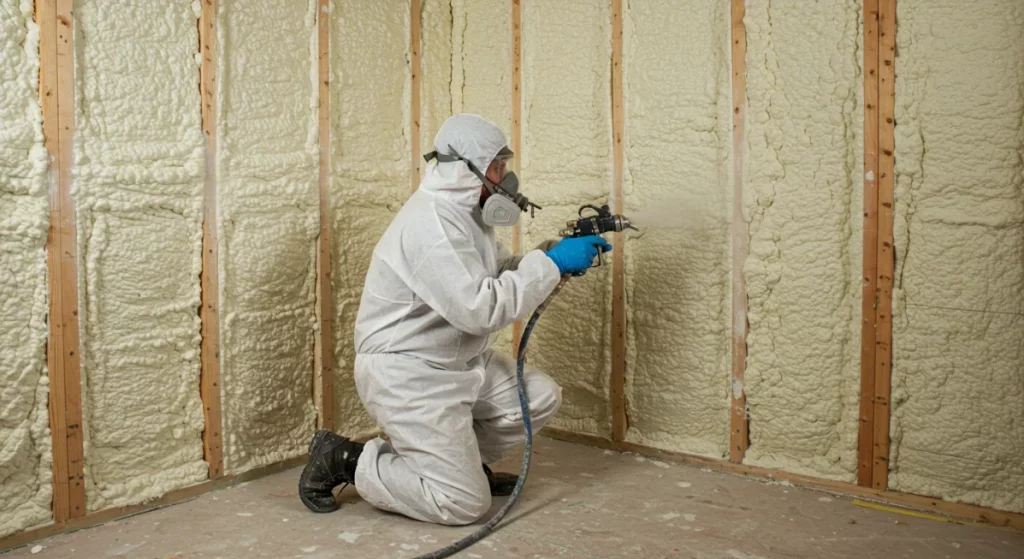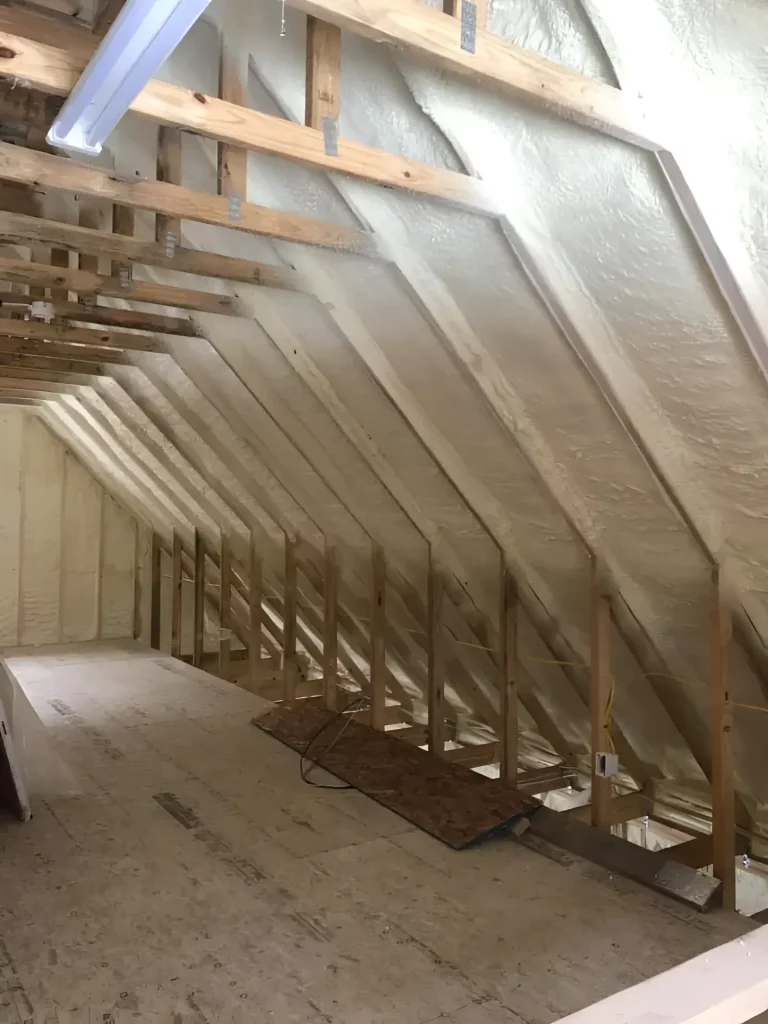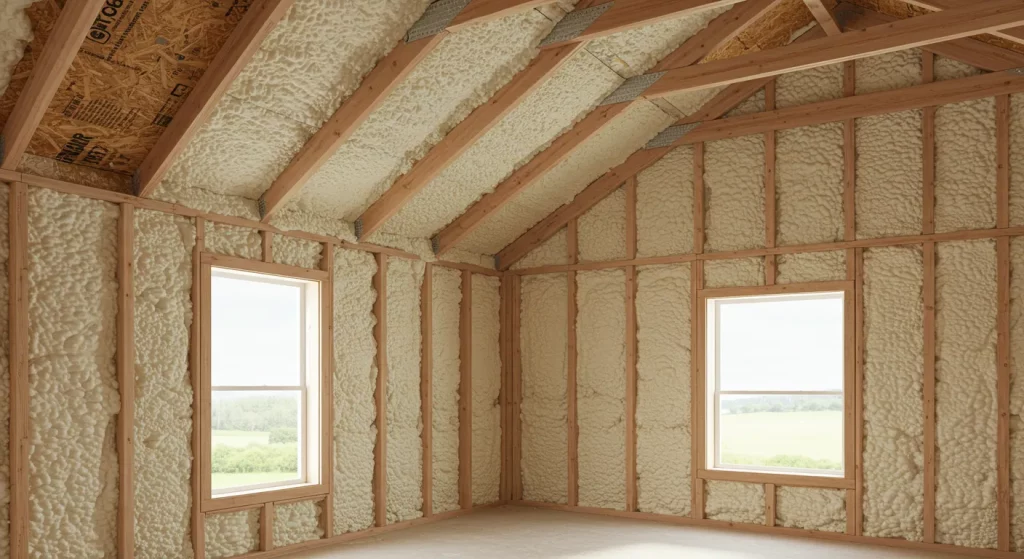



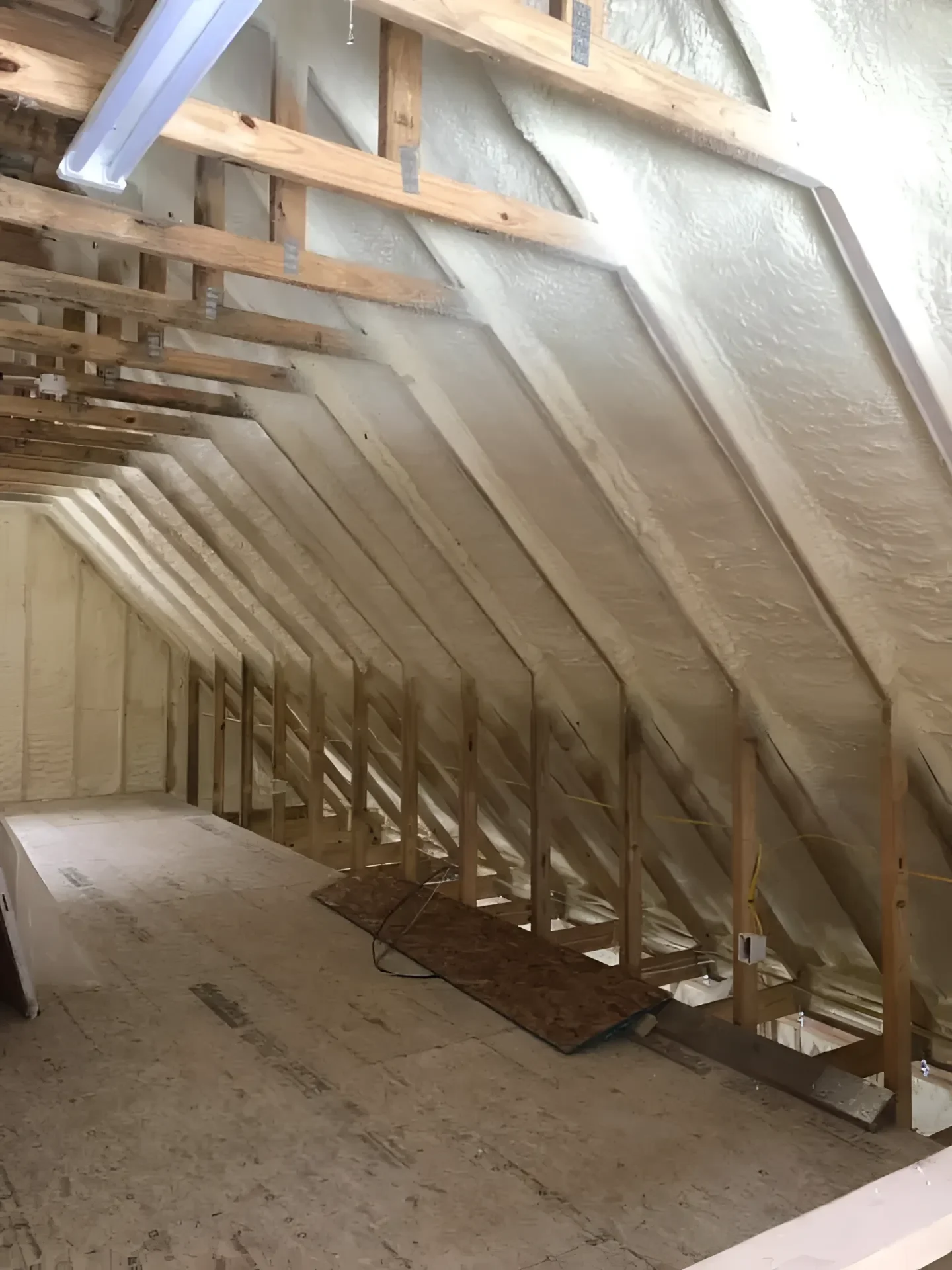
Spray foam insulation irregular framing jobs go well because the foam sprays on as a liquid, expands, and bonds to every stud, plate, wire, and pipe it touches. That closes the gaps and voids batts leave behind in crooked, doubled-up, or crowded cavities. You get fuller coverage and fewer air leaks.
TL;DR
- Batts leave gaps or get squeezed around odd framing. Foam fills the space instead.
- Gaps and voids let air loop around insulation, so filling them matters.
- Open-cell foam flexes with movement. Closed-cell foam is denser and more rigid.
- Keep foam out of electrical boxes, and plan for expansion behind obstructions.
- Clean, dry surfaces help the foam bond.
Why Irregular Framing Gives Batts So Much Trouble
Batts are cut to fit standard cavities. Once framing gets crooked, doubled up, or crowded with pipes and wires, a good fit gets hard to find.
Building Science Corporation, writing for the U.S. Department of Energy’s Building America program, says batts work best in uniform cavities. A batt cut too short, too narrow, or too wide around an obstruction leaves gaps, and squeezing one in lowers its R-value. Gaps and voids also give air room to loop around the insulation, which the same source names as a main reason cavity insulation underperforms.
Here’s an example. Picture a window opening where two studs sit an inch apart. Nobody can fluff a batt into that slot, so it gets jammed in or skipped. Either way, you end up with a weak stripe in the wall.
How Spray Foam Fills Gaps That Other Insulation Misses
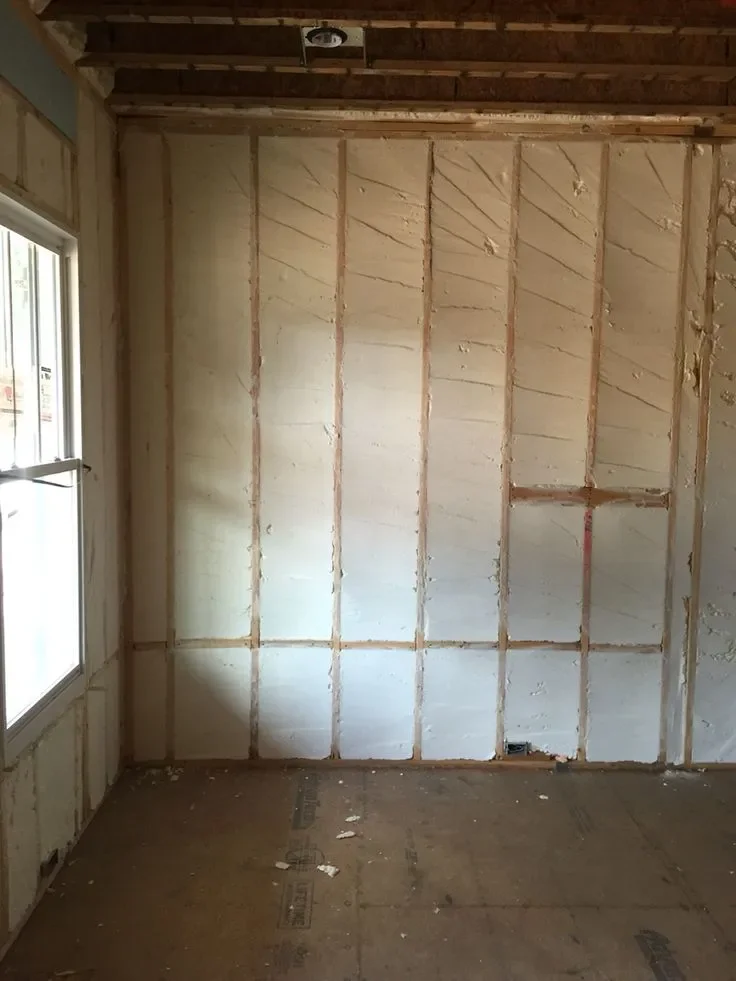
Spray foam goes on wet, then expands and sticks. In odd framing, that’s the whole advantage, because the cavity doesn’t have to be square.
Building Science Corporation says spray foam can fill framing cavities, irregular spaces, and the areas around obstructions. It can also keep the air barrier continuous at tricky details like rim joists. Spray foam gap coverage works because the foam takes the shape of the cavity instead of asking the cavity to match the insulation. Proper spray foam insulation coverage helps address gaps and hard-to-reach spaces that traditional insulation may leave behind.
Wiring is a good test. A manufacturer-sponsored course from BNP Media’s CE Center points out that batts often get compressed, cut away, or pushed aside around electrical lines and boxes. Foam sprayed after the rough-in covers around them instead.
Where Spray Foam Works Best In Odd Framing
Spray foam difficult areas have one thing in common: bats need a lot of cutting and patching to fit them. Spray foam irregular framing problems tend to show up in the same few places.
Common spray foam framing applications include:
- Rim joists: Architect Magazine calls foam’s air sealing especially valuable here and in other hard-to-seal areas.
- Floors over open space: Foam bonds to the subfloor and won’t sag the way batts sometimes do, according to the same article.
- Truss-framed assemblies: The article lists these among areas that are difficult or impossible to insulate with batts.
- Irregular masonry: Foam adheres well to masonry, including irregular stone foundations.
Which Foam Type Fits Odd Cavities Better?
Open-cell and closed-cell foam both fill gaps, but they act differently once they cure. Your framing, and how much it moves, helps decide. Building Science Corporation notes that low-density foam makes a flexible installation that forgives movement. Higher-density foam resists abuse better but tolerates movement less. Homeowners comparing open-cell foam insulation options can evaluate their flexibility and insulating properties before choosing the right solution for irregular framing.
Building Science Corporation notes that low-density foam makes a flexible installation that forgives movement. Higher-density foam resists abuse better but tolerates movement less. Density also changes insulating value. Architect Magazine puts half-pound foam at about R-3.5 per inch and 1.8-pound foam at about R-7, with the denser foam costing more per square foot.
Some installers spray a thin closed-cell layer and fill the rest of the cavity with batts. That hybrid approach is controversial, so ask your installer why they’d use it on your walls.
What Needs To Happen Before And During Spraying?
Foam only covers well if the surfaces and the plan are right. Good spray foam installation coverage depends as much on prep as on the spraying itself.
The BNP Media course says foam shouldn’t go on wet, dirty, or oily surfaces because adhesion suffers. It also says foam has to stay out of electrical boxes, so boxes need to be prepped or cleaned of any that gets in. Building Science Corporation adds that rapid expansion calls for care behind obstructions and in confined cavities, and that the foam must be mixed at the right chemistry to perform as intended.
A quick checklist before spray day:
- Point out the tight pockets: doubled studs, window and door framing, and corners.
- Finish wiring and plumbing first, and mark the boxes that must stay clear.
- Make sure framing is dry and free of dirt and oil.
- Ask which foam type and thickness the installer plans for each area, and why.
Have Odd Framing You Want A Second Look At?
If your walls have crowded cavities, doubled studs, or pockets that can’t fill, we’re glad to take a look. Raleigh Excel Spray Foam Insulation can talk through where foam makes sense and where it doesn’t.
Call us at (919) 301-9435 or email [email protected] to start the conversation.
Frequently Asked Questions About Spray Foam In Irregular Framing
Can I spray foam directly onto existing batts?
Often it’s a poor idea. Foam needs a firm surface to bond to, and foam sprayed onto soft batts can crack or pull free. Most installers prefer to remove the batts first so the foam grips the framing and sheathing.
Does cold weather affect spraying?
Yes, because foam cures by chemical reaction. Each product lists a temperature range for the air and the surfaces, so ask which one applies. One forum contributor said canned foam won’t cure properly below about 50°F, but professional products differ.
How long should we stay out after the foam goes in?
Follow the manufacturer’s re-entry instructions for your product. The EPA says re-entry should wait until the foam has cured and the space has been ventilated and cleaned. Some manufacturers suggest about 24 hours for two-component professional systems, but it varies.
Does the foam need trimming afterward?
Sometimes. Low-density foam expands a lot and usually bulges past the framing, so the excess gets trimmed flush. Denser foam is typically sprayed thinner than the framing depth.
Is it worth foaming only the odd cavities?
Often, yes. Batts struggle most in those spots, and foam costs more per square foot than batts. Limiting it to trouble spots keeps the extra cost down.
Sources
- Building Science Corporation (U.S. DOE Building America) – batt gaps and compression, convective looping, foam in irregular cavities, rim joist air barrier, foam flexibility, expansion cautions.
- Architect Magazine – rim joists, floors, trusses, masonry, R-value by density, hybrid foam and batt debate.
- BNP Media CE Center – batts around wiring and boxes, surface prep, keeping foam out of electrical boxes.

- What Role Does Insulation Thickness Play in Building Durability and Material Performance? - October 23, 2026
- How Can Spray Foam Insulation Improve Coverage Around Irregular Framing? - October 23, 2026
- Why Is Closed Cell Spray Foam Effective Around Moisture-Prone Building Areas in Raleigh, NC? - October 21, 2026