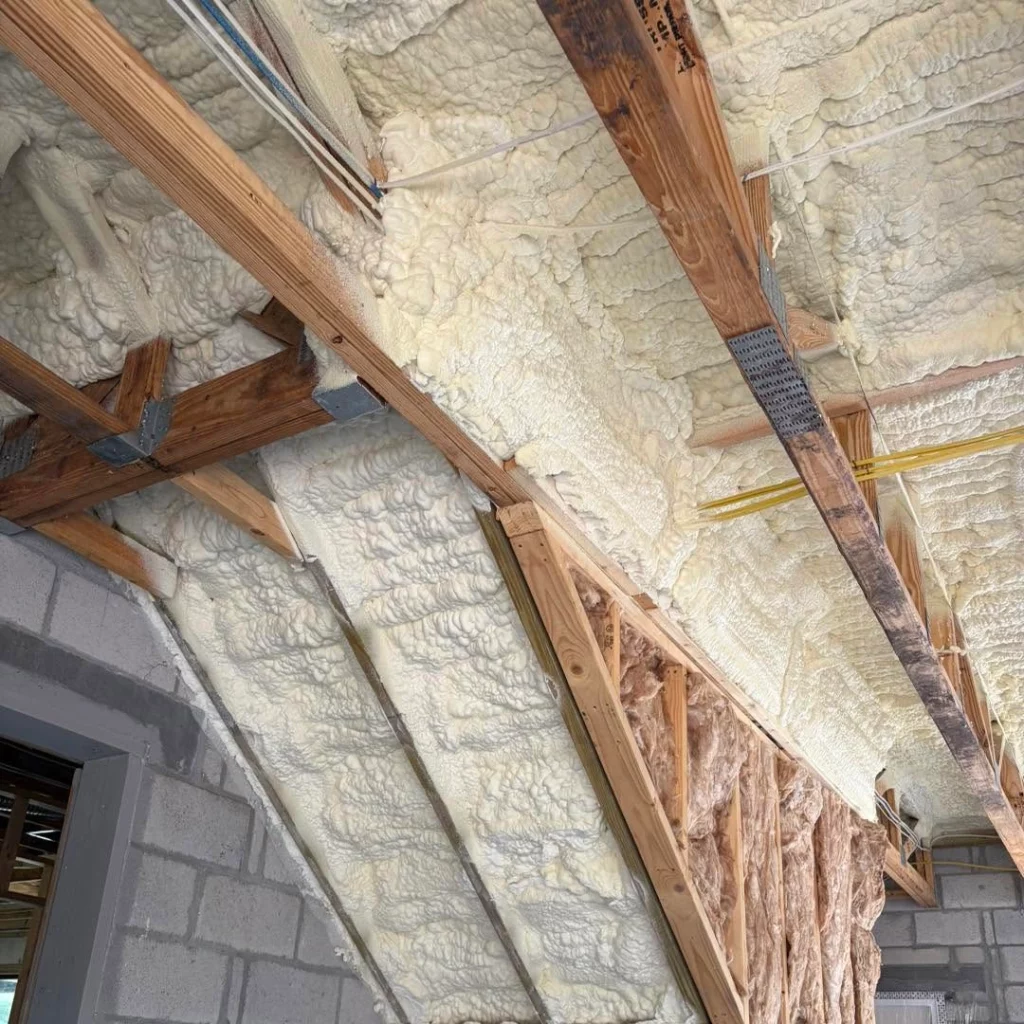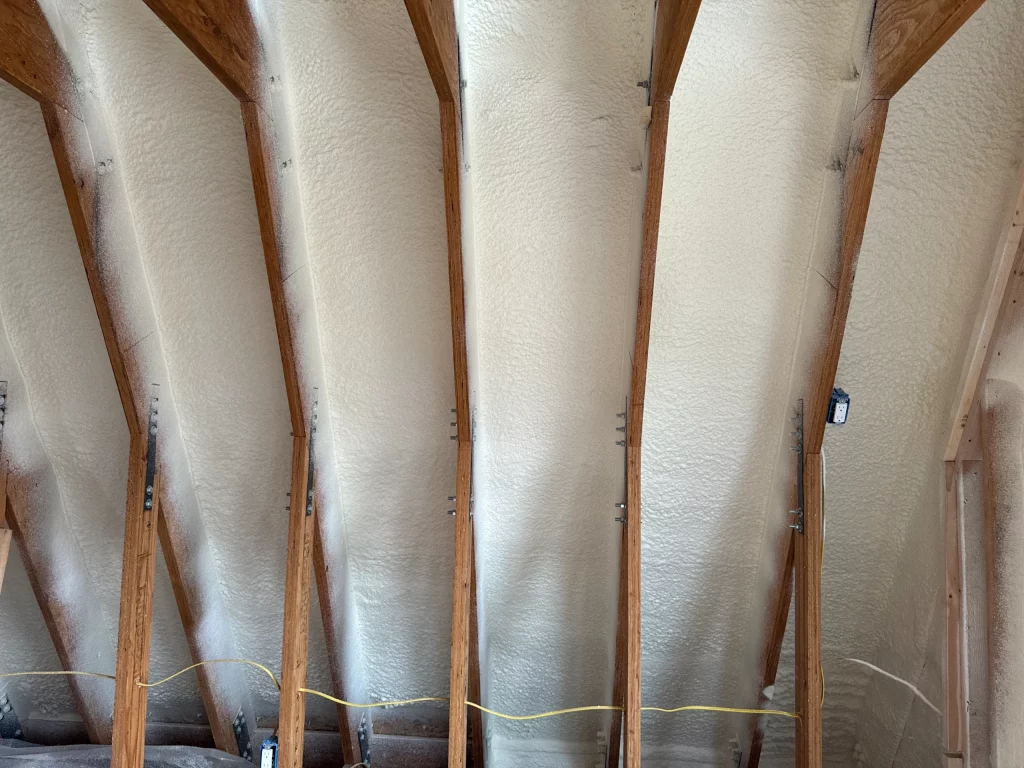




Closed-cell spray foam suits dense building assemblies in Knightdale, NC, because it packs the three qualities a tightly framed, humidity-exposed assembly needs most: high R-value in a thin layer, built-in air and vapor control, and enough rigidity to reinforce the structure it fills. In a 2×4 wall, rim joist, or crawl space where every inch is spoken for, a medium-density foam rated around R-5 to R-8 per inch delivers more thermal resistance than batts can fit into the same cavity, and at the right thickness it doubles as the air barrier and vapor retarder the assembly would otherwise need separate products to provide. The right insulation choice always depends on the assembly, the climate load, and the project goals. A closed-cell spray foam analysis of its benefits, best uses, and affordability can help clarify these factors, so below we break down the properties, the local conditions, and the specific project types where closed-cell clearly earns its place.
TL;DR
- Closed-cell spray foam, often called medium-density or 2 lb foam, has a long-term thermal resistance of roughly R-5 to R-6 per inch, the highest of any readily available spray foam used in homes and buildings Wikipedia – Spray foam.
- At a 2-inch minimum application, closed-cell foam functions as both an air barrier and a vapor barrier, which matters because air movement drives more than 98% of all water vapor movement in building cavities.
- One inch of closed-cell delivers roughly the insulation of two inches of open-cell foam, a major advantage in shallow 2×4 walls, rim joists, and other space-limited cavities.
- The rigid, adhesive cure adds racking strength and reinforces the insulated surface, unlike soft open-cell foam or unfaced batts.
- Knightdale’s humid subtropical climate, with hot, humid summers and the wettest months landing in July and August, rewards assemblies that manage airborne moisture.
- Knightdale grew 70.5% between 2010 and 2020 and is one of the fastest-growing communities in the Research Triangle, so dense new-construction framing is everywhere and foam fills irregular cavities with little waste Knightdale, North Carolina.
- Common pitfalls include spraying below the thickness where vapor performance starts, skipping the required thermal barrier covering, and sealing tight without planning mechanical ventilation.
- Closed-cell is not the answer for every assembly, sound-focused interior walls often perform better with open-cell, so match the foam to the goal.
What “Dense Building Assemblies” Actually Means
A dense building assembly is any framed section where cavity depth is limited and every layer has to do more than one job. In Knightdale homes and light commercial buildings, the most common examples are:
- 2×4 exterior walls and additions where the cavity is only 3.5 inches deep
- Rim joists and band boards between floors
- Floor systems over vented crawl spaces
- Roof decks and bonus rooms with shallow rafter bays
- Metal buildings and workshops where condensation forms on steel
In these assemblies, insulation must conform to irregular cavities, seal penetrations around wiring and plumbing, and control moisture without adding bulk. Spray foam excels here because it expands while curing, filling bypasses and gaps that batts and blown-in products routinely leave behind, and it works well in tight spaces where loose-fill simply cannot be installed. Dense assemblies also tend to accumulate small leaks, and a foam application seals the entire cavity in one pass rather than relying on careful hand-cutting around every obstruction Wikipedia.
The Properties That Make Closed-Cell the Right Fit
High R-Value in a Thin Profile
A closed-cell spray foam contractor can provide insulation with strong thermal performance. Medium-density closed-cell foam carries a long-term thermal resistance between R-5.1 and R-6 per inch, and closed-cell foams in general can attain R-values of 5 to 8 per inch. For comparison, glass wool batts typically sit at R-3 to R-4 per inch, and open-cell foam runs about R-3.8 per inch. One inch of closed-cell provides roughly the same insulation factor as two inches of open-cell, which is exactly the math a shallow cavity needs. In a 3.5-inch 2×4 wall, two to three inches of closed-cell leaves room for wiring while pushing thermal performance well beyond what a batt can achieve in the same space.
Air Barrier and Vapor Control in a Single Step
Most closed-cell spray foam products, when installed at a minimum thickness of about 50 mm or 2 inches, qualify as both a vapor barrier and an air barrier. That dual function matters because air movement accounts for more than 98% of all water vapor movement in building cavities. A batt wall needs a separate air-sealing strategy and a separate vapor retarder; closed-cell handles both in one application Vapor barrier. Building codes classify vapor retarders by perm rating, and a correctly applied closed-cell layer sits at the impermeable end of that scale, which is what keeps humid outdoor air from condensing inside a wall during a Knightdale summer.
Structural Rigidity and Adhesion
Closed-cell foam is rigid to the touch once cured, and each cell is completely sealed. Unlike open-cell foam, which stays soft with little structural strength, closed-cell is strong enough to structurally reinforce the surface it insulates. This is one of the least advertised but most valuable traits in dense assemblies: the foam bonds to sheathing, studs, and joists, seals cracks and construction joints, and contributes to racking strength in tall gable walls, metal buildings, and floor systems. It also rarely requires trimming after installation, so dense cavities are filled with little waste.
Moisture Resistance Built for a Humid Climate
Closed-cell foam is non-porous and resists moisture penetration, effectively forming a semi-permeable vapor barrier rather than absorbing water like fiberglass. That matters in Knightdale, which has a moderate subtropical climate with hot, humid summers where daytime highs often reach the upper 80s to low 90s, and where July and August are the rainiest months. Statewide data from the North Carolina State Climate Office confirms the pattern is intensifying, with recent Augusts ranking among the warmest on record. Warm, moisture-heavy air meeting a cool interior surface is the recipe for interstitial condensation, and a foam layer placed at the correct thickness manages that dew point risk inside the assembly instead of letting it form on sheathing.
Why Knightdale’s Housing Stock Rewards Dense Assembly Planning
Knightdale is one of the fastest-growing towns in the Triangle. The population climbed from 1,700 in 1990 to 19,435 in 2020, and estimates for 2025 approach 23,144, with new subdivisions and commercial construction spreading along the Business US 64 corridor. Rapid construction cycles often mean dense framing schedules, complex rooflines, and conditioned spaces tucked into shallow cavities. When our team assesses these homes, the assemblies that cause the most comfort complaints are almost always the space-limited ones: bonus rooms over garages, floor systems over crawl spaces, and 2×4 walls on older additions. Closed-cell spray foam in Knightdale, NC, directly addresses the physics of those assemblies, and per Department of Energy studies cited in building science literature, roughly 40% of a home’s energy loss traces back to air infiltration through walls, windows, and doorways.
How Closed-Cell Compares in Dense Assemblies
| Insulation Type | R-Value per Inch | Air Barrier | Vapor Control | Structural Contribution |
|---|---|---|---|---|
| Closed-cell spray foam | R-5 to R-8 | Yes, at ~2 inches | Semi-permeable vapor barrier | Reinforces and stiffens assembly |
| Open-cell spray foam | R-3 to R-4 | Only at 5.5+ inches | Not an effective vapor barrier | Minimal, stays soft |
| Fiberglass batts | R-3 to R-4 | No | Requires separate retarder | None, gaps reduce performance |
| Dense-pack cellulose | R-3.4 to R-3.8 | Blocks, but does not seal bypasses | Permeable | Slight wall stiffening |
The comparison makes the case plainly: in assemblies where depth is fixed, moisture is a threat, and air leakage is the enemy, closed-cell does the work of three products in one pass.
Recommendations by Project Type
| Assembly / Project | Recommended Approach | Key Notes |
|---|---|---|
| Crawl spaces in Knightdale’s humid climate | Closed-cell on walls and rim joists | Ground moisture plus humid summers demand vapor control at the source |
| 2×4 walls and additions | 2 to 3 inches of closed-cell | Maximum R-value in a fixed cavity depth |
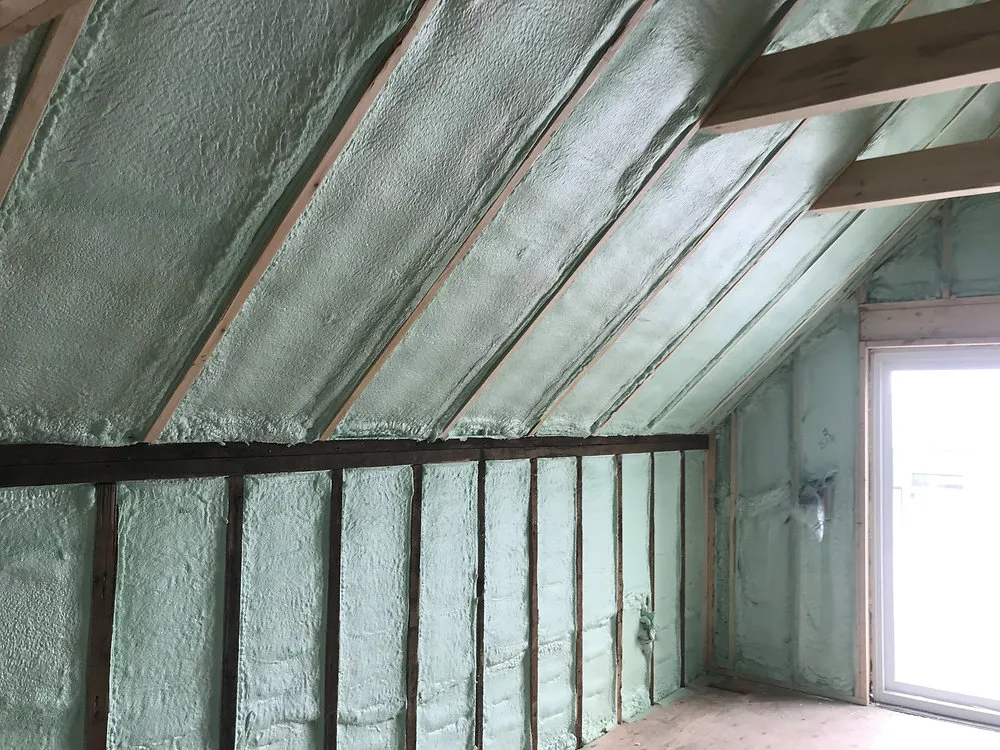
| Roof decks and bonus rooms | Hybrid flash of closed-cell plus fill insulation | Foam manages the dew point, fill adds bulk R in deeper bays |
| Metal buildings and workshops | Closed-cell applied to sheathing and purlins | Prevents condensation dripping on steel framing |
| Finished walls in retrofits | Wall injection with closed-cell | Fills cavities through small drilled holes without demolition |
Signs You’ve Chosen the Right Approach
- The written scope states the exact thickness and expected R-value per assembly, not just the word “foam”
- Air barrier continuity is addressed at rim joists, penetrations, and transitions between assemblies
- The plan covers thermal barrier requirements, since most codes require an ignition barrier such as drywall with a 15-minute fire rating over foam in occupied spaces
- Ventilation and mechanical fresh air are part of the conversation once the building is sealed tight
- The proposal explains where foam is not the right answer, such as sound-focused interior walls where open-cell performs better
Let’s Plan Your Dense Assemblies the Right Way
Raleigh Excel Spray Foam Insulation helps Knightdale homeowners, builders, and property managers match the right foam to the right assembly, from crawl space encapsulation to shallow wall cavities and metal buildings. Our team specifies thickness, air sealing, and vapor strategy up front so your assemblies perform the way the building science says they should. Call us at (919) 301-9435 or email [email protected] to get started, and close the gap between how your building was framed and how it actually performs.
FAQs
How thick does closed-cell spray foam need to be to act as a vapor barrier?
Most medium-density closed-cell products qualify as both an air barrier and a vapor barrier at a minimum installed thickness of about 2 inches (50 mm). Always confirm the required thickness against the specific product listing.
Can closed-cell spray foam be used in 2×4 walls?
Yes, and it is one of its strongest use cases. Two to three inches of closed-cell in a 3.5-inch cavity delivers high R-value while leaving room for wiring and still functioning as the air and vapor barrier.
Is closed-cell foam appropriate for crawl spaces in Knightdale’s humid climate?
Closed-cell foam is widely used in crawl spaces and basements precisely because it resists moisture penetration and controls humid air. Wall and rim joist applications keep ground moisture and summer humidity out of the floor system.
Does closed-cell spray foam really add structural strength?
Its dense, rigid cure adheres to framing and sheathing and helps structurally reinforce the insulated surface, adding racking resistance that soft open-cell foam and batts cannot provide.
Do I need to cover spray foam with drywall?
In most occupied spaces, building codes require a thermal barrier such as drywall with a 15-minute fire rating over foam insulation. Our team will confirm the covering requirements for your specific assembly during the estimate.
Sources
- Wikipedia – Spray foam – Technical overview of spray polyurethane foam types, including medium-density closed-cell R-values of R-5.1 to R-6 per inch, the 2-inch air and vapor barrier threshold, and DOE findings on air infiltration losses.
- Wikipedia – Building insulation material – Comparative data on insulation R-values per inch, the structural advantages of closed-cell over open-cell foam, and moisture control characteristics of cavity insulation.
- Wikipedia – Knightdale, North Carolina – Local climate data for Knightdale, including humid subtropical conditions, summer temperatures, and rainfall patterns, plus population growth and housing development trends.
- North Carolina State Climate Office – The state’s primary scientific extension resource for weather and climate data, documenting North Carolina’s heat and humidity patterns and recent record-warm summers.
- Wikipedia – Vapor barrier – Building science reference on vapor retarder classes, perm ratings, and the finding that air movement accounts for more than 98% of water vapor movement in building cavities.