


Commercial insulation directly reduces the amount of energy a large building needs for heating and cooling by slowing heat transfer through walls, roofs, and foundations. In commercial buildings, 29% of all site energy goes toward space heating and cooling alone, according to research from Oak Ridge National Laboratory, making the building envelope one of the highest-impact areas for efficiency improvements. The right insulation strategy depends on factors like climate zone, building type, existing construction, and whether the goal is new construction or retrofit. Different insulation materials, from spray foam to rigid board to mineral wool, each serve specific applications and performance requirements, and the results vary based on installation quality, air sealing, and commercial insulation installation.
TL;DR
- Commercial buildings account for roughly 19% of total U.S. primary energy consumption, with heating and cooling representing nearly a third of site energy use.
- EPA estimates that air sealing combined with insulation improvements can reduce heating and cooling costs by an average of 15% across all climate zones.
- Buildings insulated and sealed to current code standards can demonstrate up to 40% less energy consumption for HVAC compared to poorly insulated structures.
- Spray foam insulation provides the highest R-value per inch and doubles as an air barrier, while fiberglass and mineral wool remain cost-effective for large wall cavities.
- Commercial energy codes (ASHRAE 90.1 and IECC) set minimum R-value requirements based on climate zone, but building to code is the legal minimum, not the performance target.
- Upgrading insulation in just 25% of existing commercial building floor space in the U.S. would save over 700 therms of natural gas annually, equivalent to removing 800,000 passenger vehicles from the road.
- Insulation upgrades in large buildings improve occupant comfort, reduce HVAC wear and tear, lower carbon emissions, and can increase property value.
- Installation quality matters as much as material choice. Gaps, compression, and thermal bridging all reduce effective R-value.
How Heat Transfer Works in Large Commercial Buildings
Understanding why insulation matters starts with how heat moves through a building envelope. The U.S. Department of Energy explains that heat flows through three mechanisms: conduction through solid materials, convection through air movement, and radiation across open spaces. In a large commercial building, all three are at work simultaneously. In winter, heated indoor air transfers heat outward through walls, roofs, and foundations. In summer, the process reverses as external heat pushes inward.
Without adequate insulation, the HVAC system must compensate for this constant heat loss and gain, running longer cycles and consuming significantly more energy. Insulation materials resist this heat flow by trapping air or gas within their structure, creating thermal resistance measured as R-value. The higher the R-value, the greater the resistance to heat transfer and the less energy the building loses or gains through its envelope.
Why Commercial Buildings Face Unique Insulation Challenges
Large buildings present complications that residential structures rarely encounter. Higher ceiling heights mean greater volumes of air to condition. Metal framing, common in commercial construction, conducts heat far more readily than wood studs, a problem known as thermal bridging. Large window arrays, loading dock doors, and warehouse openings create substantial weak points in the thermal envelope. Mechanical systems and ductwork running through unconditioned spaces add further losses if left uninsulated, highlighting the importance of commercial building insulation.
Research published through the DOE’s Office of Scientific and Technical Information confirms that applying insulation materials to commercial building envelopes is an effective way to reduce energy consumption for heating and cooling while limiting negative environmental impacts from the buildings sector. The study notes that insulation materials have a net positive lifetime environmental impact because the energy savings they produce far outweigh the embodied energy used in their manufacture.
Insulation Types Used in Commercial Buildings
Not all insulation performs equally in every commercial application. The Department of Energy identifies several major categories, each with distinct advantages:
| Insulation Type | R-Value Per Inch | Best Commercial Applications | Air Sealing Capability |
|---|---|---|---|
| Closed-cell spray foam | R-6 to R-7 | Metal buildings, warehouses, roof decks, irregular cavities | Excellent, acts as air and vapor barrier |
| Open-cell spray foam | R-3.5 to R-4 | Interior wall cavities, sound-dampening partitions | Good air barrier, not a vapor barrier |
| Rigid foam board | R-4 to R-6.5 | Continuous exterior insulation, below-grade walls, roof assemblies | Varies by installation, reduces thermal bridging |
| Mineral wool (batts/boards) | R-3.3 to R-4 | Steel stud walls, fire-rated assemblies, acoustic partitions | Moderate, requires separate air sealing |
| Fiberglass batts | R-2.9 to R-3.8 | Standard stud walls, above-ceiling applications | Low, gaps are common |
| Loose-fill blown-in | R-2.2 to R-3.8 | Retrofitting existing wall cavities, attics | Moderate in fills, gaps at edges |
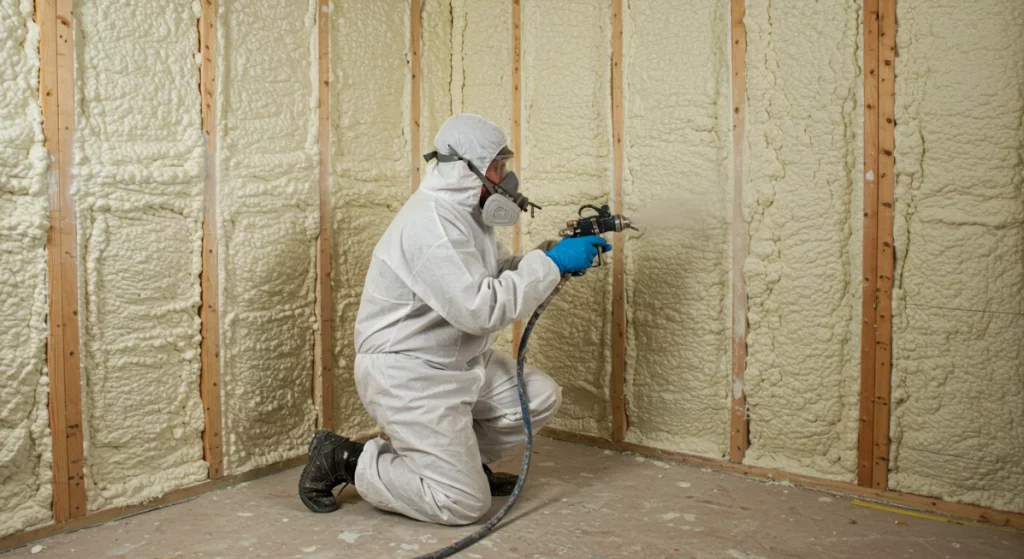
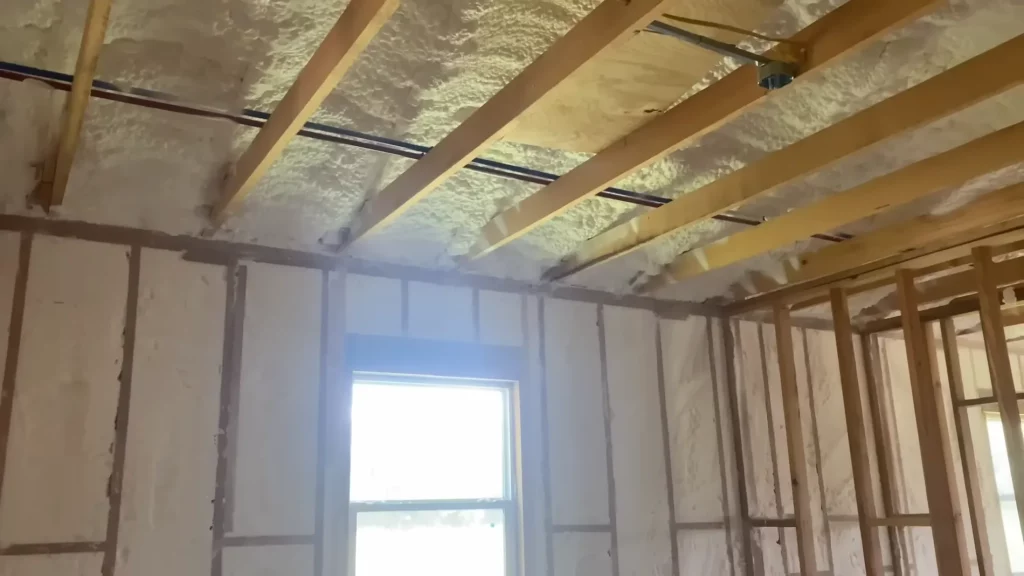
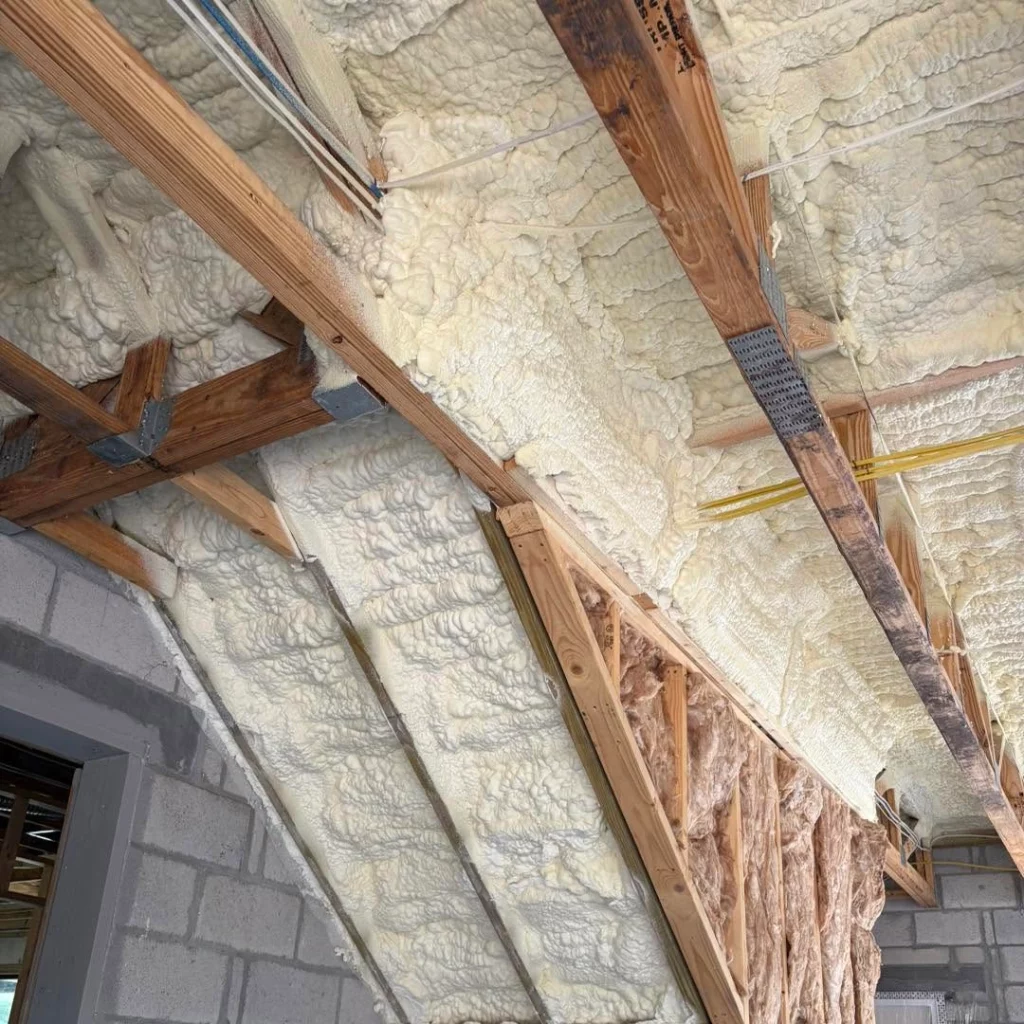
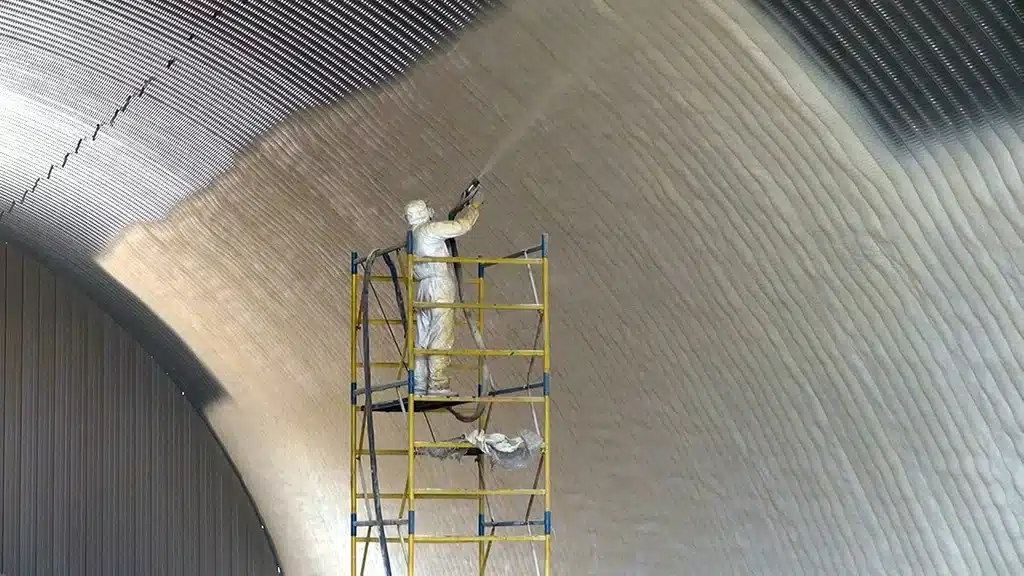
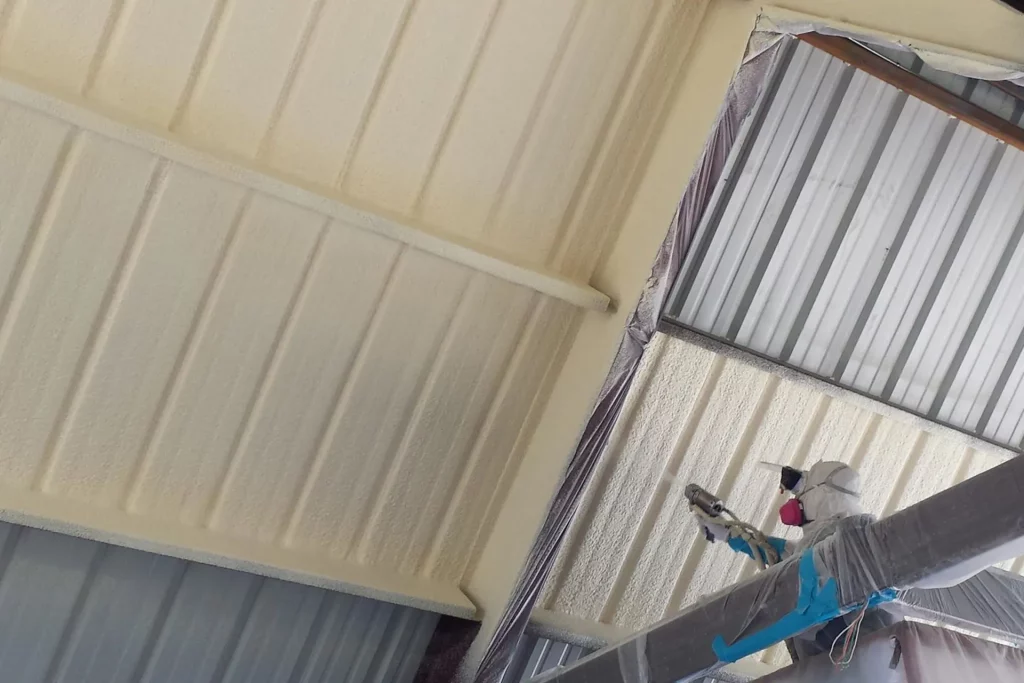
Spray foam stands out in commercial settings because it expands to fill gaps and cracks, providing both thermal insulation and an air barrier in a single application. This dual function is especially valuable in metal buildings and warehouses where sealing against air infiltration is notoriously difficult.
The Role of Air Sealing in Commercial Energy Efficiency
Insulation alone is not enough. If a building leaks air through gaps around windows, doors, roof penetrations, and wall joints, even the highest R-value insulation will underperform. The EPA’s ENERGY STAR program estimates that combining air sealing with insulation improvements reduces heating and cooling costs by an average of 15%, with savings reaching up to 20% in colder northern climate zones.
In large commercial buildings, common air leakage points include:
- Roof-to-wall transitions
- Dock door perimeters and loading bays
- Window and door frames across multiple floors
- Penetrations for plumbing, electrical, and HVAC runs
- Joints in metal building panels and precast concrete
- Unsealed attic and mechanical room accesses
Air sealing these areas before or during insulation installation ensures the thermal envelope performs as designed. Spray foam insulation simplifies this process because it seals and insulates simultaneously, which is why our team at Raleigh Excel Spray Foam Insulation frequently recommends it for commercial new construction and retrofits.
Building Energy Codes and Compliance Standards
Commercial insulation is not optional; it is governed by energy codes that set minimum requirements. The EPA’s Guide to Action on building codes notes that well-designed and enforced energy codes reduce building life-cycle costs, lower peak energy demand, and cut greenhouse gas emissions. The two primary standards governing commercial buildings in the U.S. are ASHRAE 90.1 and the International Energy Conservation Code (IECC).
Both standards specify minimum R-values for walls, roofs, floors, and foundations based on climate zone. For large commercial buildings, these requirements often mandate continuous insulation on the exterior of wall assemblies, which reduces thermal bridging through structural framing. Meeting code means satisfying the legal minimum, but designing beyond code is where real efficiency gains and long-term savings materialize.
The Insulation Institute reports that energy-efficient commercial properties command lease rates up to 20% above average, with decreased vacancy rates and higher tenant demand. As more municipalities adopt energy benchmarking and disclosure requirements, commercial buildings with superior insulation and lower energy use will carry a clear market advantage.
Where to Prioritize Insulation in Large Buildings
Targeting the right areas delivers the strongest return on investment. In most large commercial buildings, these locations offer the highest energy-loss potential:
- Roof and attic assemblies – Heat rises, making the roof the largest source of energy loss in most buildings. Roof insulation upgrades typically deliver the fastest payback.
- Exterior walls – Particularly in metal-framed or steel stud construction, where thermal bridging through framing significantly reduces effective wall R-value.
- Loading docks and large openings – These areas combine high air infiltration with thin insulation, creating major thermal weak points.
- Below-grade walls and foundations – Ground contact creates steady conductive heat loss that continuous insulation on the exterior can effectively address.
- HVAC ductwork and mechanical rooms – Ducts running through unconditioned spaces lose conditioned air before it reaches occupied areas.
Recommendations by Building Type
| Building Type | Recommended Insulation Strategy | Key Considerations |
|---|---|---|
| Office buildings (multi-story) | Spray foam in wall cavities, rigid board continuous insulation on exterior, sound-dampening mineral wool between floors | Acoustic performance matters as much as thermal. Air sealing around windows on every floor is critical. |
| Warehouses and distribution centers | Closed-cell spray foam on metal roof decks and walls, rigid board on foundation walls | Metal buildings conduct heat aggressively. Spray foam seals panel joints while insulating. Large dock doors need perimeter sealing. |
| Retail spaces | Spray foam in ceiling cavities, mineral wool in demising walls between tenants | Sound isolation between adjacent retail units and consistent temperature for customer comfort drive insulation decisions. |
| Healthcare and institutional | High R-value spray foam or rigid board assemblies, moisture-resistant materials throughout | Indoor air quality, moisture control, and code compliance for occupied facilities require careful material selection and installation. |
| Multifamily residential (large) | Spray foam in exterior walls, mineral wool between units for fire ratings and sound control | Building codes often require fire-rated assemblies in party walls. Mineral wool provides both fire resistance and acoustic performance. |
Signs You Have Found the Right Insulation Approach
Choosing the right contractor and insulation system for a commercial building involves more than comparing material specs. Here are indicators that an insulation provider and approach are aligned with your building’s needs:
- Clear communication about R-value targets tied to your specific climate zone and building assembly, not generic recommendations.
- Detailed air sealing plan included alongside the insulation scope, showing exactly where penetrations, joints, and transitions will be sealed.
- Material recommendations match the application, such as spray foam for irregular cavities and metal buildings, rigid board for continuous exterior insulation, and mineral wool where fire ratings are needed.
- Transparent project scope with defined areas of work, specified R-values per assembly, and a clear timeline for phased installations if the building is occupied.
- References and experience with buildings of similar size, type, and construction method to your project.
Get a Professional Assessment for Your Commercial Building
Raleigh Excel Spray Foam Insulation provides expert commercial insulation services tailored to large buildings in Raleigh and the surrounding area. Our team evaluates your building envelope, identifies energy-loss priority areas, and recommends the insulation system that delivers the strongest performance for your specific structure and climate zone.
Contact us today to discuss your commercial insulation needs:
- Email: [email protected]
- Phone: (919) 301-9435
Frequently Asked Questions About Commercial Insulation
How does insulation reduce heating and cooling costs in commercial buildings?
Insulation resists heat flow through the building envelope, meaning the HVAC system works less to maintain indoor temperatures. Combined with proper air sealing, insulation can reduce heating and cooling energy consumption by up to 15% on average.
What R-value should my commercial building insulation meet?
Required R-values depend on your climate zone, building assembly type, and whether the project is new construction or a retrofit. ASHRAE 90.1 and the IECC specify minimums for each climate zone, but designing beyond code yields better long-term performance.
Is spray foam insulation better than fiberglass for commercial buildings?
Spray foam provides higher R-value per inch and serves as both insulation and an air barrier, making it particularly effective for metal buildings and irregular cavities. Fiberglass remains a practical option for standard stud wall cavities where budget is a primary concern.
Can insulation be added to an existing commercial building without major renovations?
Yes, several insulation methods work for retrofits, including blown-in insulation for wall cavities, spray foam for roofs and attics, and rigid foam board applied to exterior surfaces during re-siding. The best approach depends on the building’s construction type and accessibility.
How long does commercial insulation last before it needs replacement?
Most commercial insulation materials, including spray foam, rigid board, and mineral wool, last the life of the building when properly installed. Fiberglass and blown-in materials can settle over decades but typically still perform adequately without replacement.
Sources
- U.S. Department of Energy – Insulation – Comprehensive guide to how insulation works, R-values, thermal bridging, and recommended insulation levels by climate zone.
- DOE OSTI – Insulation Materials for Commercial Buildings in North America – Oak Ridge National Laboratory research on the lifetime energy and environmental impacts of commercial insulation materials.
- ENERGY STAR – Methodology for Estimated Energy Savings – EPA’s energy modeling data on savings from air sealing and insulation improvements by climate zone.
- EPA – Building Codes for Energy Efficiency – Federal guidance on establishing and implementing commercial building energy codes.
- Insulation Institute – Commercial Building Insulation – Industry resource on commercial insulation benefits, including energy efficiency, occupant comfort, acoustics, and sustainability data.

- How Should Raleigh, NC Property Owners Evaluate Insulation for Long-Term Use? - September 23, 2026
- What Factors Affect Insulation Performance Across Different Parts of a Property? - September 23, 2026
- Could Spray Foam Insulation Be Useful Around Uneven Building Sections in Wake Forest, NC? - September 18, 2026