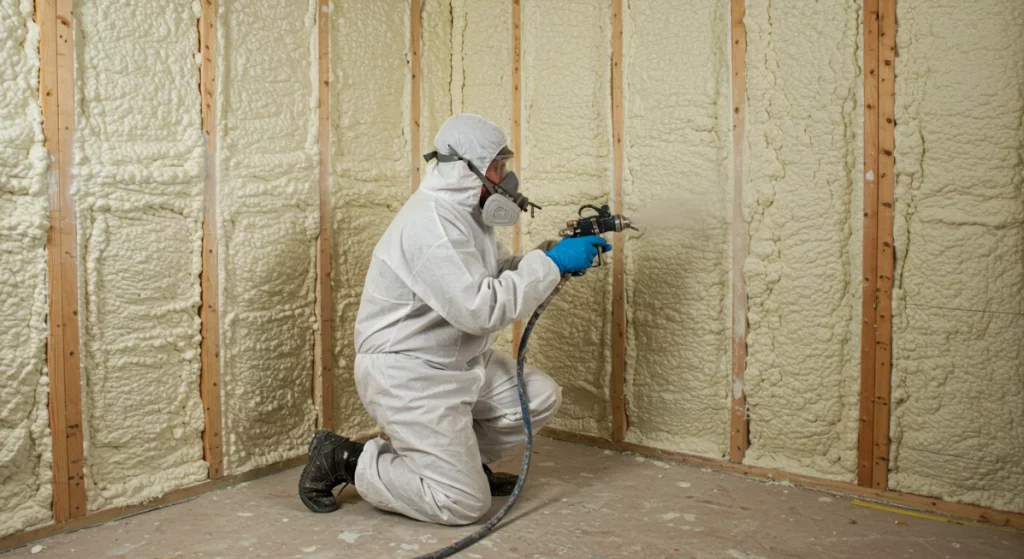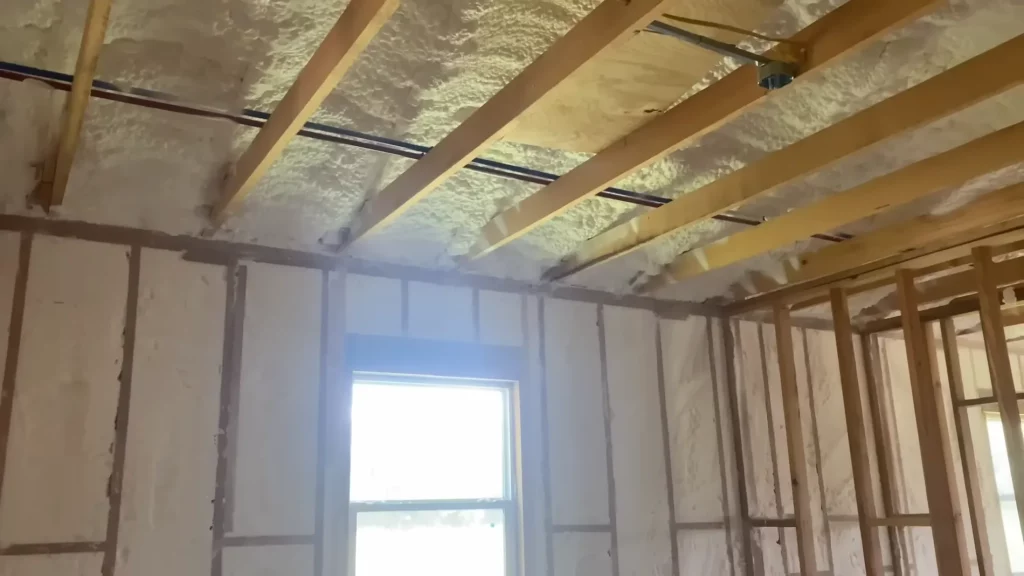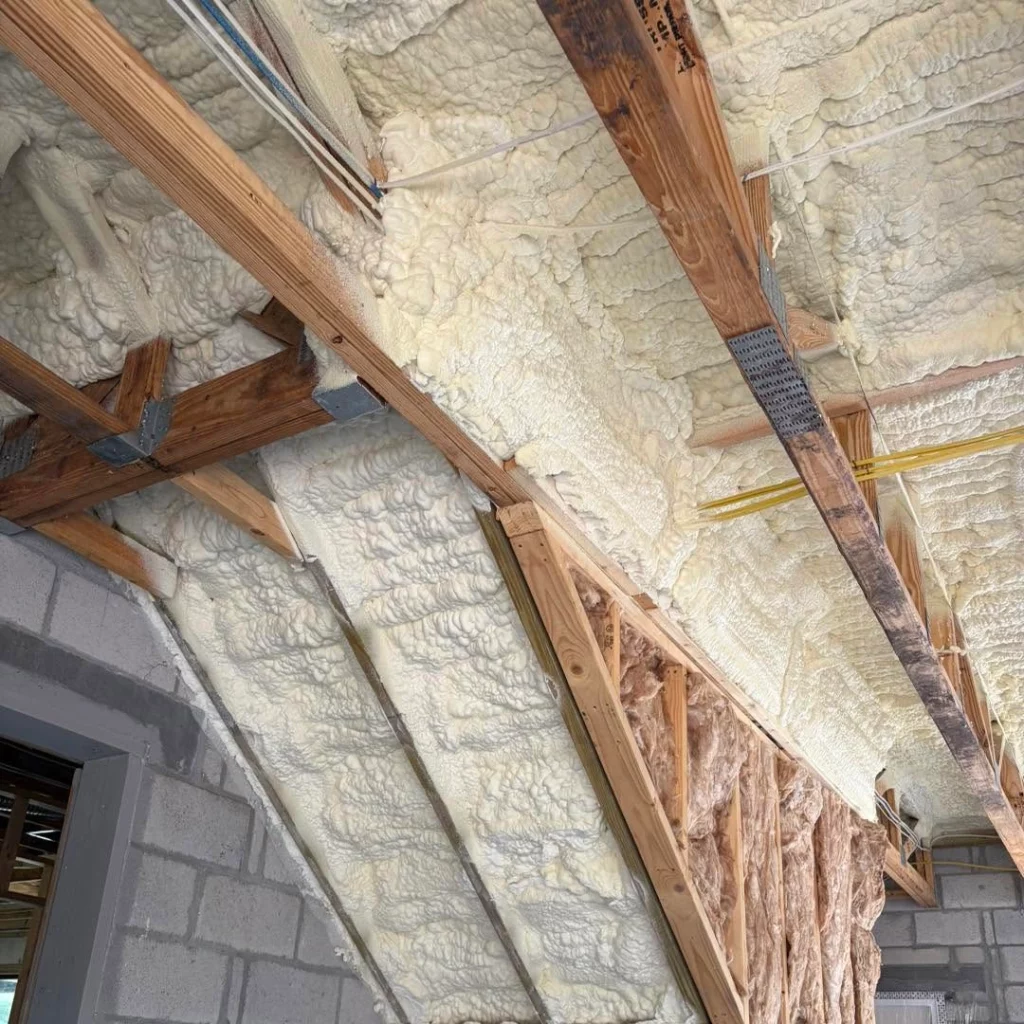



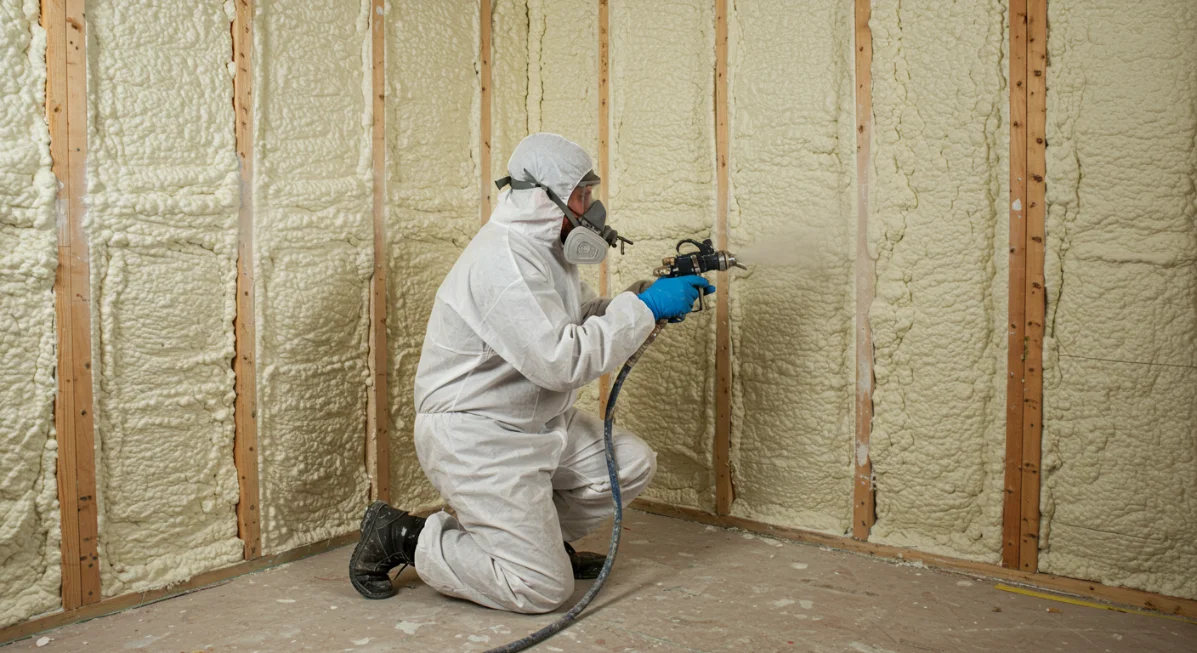
To evaluate insulation for long-term use, Raleigh, NC, property owners should look past the day-one R-value printed on a label and weigh four factors: whether the R-value target matches our climate zone, how the material holds its thermal resistance as it ages, how it manages moisture through our humid summers, and how completely the installation seals air leaks. Open-cell and closed-cell spray foam serve assemblies where airtightness and moisture control matter most; fiberglass and mineral wool batts suit ventilated cavities; blown cellulose works well for attic top-ups; and rigid foam adds continuous coverage that fights thermal bridging. Understanding insulation types and efficiency helps property owners match each material to the specific assembly.The right choice depends on your building, your existing assemblies, and how long you plan to own the property, and the sections below walk through each decision point with local benchmarks.
TL;DR
- Raleigh sits in IECC climate zone 4A, where ENERGY STAR’s insulation recommendations call for R-60 in an uninsulated attic, R-49 when adding to 3 or 4 inches of existing material, R-19 on floors, and R-10 rigid sheathing or R-13 batts on crawlspace walls.
- Our humid subtropical climate delivers a July mean of 80.5°F, about 48 days per year at or above 90°F, roughly 46 inches of annual rain, and August humidity near 78 percent, so moisture behavior largely determines insulation lifespan.
- EPA guidance states that moisture control is the key to mold control, and hidden mold often starts behind drywall and above ceiling tiles where insulation is insufficient.
- Material durability varies widely: U.S. Army Engineer Research and Development Center testing, summarized on Wikipedia’s R-value page, found fiberglass and extruded polystyrene retained over 97 percent of initial R-value, while closed-cell polyurethane samples dropped 27.5 percent under combined heat and humidity exposure.
- Foam products are often rated with LTTR, a 15-year weighted average that effectively reflects an 8-year aged value, a short horizon for buildings expected to last 50 to 100 years.
- The FTC’s R-Value Rule requires manufacturers, professional installers, retailers, and new home sellers to disclose R-values based on standard tests, so request the fact sheet in writing before you sign.
- Installed quality beats product marketing: compressed batts, voids, and thermal bridging through studs erode nominal R-value, while spray foam’s airtight bond to the substrate addresses the air leakage that lab ratings ignore.
Why Long-Term Performance Looks Different in Raleigh
Raleigh’s climate stresses insulation from both directions. Summers push attic temperatures far above outdoor air temperatures during those 48-plus days of 90°F heat, forcing cooling systems to run against a constant heat load. Winters bring an average of 69 nights at or below freezing, which creates repeated expansion and contraction across the building envelope NOAA-based climate data for Raleigh.
Moisture is the bigger long-term threat. With average relative humidity running around 70 percent annually and approaching 78 percent in August, our zone 4A climate keeps assemblies damp for long stretches. The EPA notes that mold grows when spores land on wet surfaces and that wet or damp materials must be dried within 24 to 48 hours to prevent growth. Insulation that absorbs moisture, sags when wet, or traps vapor against cold sheathing will underperform long before its rated lifespan, regardless of what the product label promises.
Start With R-Value Targets for Climate Zone 4A
Before comparing brands, set the performance target. ENERGY STAR publishes cost-effective insulation levels by climate zone, and insulation in Raleigh, NC, should follow the applicable 4A recommendations, which reflect the 2021 International Energy Conservation Code.
| Location | If Currently Uninsulated | If 3-4 Inches Already Exist |
|---|---|---|
| Attic | R-60 | Add R-49 |
| Floor above crawlspace or garage | R-19 | R-19 |
| Crawlspace wall | R-10 rigid sheathing or R-13 batt | Same |
| Exterior walls (when residing) | Blow cavities plus R-5 to R-10 sheathing | Add R-10 sheathing |
These targets assume a wood-framed building. If your home has less attic insulation than the R-49 top-up level, bringing it to target is the single clearest benchmark for a long-term upgrade, and it gives you an objective standard to hold any bid against.
Compare Materials on Durability, Not Day-One Numbers
A material labeled R-value per inch tells you how it performs when new and properly installed. For a 20-year decision, also weigh how each material ages in a humid climate.
| Material | Typical R-Value Per Inch | Long-Term Behavior | Best Use in Raleigh Homes |
|---|---|---|---|
| Closed-cell spray foam | ~5.5 to 6.5 | Can lose some R-value as blowing agent diffuses; strongly air-seals | Rooflines, crawlspaces, rim joists |
| Open-cell spray foam | ~3.6 | Water-blown, stable R-value; air-seals but stays vapor-permeable | Attic rooflines with proper moisture planning |
| Fiberglass batts | ~3.1 to 4.3 | Retained over 97 percent of R-value in ERDC testing; loses value if compressed or wet | Ventilated wall and floor cavities |
| Blown cellulose | ~3.0 to 3.8 | Can settle and compact, creating voids over time | Attic top-ups over existing insulation |
| Mineral wool batts | ~3.0 to 3.85 | Dimensionally stable and moisture-tolerant | Exterior walls, fire-prone areas |
| Rigid foam (XPS, EPS) | ~3.9 to 5.4 | Retained over 97 percent of R-value in testing | Continuous exterior sheathing, crawlspace walls |
The ERDC study matters because it tested aging under temperature and humidity, the exact combination Raleigh delivers every summer. Its finding that moisture absorption and blowing-agent loss were the major causes of R-value decline should shape which questions you ask any installer about roof insulation services.
Ask About Aged R-Value, Not Labeled R-Value
For foam products, many manufacturers report LTTR, a long-term thermal resistance rating based on a 15-year weighted average. As Wikipedia’s R-value article points out, LTTR effectively provides only an 8-year aged value, while buildings commonly serve for 50 to 100 years. When you evaluate insulation proposals for foam, ask what the material’s R-value is expected to be at 15 and 25 years, and get the answer in writing.
Judge the Installation, Not Just the Product
Manufacturer R-values apply only to properly installed insulation, and real-world performance depends on details that never appear on a spec sheet:
- Compression: Stuffing two batt layers into a cavity sized for one increases R-value but does not double it, and compressed fiberglass loses effectiveness.
- Gaps and voids: Every uninsulated pocket is a thermal shortcut that runs all summer and winter.
- Thermal bridging: Studs and framing conduct heat around cavity insulation, which is why doubling cavity R-value does not cut heat loss in half, and why continuous exterior foam is the accepted fix.
- Air leakage: Air infiltration degrades insulation through convective heat transfer and condensation, and one of spray foam’s primary values is its ability to create an airtight seal directly against the substrate.
The FTC’s R-Value Rule exists because the marketplace needs honest, test-based numbers. Professional installers are covered by the rule, so a trustworthy contractor will provide R-value fact sheets, list the product and thickness being installed, and explain how the numbers were tested.
Moisture Checks to Complete Before You Commit
Because moisture is the main enemy of insulation longevity here, EPA’s mold and moisture guide offers a checklist worth completing before any insulation work:
- Keep indoor relative humidity below 60 percent, ideally between 30 and 50 percent.
- Clean and repair roof gutters regularly, and make sure soil slopes away from the foundation.
- Keep air conditioning drip pans clean and drain lines unobstructed.
- Insulate cold surfaces, such as cold water pipes, to prevent condensation.
- Treat any water-damaged area as urgent, drying it within 24 to 48 hours.
An insulation plan that ignores drainage, ventilation, and humidity will not last, no matter which material you choose.
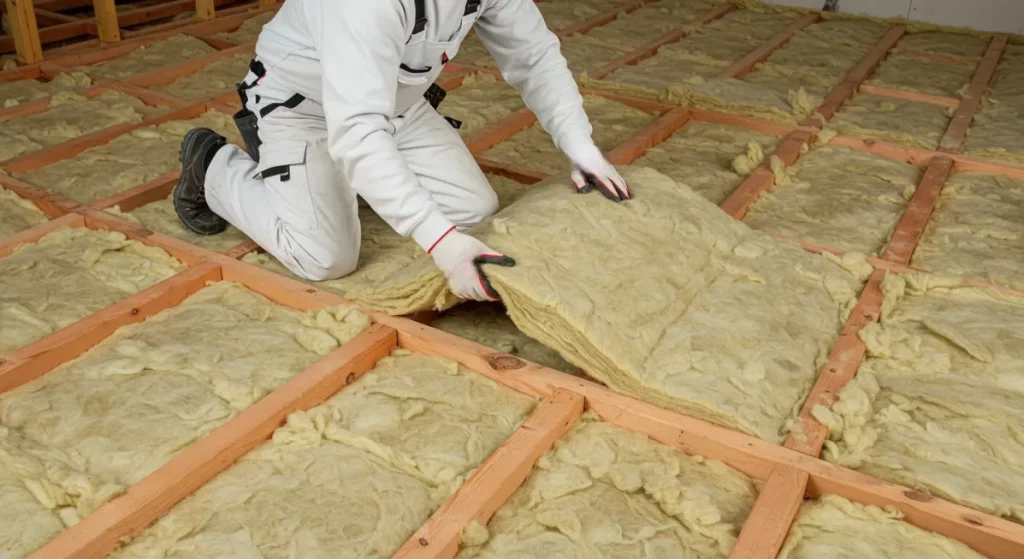
Mistakes That Shorten Insulation Lifespan
- Buying on R-value per inch claims alone, which the FTC restricts precisely because the number drops as thickness changes for many products.
- Air sealing after insulating instead of before, or not at all.
- Skipping soffit baffles, which blocks ventilation in attics and invites moisture buildup.
- Encapsulating a crawlspace without addressing standing water, grading, or humidity first.
- Installing batts over wiring and can lights without cutting and fitting around obstructions.
- Choosing a vapor-impermeable material for an assembly that needs drying capacity.
- Accepting a verbal R-value promise instead of documented product and thickness.
Insulation Recommendations by Property Type
| Property Scenario | Recommended Approach | Why It Works Long-Term |
|---|---|---|
| Older Raleigh home with an open attic | Air-seal, then blow to R-49 or R-60 | Matches ENERGY STAR zone 4A targets and preserves attic ventilation |
| Humid, vented crawlspace | Closed-cell foam on walls and rim joist with humidity control | Addresses both heat loss and our seasonal moisture load |
| New construction or gut renovation | Spray foam at the roofline or batts plus continuous exterior foam | Controls air leakage and thermal bridging together |
| Rental properties | Attic top-up with blown cellulose or batts in accessible cavities | Delivers code-level performance with simple, inspectable installations |
| Additions and bonus rooms over garages | Closed-cell foam in floors and rooflines | Seals irregular framing that batts fit poorly |
Signs You Have Found the Right Long-Term Approach
- The proposal names specific products, target R-values matched to zone 4A, and installed thickness, not vague claims of premium performance.
- Your installer explains aged versus labeled R-value and puts the numbers in writing, consistent with FTC disclosure requirements.
- The assessment includes moisture conditions, attic ventilation, and crawlspace humidity, not just square footage.
- Air sealing is part of the scope, and the crew can describe how leaks at rim joists, penetrations, and top plates will be handled.
- The contractor documents the work with photos, warrantied coverage, and clear post-installation expectations.
- Communication focuses on how the assembly will perform in year 20, not just the day the truck leaves.
Get a Long-Term Insulation Plan for Your Raleigh Property
At Raleigh Excel Spray Foam Insulation, our team evaluates your attic, crawlspace, and wall assemblies against zone 4A benchmarks, then recommends the material and air-sealing strategy that will still perform decades from now. We document target R-values, moisture conditions, and installation details so you know exactly what you are getting, from the first assessment through final walkthrough. Call us at (919) 301-9435 or email [email protected] to get started, and protect your property with insulation built for Raleigh’s climate.
FAQs
What R-value should my attic have in Raleigh?
ENERGY STAR recommends R-60 for an uninsulated attic in climate zone 4A, or adding R-49 if you already have 3 to 4 inches of insulation. Many older Raleigh homes fall well short of both targets.
Does spray foam insulation lose R-value over time?
Closed-cell polyurethane can lose some R-value as its blowing agent diffuses out, with ERDC testing showing a 27.5 percent reduction under combined heat and humidity exposure. Ask for aged R-value projections rather than day-one numbers.
Is fiberglass a poor choice for long-term use?
No, fiberglass performed well in durability testing, retaining over 97 percent of its initial R-value. Its weak points are compression, gaps, and moisture, so installation quality and a dry assembly matter more than the material itself.
Should I air seal before adding insulation?
Yes. Air infiltration degrades insulation through convection and can drive condensation inside assemblies, so sealing leaks first protects whatever material you install. Spray foam handles both jobs in a single application.
How often should insulation be inspected?
Walk your attic and crawlspace once a year and after major storms, looking for dampness, settling, or pest damage. If any material gets wet, dry it within 24 to 48 hours per EPA guidance to prevent mold growth.
Sources
- ENERGY STAR – Recommended Home Insulation R-Values – Climate-zone insulation targets for attics, floors, walls, and crawlspaces, including the zone 4A recommendations that apply to Raleigh and guidance based on the 2021 IECC.
- Wikipedia – R-value (insulation) – Technical reference covering R-value definitions, per-inch ratings for common materials, insulation aging, LTTR ratings, thermal bridging, air sealing, and U.S. Army ERDC durability testing results.
- Federal Trade Commission – R-Value Rule – The federal regulation requiring insulation manufacturers, professional installers, retailers, and new home sellers to disclose test-based R-value information to consumers.
- EPA – A Brief Guide to Mold, Moisture and Your Home – Federal guidance on moisture control, indoor humidity targets, hidden mold risks tied to insufficient insulation, and condensation prevention for building assemblies.
- Wikipedia – Raleigh, North Carolina – NOAA-based climate data for Raleigh documenting its humid subtropical climate, seasonal temperature extremes, rainfall totals, and humidity levels used for the local performance context.