


Choosing the right spray foam insulation for your project comes down to understanding how open-cell and closed-cell foam differ in performance, cost, and application. Open cell foam costs less upfront and excels at sound absorption, while closed cell foam delivers higher R-values and acts as an integrated vapor barrier. The best choice depends on your climate zone, budget constraints, and whether you need moisture protection.
Closed-cell spray foam provides R-7 per inch of thermal resistance, roughly double what open cell delivers at R-3.8 per inch. This means closed-cell achieves code-compliant insulation thickness with roughly half the material. Open cell foam, with its lighter 0.5 lb/ft3 density, expands more during application and fills wall cavities completely, making open cell insulation a popular choice for full coverage. Closed cell density reaches 2 lbs/ft3, creating a rigid, structural bond that adds strength to building assemblies.
The U.S. Department of Energy notes that both types create effective air barriers when installed to proper thickness, but only closed-cell foam qualifies as a vapor retarder at 1.5 inches or greater. This distinction matters significantly for below-grade applications, crawl spaces, and northern climates where moisture control prevents costly structural damage.
TL;DR
- R-value difference is substantial: Closed cell delivers R-7 per inch compared to open cell’s R-3.8 per inch, requiring less material to achieve the same thermal performance
- Open cell costs less upfront: Material costs range from $0.40 to $1.50 per board foot for open cell versus $1.25 to $4.50 for closed cell
- Closed cell provides vapor barrier protection: At 1.5 inches thickness, closed cell spray foam meets vapor retarder requirements without additional materials
- Open cell outperforms for sound dampening: The porous, flexible structure absorbs airborne sound waves more effectively than dense closed cell foam
- Thickness affects air barrier compliance: Open cell requires 3.75 inches minimum for air barrier designation, while closed cell achieves this at just 1 inch
- Climate zone matters: Northern states with extreme temperature differentials between indoors and outdoors typically benefit more from closed cells’ superior R-value
- Application environment determines suitability: Below-grade, damp, or moisture-prone areas strongly favor closed-cell’s water resistance
How the Cellular Structure Creates Performance Differences
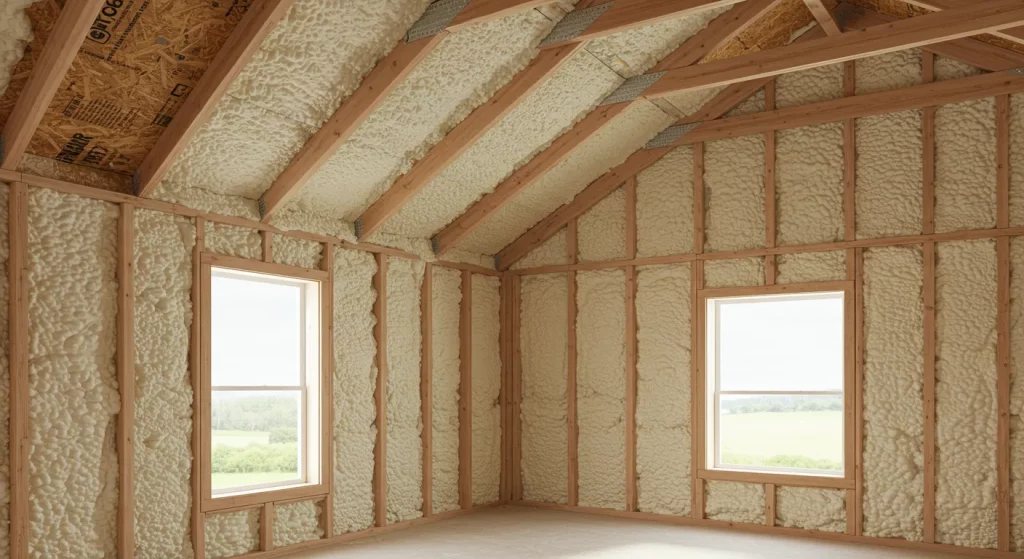
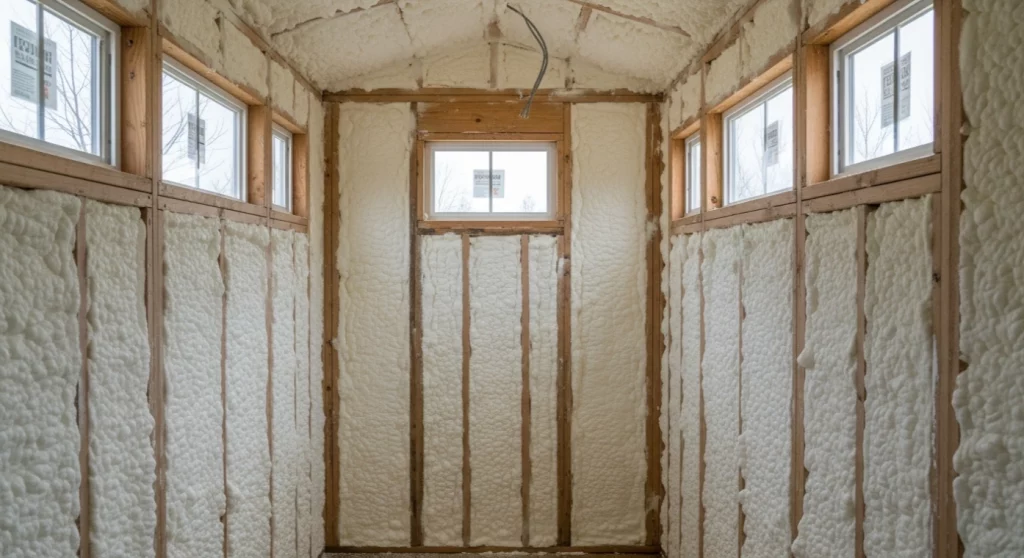
The microscopic structure of spray foam determines its macroscopic performance characteristics. During application, two chemical components combine and expand rapidly, forming thousands of tiny bubbles. In open-cell foam, these bubbles rupture upon expansion, leaving only the struts where bubbles touched. This creates an interconnected, porous network that resembles a flexible sponge.
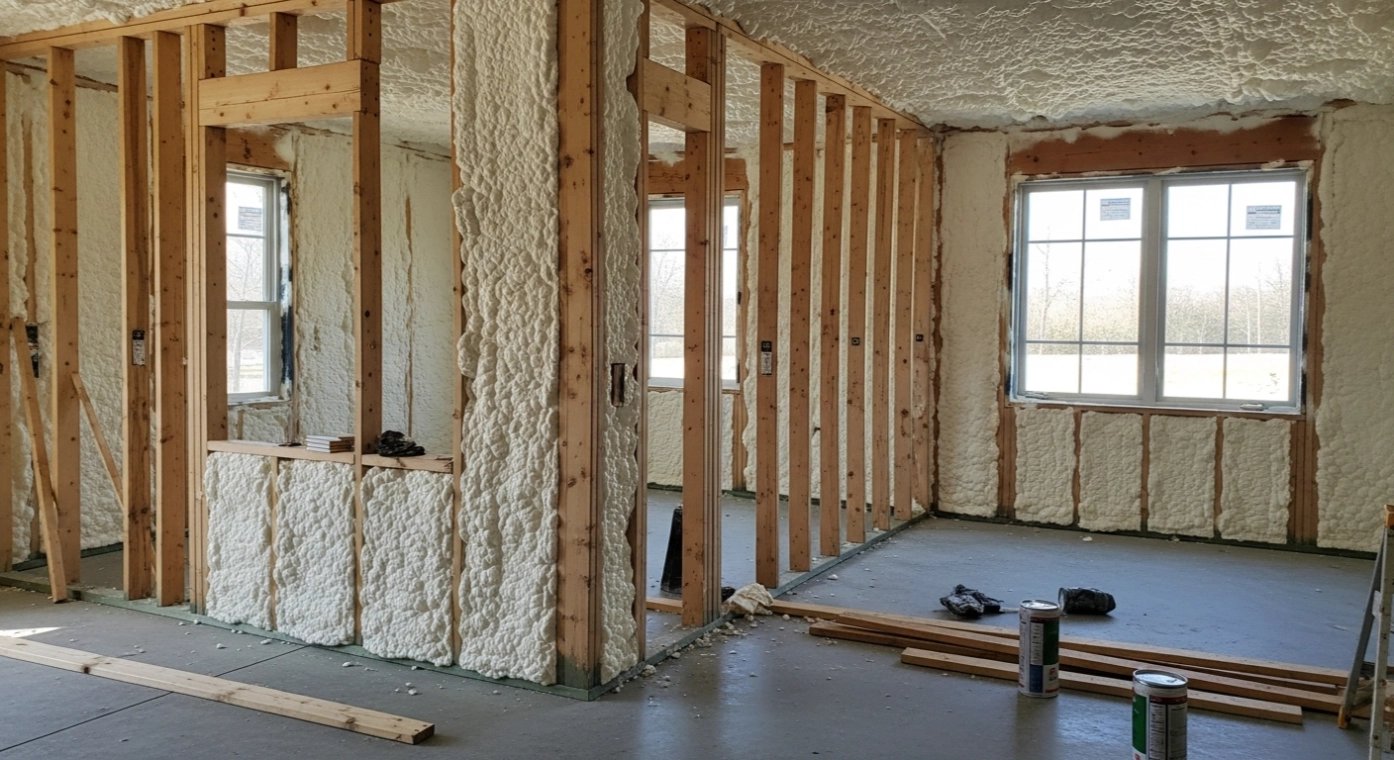
Closed-cell foam maintains intact bubble walls during and after expansion. Each pocket remains sealed, creating a dense, rigid material with distinct performance properties. These structural differences explain why Johns Manville’s technical documentation identifies closed-cell spray foam as R-7 per inch while open-cell reaches only R-3.8 per inch.
The open structure of open-cell foam allows air and moisture vapor to pass through, which makes it breathable but unable to serve as a vapor barrier. Closed cells’ sealed pockets prevent moisture penetration entirely, making it suitable for applications where water resistance matters.
Cost Comparison: Material and Installed Costs
Material costs for spray foam insulation vary based on product type, but the installed cost difference narrows when you account for thickness requirements.
| Cost Factor | Open Cell Spray Foam | Closed Cell Spray Foam |
|---|---|---|
| Material cost per board foot | $0.40 – $1.50 | $1.25 – $4.50 |
| Minimum thickness for air barrier | 3.75 inches | 1 inch |
| Minimum thickness for vapor barrier | Requires separate material | 1.5 inches (built-in) |
| Typical R-value achieved in a 2×4 wall | R-13 to R-15 | R-21 to R-28 |
| Density | 0.5 lb/ft3 | 2.0 lb/ft3 |
When calculating total installed cost, remember that open-cell applications typically require more thickness to achieve equivalent R-values. A project needing R-30 in an attic space might need 8 inches of open-cell foam, but only 4 to 5 inches of closed-cell. Always request a detailed breakdown from your contractor, comparing total material quantities and labor.
Performance in Different Applications
Attic Insulation
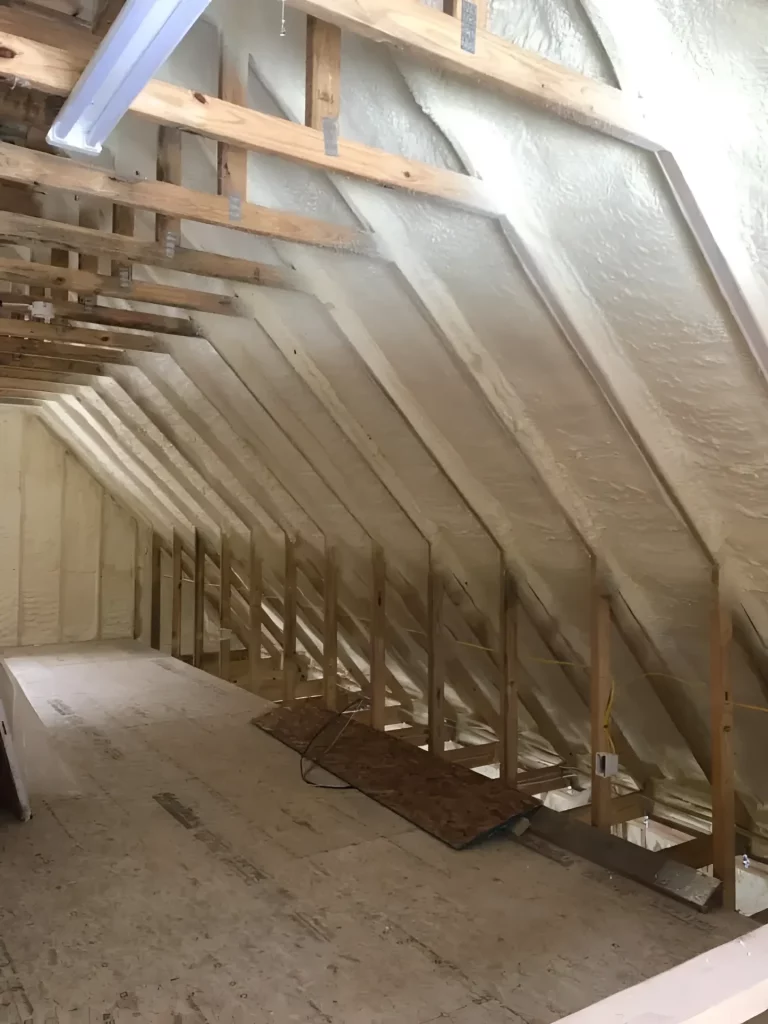
Attics present unique challenges because temperature extremes hit hardest in these unconditioned spaces. Closed-cell spray foam performs exceptionally well in attic applications because it achieves high R-values in thin applications, leaving more attic space usable. Open cell can work in attics but requires thicker applications that may reduce storage or headroom, as explained in open cell insulation guide.
Wall Cavities
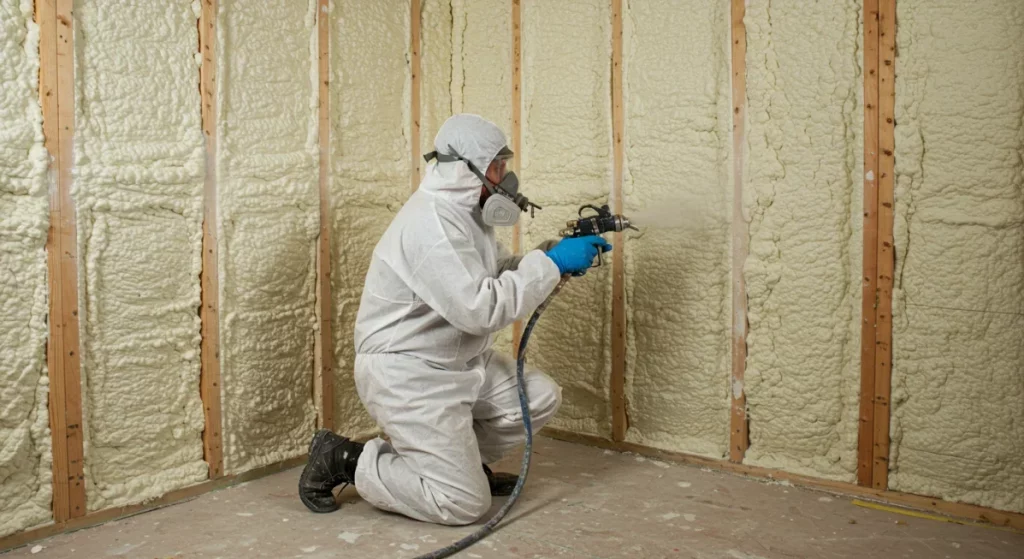
Both products work effectively in wall cavities when properly installed. Open-cell foam expands aggressively during application, filling every gap and corner completely. This makes it excellent for hard-to-reach areas and irregular cavities. Closed cell provides structural rigidity that can help stabilize older wall assemblies.
Below-Grade and Crawl Spaces
This is where closed-cell foam clearly dominates. Open-cell foam’s vapor-permeable nature makes it unsuitable for below-grade applications where ground moisture poses a constant threat. Closed-cell spray foam’s water resistance protects foundations and crawl spaces from moisture intrusion while providing insulation.
Sound-Sensitive Spaces
Home theaters, recording studios, and bedrooms benefit from open-cell foam’s acoustic properties. The porous structure absorbs sound waves rather than reflecting them, reducing noise transmission between rooms and from exterior sources.
Real-World Contractor Scenarios
| Scenario | Property Type | Recommended Option | Estimated Installed Cost Range |
|---|---|---|---|
| New construction, 2,400 sq ft home, mixed climate | Single-family residential, Climate Zone 3 | Open the cell in the walls and attic | $8,500 – $12,000 |
| Historic home with moisture issues in the basement | 1920s craftsman, unfinished basement | Closed cell in walls and below-grade areas | $14,000 – $18,000 |
| Commercial warehouse conversion to apartments | Mixed-use renovation, Climate Zone 4 | Closed cell for exterior walls, open cell for interior partitions | $45,000 – $65,000 |
| Coastal vacation home, high-humidity area | Single-family, humid subtropical climate | Closed cell throughout | $11,000 – $15,000 |
| Home theater addition with sound concerns | Residential addition, finished basement | Open cell for walls and ceiling | $6,500 – $9,000 |
Factors That Influence the Decision
Climate Zone and Temperature Differential
Northern climates with extreme winter conditions demand higher R-values to maintain thermal comfort and control heating costs. Southern regions with milder winters and hot summers may achieve adequate performance with open-cell foam. The U.S. Department of Energy building codes recognize this difference, often requiring approximately 10 inches of open cell versus 5.5 inches of closed cell to meet the same energy code requirements.
Moisture Exposure and Vapor Control
If your project involves basements, crawl spaces, or exterior applications below grade, closed-cell foam’s integrated vapor barrier eliminates the need for separate moisture protection. Open cell projects in similar conditions require additional vapor barrier materials and careful detailing.
Budget Constraints and Long-Term Value
Open cell provides excellent performance at a lower material cost, but calculate the total installed costs before deciding. Projects requiring double the thickness of open cell versus closed cell may actually cost more due to increased material quantities and longer installation time.
Sound Control Requirements
Prioritizing acoustic performance favors open-cell foam, which absorbs sound more effectively than dense closed-cell materials. Studios, home offices, and multi-family buildings often benefit from open cell’s sound-dampening properties.
Structural Reinforcement Needs
Closed-cell foam adds measurable structural strength to wall assemblies. This property proves valuable in high-wind regions, seismic zones, or when reinforcing older construction.
Who This Is For
Closed-cell spray foam is ideal for:
- Projects in northern climate zones with extreme temperature swings
- Below-grade applications, basements, and crawl spaces
- Buildings requiring integrated vapor barrier protection
- Projects where maximizing R-value in limited thickness matters
- Coastal or humid environments where moisture resistance matters
Open cell spray foam works best for:
- Projects with strict budget constraints seeking quality performance
- Interior wall applications prioritizing sound absorption
- Climates with moderate temperature differentials
- Retrofitting existing structures with irregular cavities
- Projects where breathability helps manage moisture naturally
Making the Final Decision
The choice between open-cell and closed-cell spray foam insulation ultimately comes down to your specific project requirements. Both products deliver superior performance compared to traditional insulation materials when properly installed. The key is matching the product characteristics to your building’s needs.
For projects where moisture protection and maximum R-value in minimal thickness matter, closed-cell foam provides clear advantages despite higher upfront costs. For budget-conscious projects in moderate climates where sound control matters, open cell delivers excellent value.
Our team at Raleigh Excel Spray Foam Insulation brings decades of combined experience, matching insulation solutions to project requirements. We understand the nuances of climate zone requirements, vapor management, and cost optimization that determine project success.
Whether you need a comprehensive quote for a new construction project or want to discuss options for an existing building, our professionals will assess your specific situation and recommend the most appropriate solution. Contact us today to discuss your insulation needs and discover how spray foam can transform your building’s performance. Email us at [email protected] or call (919) 301-9435 to speak with one of our insulation specialists.
Frequently Asked Questions
Can I use open-cell spray foam in a basement?
No, open-cell foam is vapor-permeable and not recommended for below-grade applications. Basements and crawl spaces require closed-cell spray foam to prevent moisture intrusion and potential mold growth.
How much thicker does open cell need to be compared to closed cell?
Open cell requires approximately twice the thickness to achieve equivalent R-values. Where closed cell achieves R-7 per inch, open cell reaches only R-3.8 per inch, so open cell installations typically need 6 to 8 inches in attics versus 3 to 4 inches of closed cell.
Does closed-cell spray foam require a thermal barrier?
Yes, both open-cell and closed-cell spray foam require a thermal barrier covering, such as drywall, to meet building code requirements. This protects the foam from fire exposure and ensures safe occupancy.
How long does spray foam insulation last?
Properly installed spray foam insulation lasts for the lifetime of the building structure. Unlike fiberglass, which can settle and lose effectiveness over time, spray foam maintains its R-value and air-sealing performance indefinitely.
Can spray foam help with existing moisture problems in walls?
Spray foam alone cannot fix existing moisture damage inside wall cavities. You must address any water intrusion, remove damaged materials, and identify the moisture source before installing spray foam insulation.
Sources
- Spray Foam: Open-Cell vs. Closed-Cell – Johns Manville – Technical comparison of spray foam types including R-values, density specifications, and application guidelines from a major insulation manufacturer.
- Which Spray Foam Is Right For You? – U.S. Department of Energy – Government publication providing building code guidance and vapor retarder requirements for spray foam applications.
- Open Cell vs Closed Cell Spray Foam R-Value Guide – sprayman – Industry guide detailing R-value differences and thermal performance specifications for both foam types.
- RR-0912: Spray Polyurethane Foam: The Need for Vapor Retarders – Building Science Corporation – Research report on vapor retarder requirements and building science principles for spray foam applications.
- Why Spray Foam? – Spray Foam Magazine – Industry resource explaining R-value fundamentals and spray foam performance characteristics for contractors.

- What Role Does Insulation Thickness Play in Building Durability and Material Performance? - October 23, 2026
- How Can Spray Foam Insulation Improve Coverage Around Irregular Framing? - October 23, 2026
- Why Is Closed Cell Spray Foam Effective Around Moisture-Prone Building Areas in Raleigh, NC? - October 21, 2026