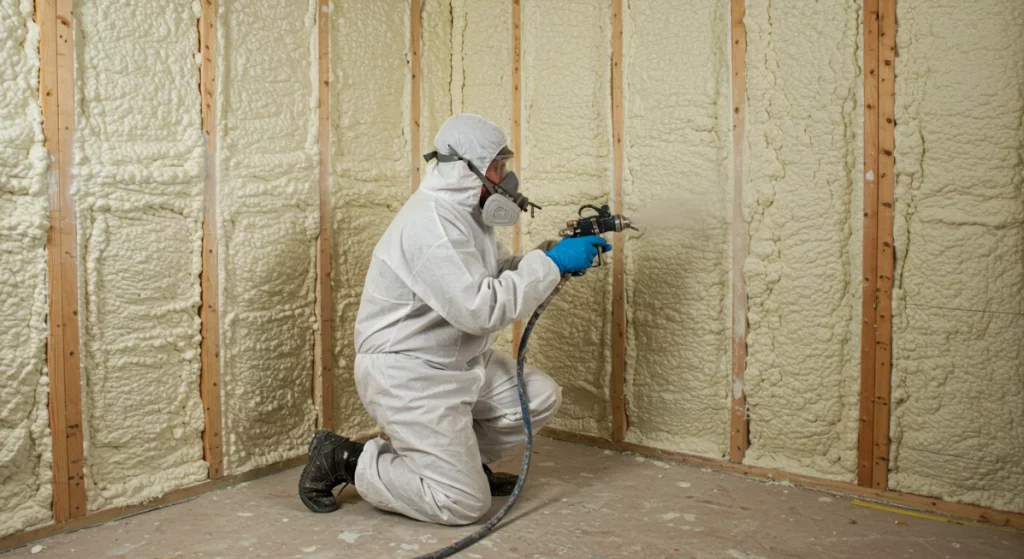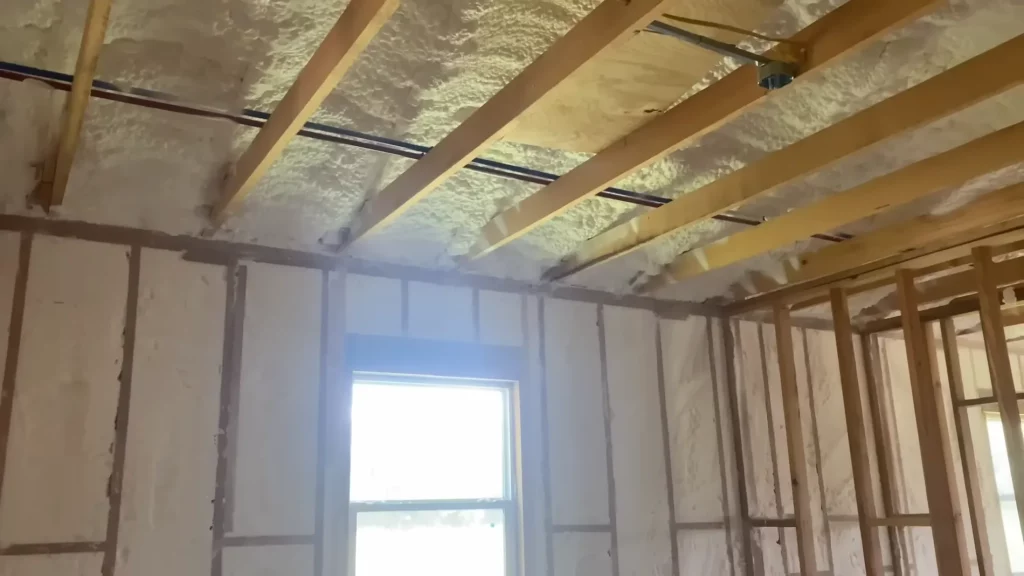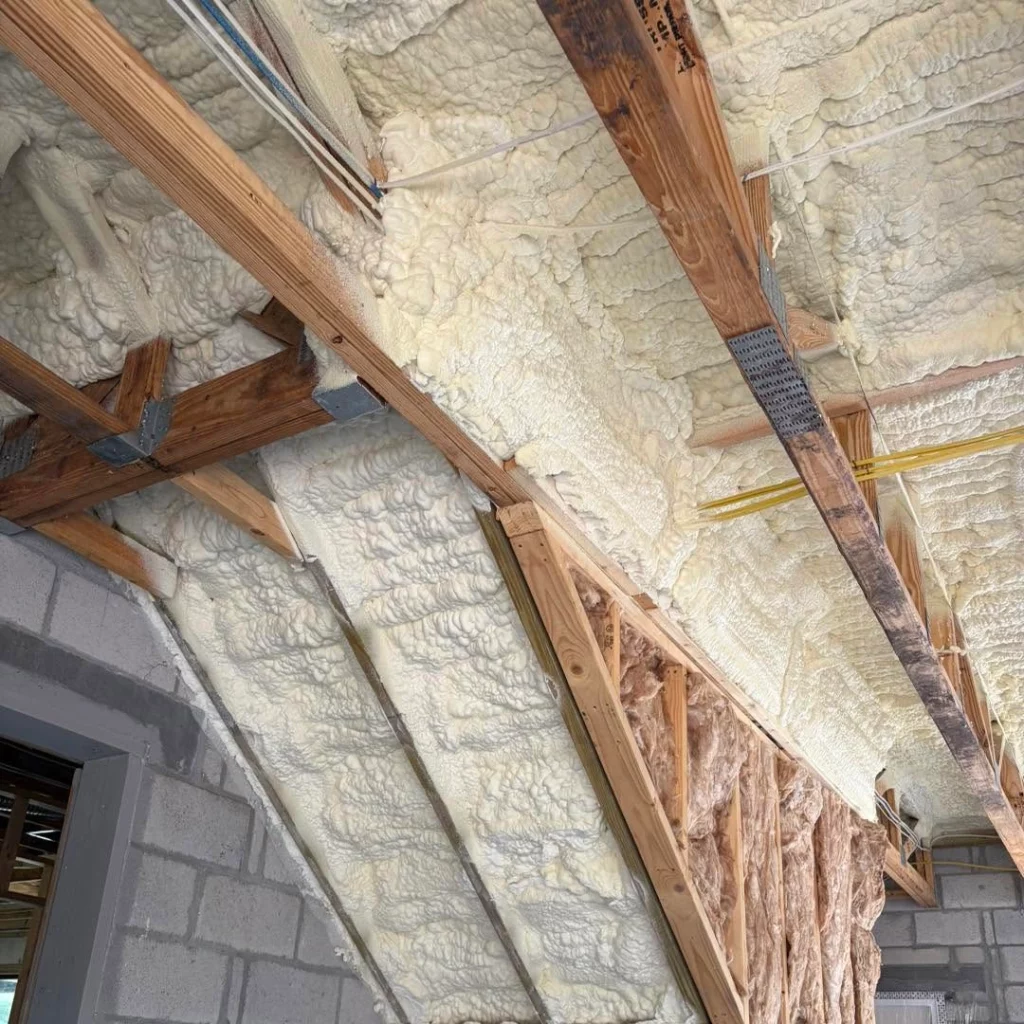



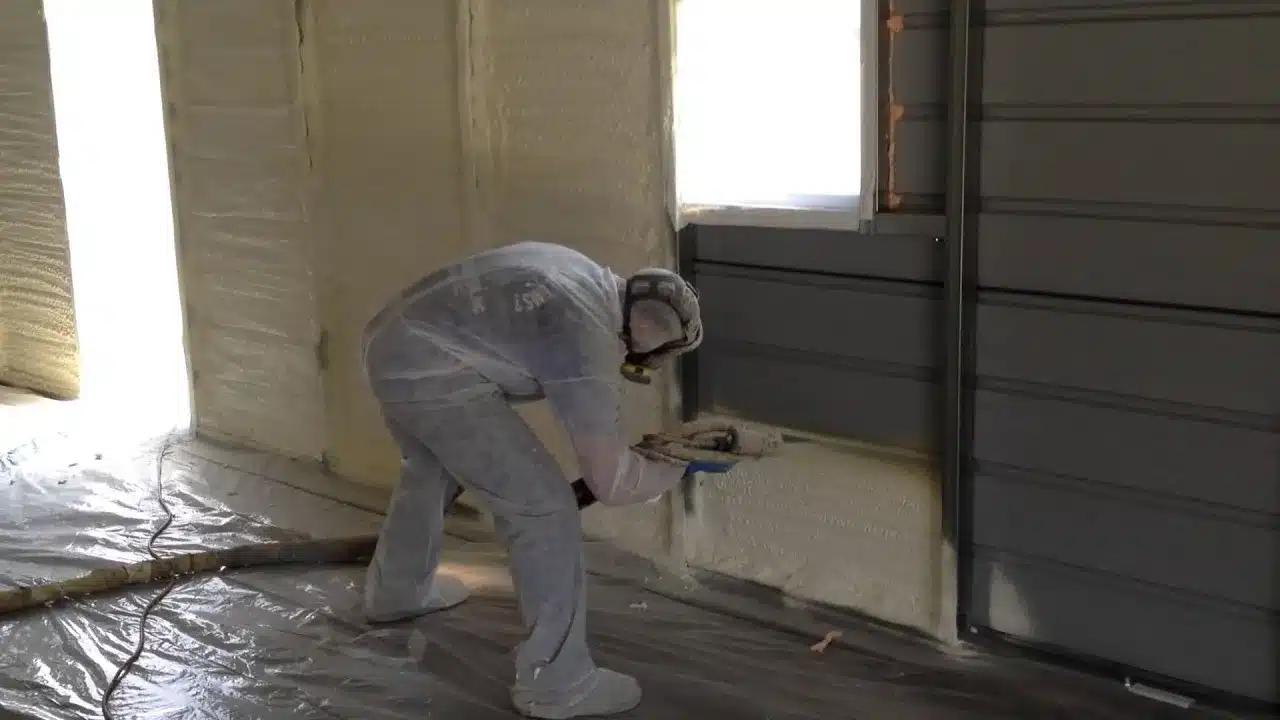
Neither closed cell nor open cell spray foam is universally “better” in Raleigh. The right choice depends on where it is being installed, what the assembly needs to do, and the specific conditions of the building. Closed cell spray foam delivers roughly double the R-value per inch compared to open cell (approximately R-6 to R-7 per inch versus R-3.5 to R-3.7 per inch), acts as a Class II vapor retarder, and adds structural rigidity to wall assemblies. Open cell spray foam expands to fill cavities more completely at a lower material density, provides effective air sealing, and works well in interior wall assemblies and vented attic floor planes. In Raleigh, which sits in IECC Climate Zone 4, both foam types can meet code requirements, but their performance advantages vary significantly by application. Crawl spaces, rim joists, and below-grade areas in Raleigh’s humid climate demand the moisture resistance that only closed cell foam provides. Wall cavities and conditioned attics can perform well with either type when installed correctly, though closed cell offers extra protection against the high humidity that drives condensation risks throughout central North Carolina.
TL;DR
- Raleigh falls in IECC Climate Zone 4, requiring R-49 ceiling insulation and R-20 or R-13 + R-5ci for wood-framed walls under the 2024 NC Energy Conservation Code
- Closed cell spray foam delivers R-6 to R-7 per inch and functions as a Class II vapor retarder at 1.5 inches of thickness
- Open cell spray foam delivers R-3.5 to R-3.7 per inch and is vapor permeable, allowing moisture to pass through
- For vented crawl spaces and rim joists in humid Raleigh conditions, only closed cell spray foam is recommended in all climate zones
- For unvented conditioned attics, both foam types work in Climate Zone 4, but open cell requires supplemental moisture removal measures (supply air at 50 cfm per 1,000 sq ft or a dehumidifier)
- Wall cavities can use either type in most Raleigh applications, with closed cell preferred where condensation control and moisture resistance are priorities
- Building Science Corporation research confirms that in hot-humid climates, attic venting actually causes moisture problems, making unvented spray foam attics a stronger performer than vented ones
R-Value and Thermal Performance in Raleigh’s Climate
Raleigh’s climate zone dictates specific minimum insulation requirements that directly influence which spray foam type is practical for a given application. Under the 2024 North Carolina Energy Conservation Code, Climate Zone 4 requires:
- Ceilings: R-49 minimum
- Wood-framed walls: R-20 cavity or R-13 + R-10ci
- Floors over unconditioned spaces: R-30
- Crawl space walls: R-10ci or R-13 cavity
The practical difference between open cell and closed cell shows up in how much cavity depth each type needs to meet these targets. A 2×4 stud cavity (3.5 inches) filled with closed cell spray foam reaches approximately R-21 to R-24, exceeding the R-20 wall cavity requirement on its own. That same cavity filled with open cell spray foam reaches approximately R-12 to R-13, which means additional continuous insulation on the exterior sheathing would be necessary to meet the R-20 requirement or the R-13 + R-10ci alternative, as explained in this closed cell vs open cell insulation guide.
For unvented attic assemblies in Climate Zone 4, the code allows air-impermeable insulation installed to the underside of the roof deck at a minimum of R-25 (or R-20 for Climate Zone 3). With closed cell at R-6.5 per inch, that means roughly 4 inches of foam. With open cell at R-3.6 per inch, roughly 7 inches would be needed. This thicker application of open cell fills deeper rafter bays but may not fit in shallower truss configurations common in Raleigh homes.
| Performance Factor | Closed Cell Spray Foam | Open Cell Spray Foam |
|---|---|---|
| R-value per inch | R-6.0 to R-7.0 | R-3.5 to R-3.7 |
| Air permeability | Air impermeable | Air impermeable (at rated depth) |
| Vapor permeability | Class II vapor retarder at 1.5″ | Vapor permeable |
| Density | 1.5 to 2.5 lb/ft³ | 0.4 to 0.7 lb/ft³ |
| Expansion | ~30x to 35x | ~100x to 150x |
| Wall cavity R-value in 2×4 (3.5″) | ~R-21 to R-24 | ~R-12 to R-13 |
| Wall cavity R-value in 2×6 (5.5″) | ~R-33 to R-38 | ~R-19 to R-20 |
Moisture Control in Hot-Humid Conditions
Raleigh’s hot-humid summers, with consistent high relative humidity, make moisture management a central concern that separates how the two foam types perform in practice. According to the Building Science Corporation’s Residential Spray Foam Guide, spray foam is unique in its ability to handle water control, air control, vapor control, and thermal control simultaneously, but not every assembly requires the foam to handle all four functions.
Closed cell spray foam at sufficient thickness functions as a Class II vapor retarder, meaning it restricts moisture diffusion through the building assembly. This matters significantly in Raleigh’s climate because the vapor drive is predominantly inward during summer months, pushing warm, humid outdoor air toward cooler conditioned interior surfaces. Closed cell foam blocks that vapor drive at the building envelope, making a spray foam insulation comparison especially useful.
Open cell spray foam, while air impermeable, is vapor permeable. This means interior moisture can migrate through the foam and reach the roof sheathing or exterior sheathing. In unvented conditioned attics, this permeability creates a known moisture risk. The Building America Solution Center’s code compliance brief documents that when tighter ductwork reduced the accidental conditioning that had previously kept open-cell foam attics dry, humidity levels climbed and condensation appeared on ductwork and roof sheathing. In Raleigh’s Climate Zone 4, this risk is real and requires either supplemental moisture removal or a switch to closed cell foam.
The Building Science Corporation’s conditioned attic analysis further confirms that in hot-humid climates, attic venting actually introduces outdoor humidity into attic spaces, making ductwork sweat and promoting mold growth on roof sheathing. Unvented conditioned attics with spray foam insulation outperform vented ones in Raleigh’s climate, provided moisture is actively managed.
Where Each Type Performs Best in Raleigh Applications
Crawl spaces and rim joists – The Building Science Corporation guide states that only high density closed cell spray foam should be used for vented crawl spaces in all IECC climate zones. For encapsulated, conditioned crawlspaces, both foam types can work, but closed cell provides superior moisture resistance against Raleigh’s ground moisture and high ambient humidity. Rim joist areas, where framing meets the foundation, are particularly vulnerable to air infiltration and condensation, making closed cell the stronger performer.
Unvented conditioned attics – Both foam types work in Climate Zone 4 for unvented attic assemblies. The critical requirement is that a means of moisture removal must be provided. Closed cell at sufficient thickness adds the vapor retarder function that open cell lacks, reducing reliance on mechanical dehumidification. Open cell attics need supply air from the HVAC system (at least 50 cfm per 1,000 sq ft of ceiling area) or a dedicated dehumidifier to prevent moisture accumulation.
Exterior wall cavities – In standard 2×4 or 2×6 wood-framed walls with wood-based sheathing and an exterior water control layer, the Building Science Corporation guide confirms that both foam types work in most climates. The cavity insulation can be low density open cell or high density closed cell spray foam. For Raleigh’s Climate Zone 4, neither type is specifically mandated over the other in standard wall assemblies, though closed cell provides the added benefit of condensation control at the assembly interior.
Below-grade and basement applications – For below-grade walls in Climate Zone 5 and higher, closed cell is recommended by the Building Science Corporation. While Raleigh is in Zone 4, the same moisture protection logic applies to any below-grade surface where groundwater and soil moisture create constant vapor pressure against the building envelope.
Factors That Influence the Decision
Several project-specific variables determine which foam type delivers the strongest performance in a given Raleigh building:
- Climate zone within NC: The Triangle area is predominantly Climate Zone 4, but mountain counties west of Raleigh fall into Climate Zone 5 where closed cell is mandated for specific assemblies
- Cavity depth available: Shallower framing (2×4 walls, narrow rafter bays) favors closed cell for achieving required R-values within limited space
- Moisture exposure level: High humidity environments like crawl spaces, band joists, and below-grade walls favor closed cell for its vapor retarding properties
- Existing HVAC ductwork location: If ductwork runs through the attic, an unvented conditioned attic with closed cell foam moves the ducts inside the thermal envelope, eliminating significant energy loss
- Building airtightness targets: Both types deliver excellent air sealing when applied at manufacturer-recommended minimum depths, but closed cell provides air and vapor control in a single layer
- Renovation vs. new construction: Retrofit projects with tight stud bays or cathedral ceilings often need closed cell to hit R-value targets within the available cavity space
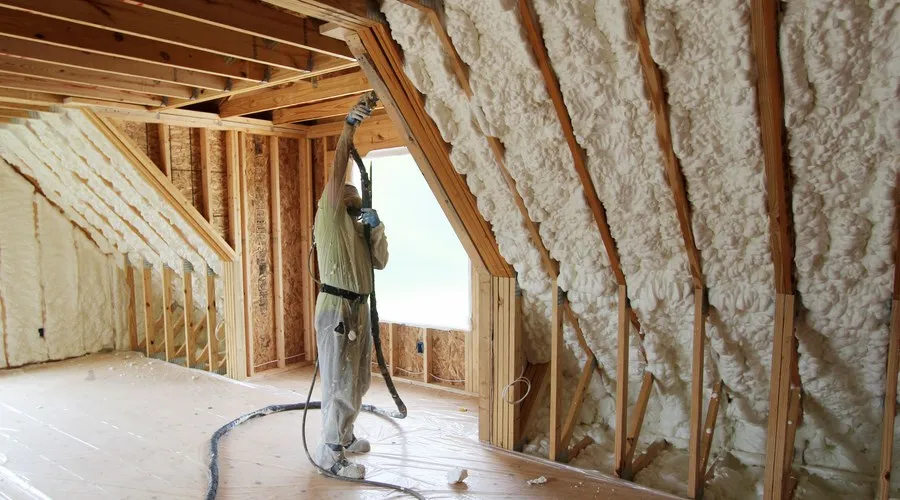
Real-World Scenarios in Raleigh
| Scenario | Property Type | Recommended Option | Rationale |
|---|---|---|---|
| Vented crawlspace with moisture damage | 1970s ranch home in North Raleigh | Closed cell spray foam | Only closed cell is recommended for vented crawlspaces in all climate zones; blocks moisture and air infiltration at the floor framing |
| Unvented attic with HVAC equipment in attic space | New construction 2-story in Cary | Closed cell spray foam | Moves ductwork inside conditioned envelope; vapor retarder property reduces moisture risk without requiring supplemental dehumidification |
| 2×4 wall cavities in full gut renovation | 1950s bungalow in downtown Raleigh | Closed cell spray foam | Achieves R-21+ within 3.5″ cavity depth to meet Climate Zone 4 wall requirements without exterior continuous insulation |
| Large open attic with deep truss bays and dedicated dehumidifier | Custom new build in Wake Forest | Open cell spray foam | Deep cavities accommodate thicker application; dehumidification handles moisture removal; lower material cost per board foot for large attic area |
| Rim joist and band beam sealing in existing basement | 1990s two-story in Garner | Closed cell spray foam | High moisture exposure at foundation transition; closed cell provides vapor barrier and air seal in the most vulnerable envelope location |
Who This Is For and Who This Is Not For
Ideal Candidates for Closed Cell Spray Foam in Raleigh
- Property owners dealing with crawlspace moisture or musty odors
- Homes with HVAC ductwork and air handlers located in unconditioned attic spaces
- Retrofit projects with limited cavity depth needing maximum R-value per inch
- Below-grade walls, band joists, rim joists, and any assembly in direct contact with moisture-prone surfaces
- Buildings targeting aggressive airtightness goals below 3.0 ACH50
Situations Where Open Cell May Be the Better Fit
- Large, open attics with deep truss bays where cavity depth is not a constraint and a dehumidifier or conditioned air supply is available
- Interior partition walls and sound isolation assemblies where vapor control is not required
- Budget-conscious projects where the lower material cost per board foot of open cell makes a large cavity area more affordable
- Wall assemblies paired with an exterior continuous insulation system that provides the additional R-value and vapor control
Get a Professional Assessment for Your Property
Choosing between closed cell and open cell spray foam in Raleigh requires evaluating your building’s specific assembly details, moisture conditions, and code compliance targets. Our team at Raleigh Excel Spray Foam Insulation assesses each project individually to recommend the spray foam type and application depth that matches your building’s needs and North Carolina’s energy code requirements. We handle crawl space encapsulation, unvented attic insulation, wall cavity spray foam, and rim joist sealing throughout the Raleigh area.
Call us at (919) 301-9435 or email [email protected] to get started. Our professionals evaluate your building envelope, identify the most cost-effective insulation strategy, and deliver installation that performs for years in Raleigh’s demanding climate.
Frequently Asked Questions
Does closed cell spray foam really outperform open cell in Raleigh’s humidity?
In applications where vapor control matters, yes. Closed cell foam acts as a Class II vapor retarder at 1.5 inches, blocking moisture drive that open cell cannot. In wall assemblies where vapor control is managed separately, both types perform well thermally.
Can open cell spray foam be used in a Raleigh crawlspace?
For vented crawlspaces, the Building Science Corporation recommends only closed cell spray foam across all climate zones. For conditioned, encapsulated crawlspaces, open cell can work if the space is properly sealed, conditioned, and equipped with moisture management.
What R-value is required for spray foam insulation in Raleigh?
Under the 2024 NC Energy Conservation Code for Climate Zone 4, ceilings require R-49, wood-framed walls require R-20 cavity or R-13 plus R-10 continuous insulation, and floors require R-30. Unvented attics using air-impermeable insulation at the roof deck require a minimum of R-25.
How does spray foam handle Raleigh’s hot-humid summers compared to fiberglass?
Spray foam creates a continuous air seal that fiberglass batts cannot match. According to North Carolina DEQ’s energy guidelines, spray foams are effective at sealing drafts and filling gaps around obstructions, which is a significant advantage over batt insulation in humid climates where air leakage drives moisture infiltration.
Is an unvented spray foam attic better than a vented attic in Climate Zone 4?
Research from the U.S. Department of Energy’s Building America program shows that in hot-humid climates, vented attics introduce outdoor humidity that causes condensation on ductwork and mold growth on sheathing. Unvented conditioned attics with spray foam keep the attic within the thermal envelope, eliminating those moisture risks and improving energy efficiency by bringing ductwork inside conditioned space.
Sources
- Building Science Corporation – GM-2102 Residential Spray Foam Guide – Comprehensive technical guide on spray foam application in walls, roofs, and foundations, including climate-specific recommendations for open cell and closed cell usage.
- U.S. Department of Energy – Building America Hot-Humid Climate Guides and Case Studies – DOE research program findings on building performance in hot-humid climates, including multiple spray foam case studies in North Carolina and the southeastern U.S.
- North Carolina DEQ – Energy Saving Fact Sheet: Insulation Guidelines – State-published guidance on insulation R-value requirements across North Carolina’s three climate regions, including spray foam performance characteristics.
- NC Office of the State Fire Marshal – 2024 NC Energy Conservation Code, Section R402 – Official North Carolina building code amendment establishing insulation minimum R-values, U-factors, and compliance requirements for Climate Zones 3, 4, and 5.
- Building Science Corporation – BSI-119: Conditioned Unconditioned – Research-based analysis of vented versus unvented attic performance in hot-humid climates, documenting why attic venting causes moisture problems in southeastern climates like Raleigh’s.

- How Should Raleigh, NC Property Owners Evaluate Insulation for Long-Term Use? - September 23, 2026
- What Factors Affect Insulation Performance Across Different Parts of a Property? - September 23, 2026
- Could Spray Foam Insulation Be Useful Around Uneven Building Sections in Wake Forest, NC? - September 18, 2026