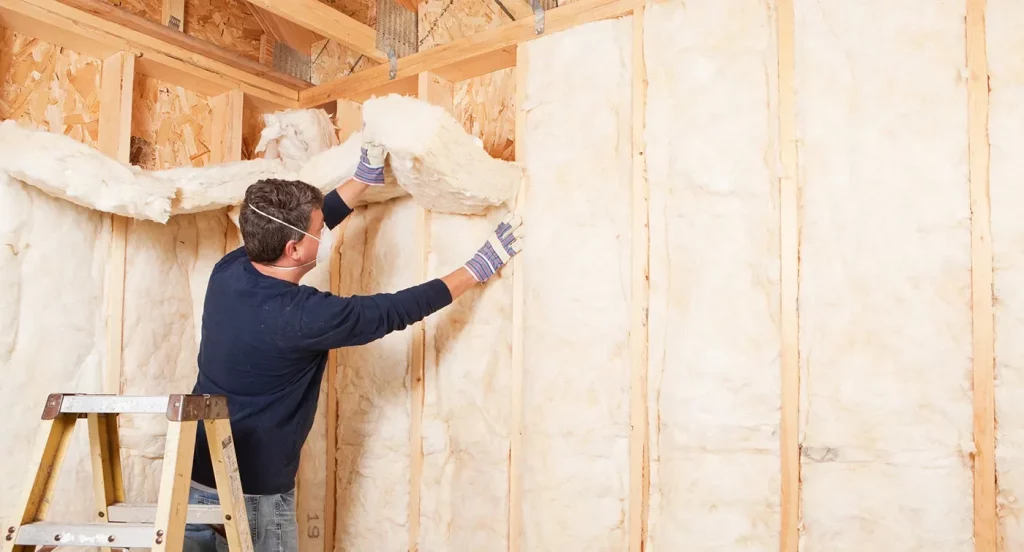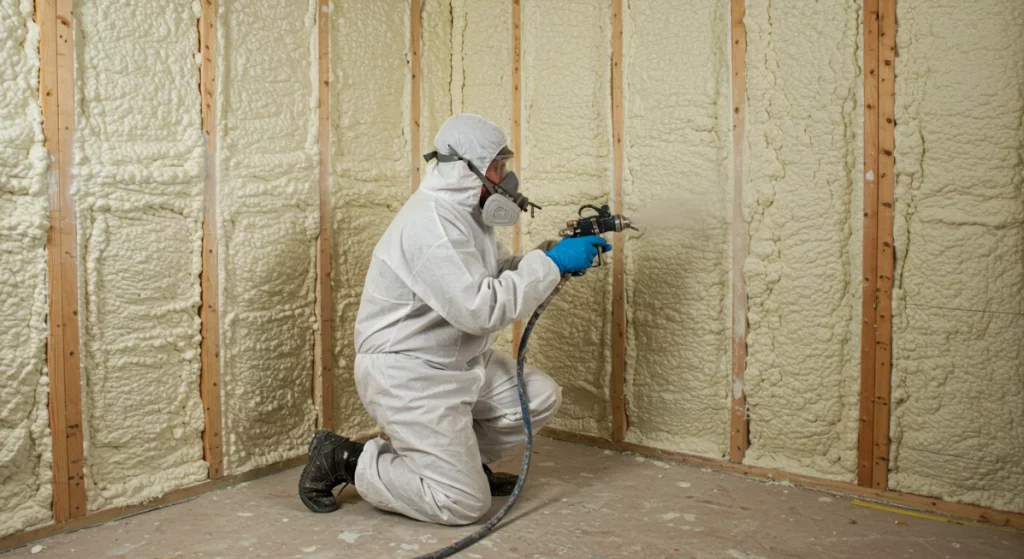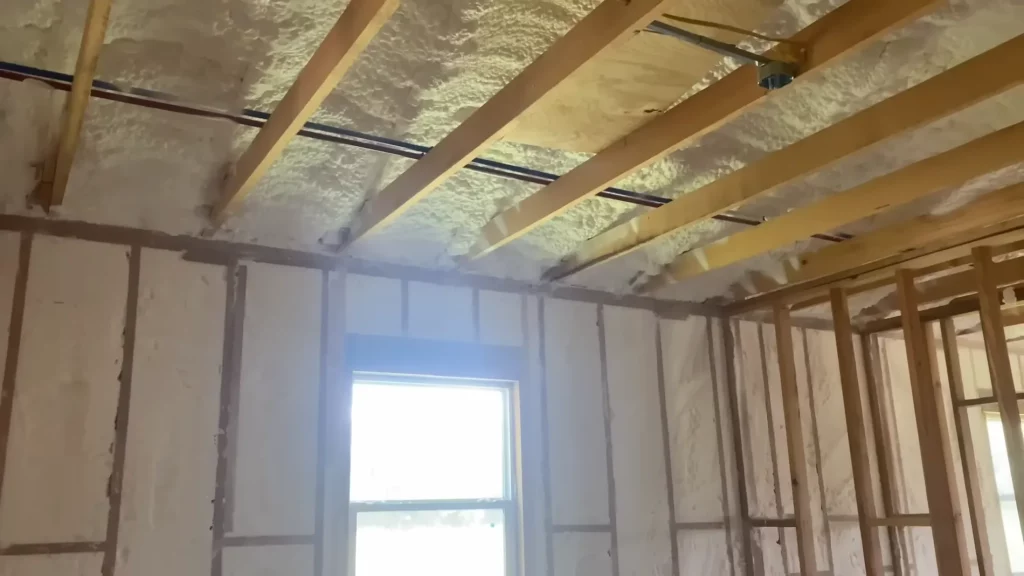



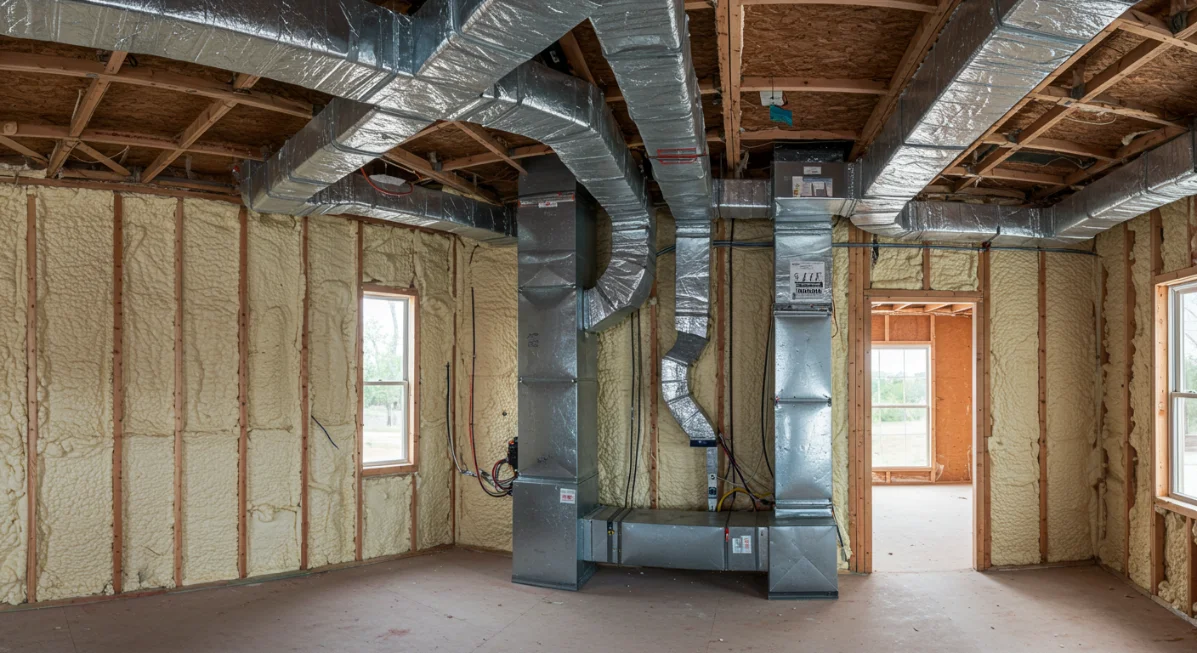
Spray foam insulation fills gaps and seals air leaks that traditional insulation materials like fiberglass batts and blown cellulose simply cannot reach. In Raleigh, NC properties, which fall within IECC Climate Zone 4, the mixed-humid climate creates a dual challenge: hot, humid summers that drive cooling costs and enough winter cold to demand meaningful heating insulation. Spray Foam Insulation: Deep Dive into Performance explores how spray foam addresses both sides of that equation by serving as insulation, an air barrier, and a vapor-diffusion retarder in a single application. The areas where it delivers the most value are attics, crawl spaces, rim joists, exterior wall cavities, and penetration sealing throughout the building envelope.
TL;DR
- Raleigh sits in IECC Climate Zone 4, requiring R-60 ceiling insulation and R-20 or higher wall insulation per the 2021 IECC, targets that spray foam can help meet or exceed.
- Spray foam delivers two functions at once: it insulates and air-seals, which is especially effective because 70 to 90% of moisture movement through the envelope comes from air leakage.
- The five highest-impact areas for spray foam in Raleigh properties are attics, crawl spaces, rim joists, exterior wall cavities, and framing penetrations.
- Closed-cell foam (approximately R-6 per inch) offers moisture resistance and structural rigidity, while open-cell foam (approximately R-3.5 per inch) provides sound dampening at a lower material density.
- Unvented, sealed crawl spaces with spray foam insulation are specifically recommended for humid climates like Raleigh’s to control condensation and mold risk.
- Walls and rim joists represent more than 40% of a home’s total envelope area, making them among the highest-leverage targets for spray foam upgrades.
Why Raleigh Properties Face Unique Insulation Challenges
Raleigh’s mixed-humid climate means homes deal with significant moisture loads in summer and meaningful heat loss in winter. The NC Department of Environmental Quality places the central Piedmont region (which includes Raleigh) in Region 3, recommending a minimum of R-38 for attics and R-13 for wood-framed walls under their guidelines. However, those are baseline recommendations, and many older Raleigh homes were built well before modern energy codes existed.
The real problem is not just insufficient R-value. It is the combination of inadequate insulation and unsealed air leaks. Closed cell spray foam can help address these vulnerabilities by creating an effective air seal while providing insulation. Gaps around top plates, plumbing penetrations, recessed lights, and duct connections allow conditioned air to escape and unconditioned air, along with moisture, to enter. In a humid climate, that moisture migration leads to condensation inside wall cavities and attic spaces, which in turn promotes mold growth and wood rot.
Five Areas Where Spray Foam Insulation Delivers the Most Value in Raleigh
1. Attics and Roof Assemblies
Attics are typically the single largest source of energy loss in any home. Traditional vented attics with insulation on the floor can work, but they leave ductwork and HVAC equipment in unconditioned space. When Raleigh summer temperatures push attic air above 130 degrees, any leak in the duct system forces the HVAC system to work against extreme heat.
Spray foam applied directly to the underside of the roof deck converts the attic into a conditioned, unvented space. In ORNL research on homes in the mixed-humid climate of East Tennessee, sealing and insulating the attic with spray foam kept attic temperatures below 83 degrees Fahrenheit in summer while a comparable vented attic reached 133 degrees. The same study found that enclosing the HVAC ducts within the conditioned envelope reduced space heating and cooling energy use by 17%.
For Raleigh homeowners, this approach also eliminates the need to remove and replace floor insulation, protects duct integrity, and brings the entire roof assembly to code-compliant R-values.
2. Crawl Spaces
Raleigh homes frequently sit on vented crawl spaces, and in a humid climate, those vents work against the homeowner. Warm, moist outside air enters through vents and condenses on cooler floor joists and subflooring, creating conditions for mold. The Building America Solution Center specifically recommends unvented, conditioned crawl spaces for humid climates because they reduce condensation potential and protect floor structures.
Spray foam applied to crawl space walls and the band joist area seals the space, insulates the perimeter, and can serve as part of the required moisture control system. Combined with a continuous polyethylene vapor retarder over the ground, a sealed crawl space keeps ductwork and plumbing within a semi-conditioned environment, improving both comfort and system efficiency.
3. Rim Joists and Band Joists
The rim joist area where the floor framing meets the foundation wall is one of the most leak-prone parts of any building envelope. Each joist bay creates a series of gaps that are difficult to seal with rigid materials or fiberglass. Rim joists are also a common source of pest entry and drafts.
Spray foam fills each joist bay completely, conforming to irregular surfaces and sealing around nails, plumbing runs, and wiring. Because the DOE identifies walls and rim joists as accounting for over 40% of total envelope area, sealing and insulating this zone produces a meaningful reduction in overall air infiltration.
4. Exterior Wall Cavities
Many Raleigh homes built before modern codes have wall cavities with no insulation, under-insulated fiberglass batts that have settled, or insulation that was compressed during installation. Drill-and-fill methods can add cellulose or fiberglass, but they do not address air sealing within the cavity.
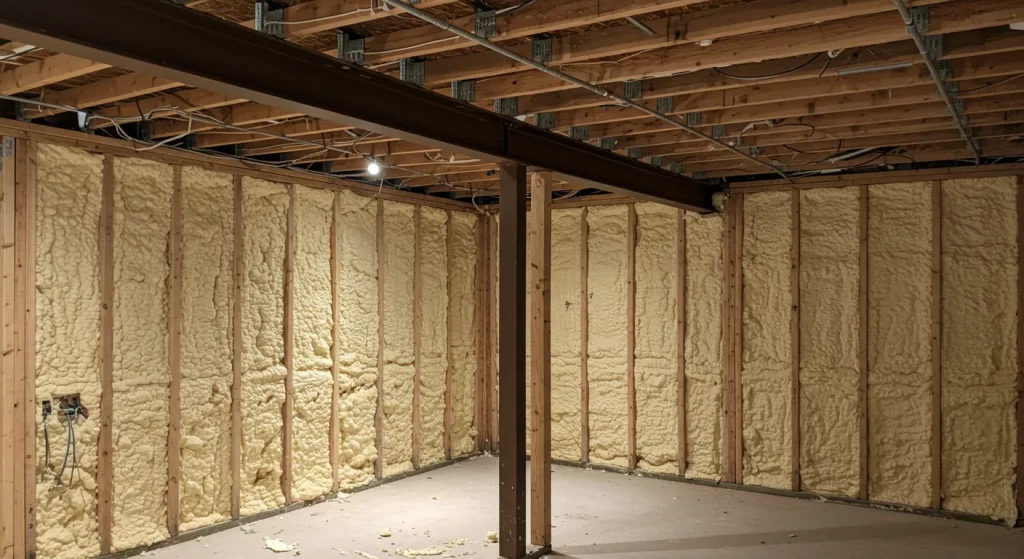
Spray foam applied to wall cavities during renovation (when drywall is removed) or through access points in new construction fills every void around electrical boxes, plumbing, and framing. The ORNL report documents that spray foam in wall cavities, when combined with attic and basement sealing, reduced air changes per hour from 12 down to 5.6 in one retrofit case study.
5. Penetrations, Top Plates, and Transition Areas
Even well-insulated homes lose significant energy through the small gaps where different building assemblies meet. Top plates (where walls meet the attic floor), plumbing and electrical penetrations, chimney chases, dropped soffits, and attic hatches all represent paths for air and moisture to move between conditioned and unconditioned spaces.
Spray foam is particularly effective at sealing these irregular, hard-to-reach locations because it expands into the gap and adheres to surrounding materials. Canned spray foam can address individual penetrations, while professional spray foam rigs can seal entire top-plate runs and transition areas in a single pass.
Closed-Cell vs. Open-Cell: Which Performs Better in Raleigh Conditions?
Choosing the right foam type depends on the application, not just the R-value per inch.
| Property | Closed-Cell Foam | Open-Cell Foam |
|---|---|---|
| R-Value per inch | ~6.0 | ~3.5 |
| Moisture resistance | Low permeability, resists water | Higher permeability, absorbs sound well |
| Air barrier | Acts as air barrier at any practical thickness | Acts as air barrier if sufficiently thick |
| Density | Medium (1.75 to 2.25 lb/ft3) | Low (0.4 to 1.2 lb/ft3) |
| Best use in Raleigh | Crawl spaces, rim joists, roof decks, below-grade | Wall cavities, sound isolation, attic floor fills |
In Raleigh’s mixed-humid climate, Spray Foam Insulation In Raleigh, NC, can be tailored to different areas of a property. Closed-cell foam is generally the better choice anywhere moisture exposure is a concern: crawl space walls, rim joists, and roof decks. Open-cell foam works well in interior wall cavities where sound dampening is a priority and moisture risk is lower.
Recommendations by Property Type
| Property Type | Priority Areas | Recommended Approach |
|---|---|---|
| Older homes (pre-2000) | Attic, rim joists, crawl space, wall penetrations | Blower door test first, then closed-cell at rim joists and crawl space, open or closed-cell in attic depending on duct location |
| New construction | Full envelope, all cavities | Closed-cell at rim joists and crawl space walls, open-cell in wall cavities and attic floor, or closed-cell on roof deck for unvented attic |
| Homes with crawl space ductwork | Crawl space encapsulation | Seal and insulate crawl space walls with closed-cell foam, add vapor retarder, condition the space |
| Homes with vented attics and ductwork in attic | Roof deck insulation | Spray foam on underside of roof deck to bring attic into conditioned space, protecting ducts from extreme temperatures |
Signs You Have Found the Right Insulation Approach
- The provider uses diagnostic testing. A blower door test before and after insulation installation confirms measurable improvement in air tightness. The ORNL research consistently used blower door measurements to track progress at each stage of retrofit, and this practice separates thorough work from guesswork.
- Moisture is addressed before insulation is added. Sealing a wet crawl space or insulating over a moisture problem traps damage in place. Reputable installers assess drainage and moisture conditions before applying any foam.
- The proposal specifies foam type and thickness for each area. Different zones of the building envelope require different products. A single material applied everywhere is a red flag.
- Ventilation is part of the conversation. Tightening the building envelope reduces natural air exchange. Properly installed spray foam should be paired with mechanical ventilation guidance to maintain healthy indoor air quality, as noted in ASHRAE 62.2 standards referenced in the ORNL report.
- Depth verification is included in the scope of work. The ORNL case studies found that initial foam thickness measurements frequently showed variations from specifications. A thorough provider agrees on a verification method before the job begins.
Get an Expert Assessment for Your Raleigh Property
Raleigh Excel Spray Foam Insulation evaluates every area of your building envelope, identifies the coverage gaps that drive your highest energy loss, and recommends the right spray foam solution for each zone. Our team serves homeowners and builders throughout the Raleigh area with a focus on diagnostic testing, proper material selection, and code-compliant installations.
Reach us at [email protected] or call (919) 301-9435 to get started.
Frequently Asked Questions
Is spray foam insulation effective in Raleigh’s hot, humid summers?
Yes. In a mixed-humid climate, spray foam’s air-sealing and moisture-resistant properties reduce the amount of humid outside air entering the building envelope, which lowers both cooling loads and condensation risk.
Can spray foam be installed in an existing home without removing drywall?
In accessible areas like attics, crawl spaces, and rim joists, spray foam can be applied directly. For wall cavities, it is most effective when drywall is already removed during a renovation, though drill-and-fill methods are possible in some cases.
Does sealing my crawl space with spray foam require a dehumidifier?
Building codes typically require a drying mechanism in sealed crawl spaces, which can be a small supply of conditioned air from the HVAC system or a dehumidifier depending on the specific conditions of the space.
How does spray foam compare to fiberglass batts for rim joist insulation?
Fiberglass batts in rim joist areas leave gaps around framing and penetrations. Spray foam expands to fill each joist bay completely, providing both insulation and an air seal in a single application.
Will adding spray foam to my attic mean I need to add mechanical ventilation?
Reducing air leakage below natural exchange rates typically requires mechanical ventilation to maintain indoor air quality. Your installer should assess whether your current system meets ASHRAE 62.2 standards after the envelope is tightened.
Sources
- DOE – Energy-Efficient Home Improvement Credit: Insulation and Air-Sealing Essentials – Federal guidance on insulation R-value requirements by climate zone, air sealing criteria, and building envelope components per the 2021 IECC.
- NC DEQ – Energy Saving Fact Sheet: Insulation Guidelines – North Carolina state guidance on insulation R-value recommendations for the three NC climate regions, including the central Piedmont (Region 3) where Raleigh is located.
- ORNL – Spray Foam in Accessible Spaces: Best Practices and Case Studies for Retrofit in Mixed-Humid Climates – Comprehensive Oak Ridge National Laboratory research report on spray foam types, air sealing checklists, and deep retrofit case studies in mixed-humid climates similar to Raleigh’s.
- Building America Solution Center – Unvented, Insulated Crawlspaces – DOE-funded guidance on sealed crawlspace construction and retrofit, including climate-specific recommendations for humid regions and moisture control strategies.
- BASC/PNNL – IECC 2021 Climate Zone Map – Official climate zone map showing Raleigh and Wake County within IECC Climate Zone 4, establishing the code baseline for insulation requirements.

- How Does Wall Insulation Help Limit Heat Transfer Through Exterior Walls? - October 15, 2026
- How Should Raleigh, NC Property Owners Evaluate Insulation for Long-Term Use? - September 23, 2026
- What Factors Affect Insulation Performance Across Different Parts of a Property? - September 23, 2026