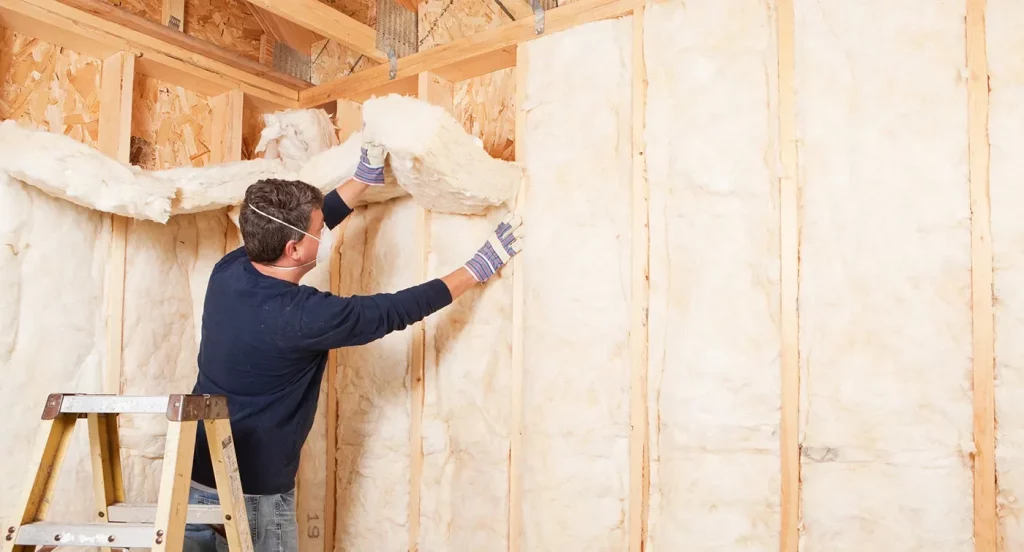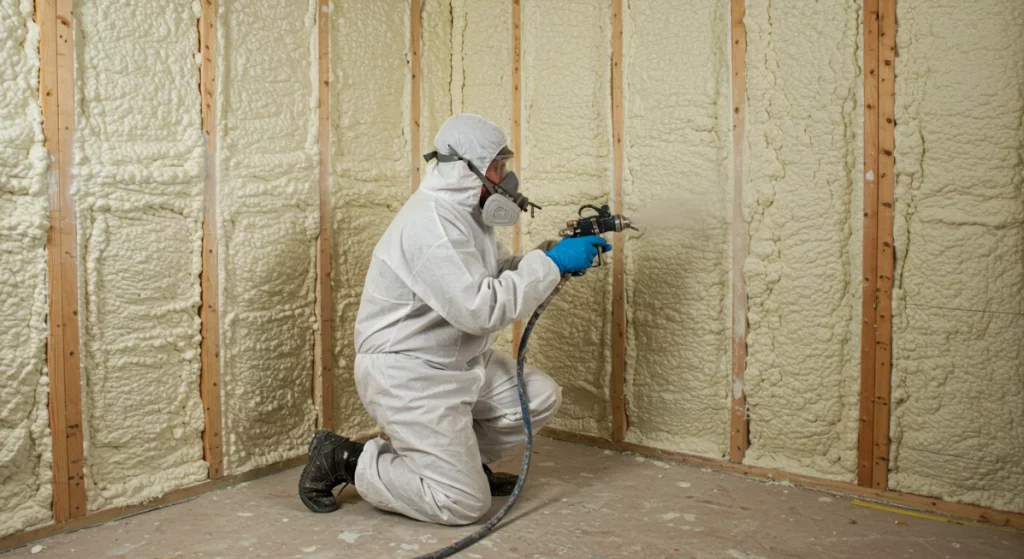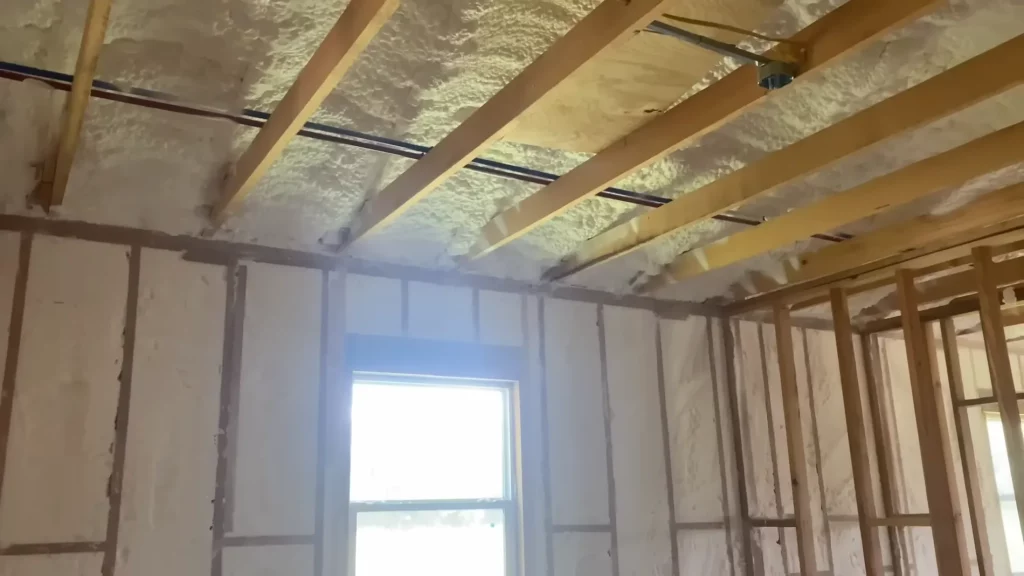



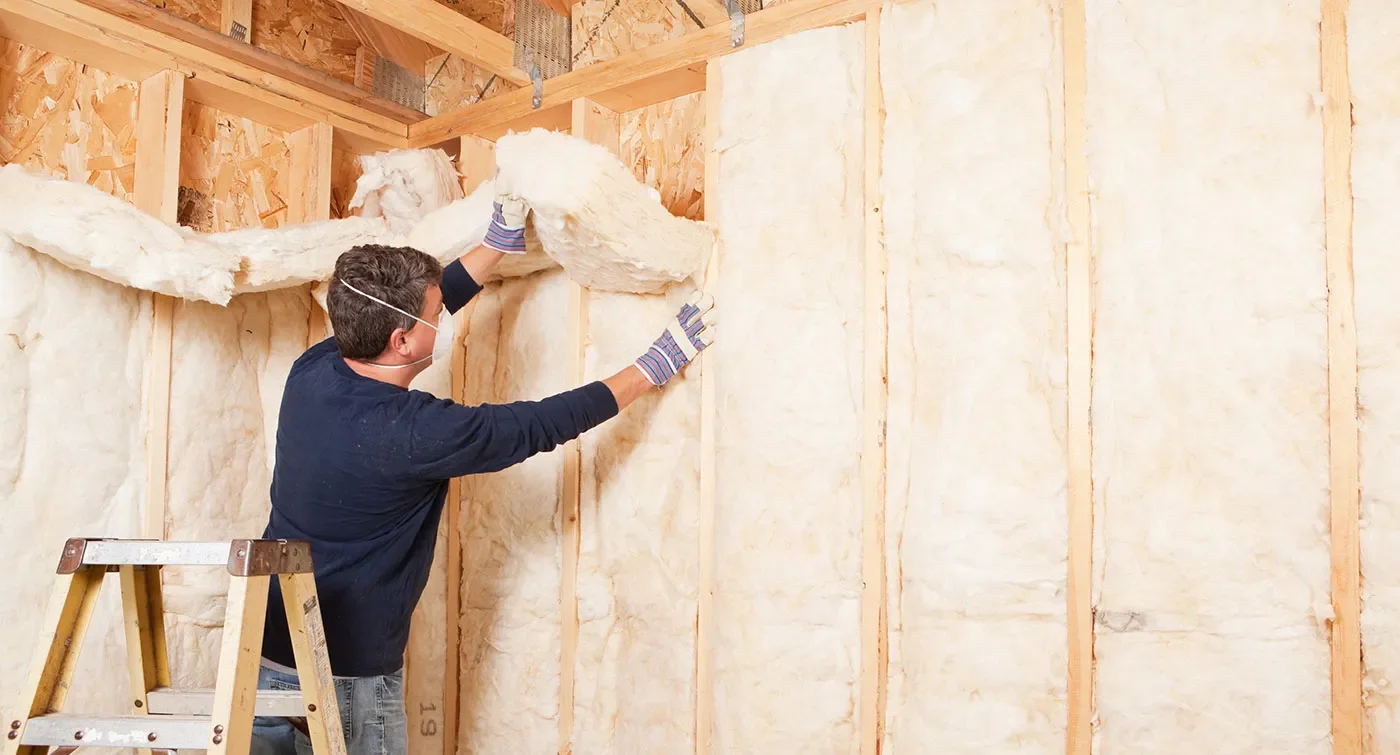
Our wall insulation guide explains how exterior wall insulation slows the heat that’s always trying to move through your walls, outward in winter and inward in summer. It works by trapping still air or gas, which cuts down on conduction and air movement. The best wall insulation heat control comes from completely filled stud cavities, sealed air leaks, and continuous wall insulation exterior coverage over the studs wherever that’s practical.
TL;DR
- Heat moves through walls three ways: conduction, air movement (convection) and radiation.
- Insulation doesn’t stop heat. It slows it down.
- Wood studs, gaps and squashed batts let heat get around cavity insulation.
- Wall insulation exterior coverage (continuous insulation) covers the studs and cuts that bypass.
- Raleigh-area homes are in Climate Zone 4, where federal guidance pairs cavity fill with continuous insulation.
- Wall insulation installation in existing homes often uses small drilled holes, so you don’t have to tear walls open.
How Heat Moves Through an Exterior Wall
Your exterior walls are the border between conditioned air and the weather. According to the U.S. Department of Energy, heat keeps flowing from warmer spaces to cooler ones until the temperatures even out. That means heat escapes to the outdoors in winter and pushes indoors during the cooling season. It does this through three paths.
Conduction
Conduction is heat passing through solid materials like drywall, studs, sheathing and siding. A wall with 95°F air on one side and 72°F air on the other is constantly conducting heat toward the cool side. The more conductive the material, the faster that happens.
Convection and Air Leaks
Air that moves inside an empty cavity or slips through gaps carries heat with it. ENERGY STAR notes that air leaking through a home’s envelope, including the outer walls, wastes a lot of energy and drives up utility costs. You can often feel this as a draft at an outlet on an exterior wall.
Radiation
Sun beating on a west-facing wall heats the siding. That heat then radiates across air spaces toward the inside. This is why some rooms stay warm well into the evening.
How Wall Insulation Heat Control Works on Each Path
Good wall insulation heat control means making each heat path harder to use. Most common insulation materials slow conductive and convective heat flow, while radiant barriers reduce radiant heat gain and only work when the reflective surface faces an air space.
| Heat path | Sign at home | What helps |
|---|---|---|
| Conduction | Warm drywall in July | Filled cavities plus continuous insulation |
| Air movement | Drafts at outlets | Air sealing, spray foam, dense-pack fill |
| Radiation | Hot sun-facing rooms | Reflective layer facing an air gap |
Performance is rated by R-value. R-value depends on the insulation type, thickness and density, and for most products it also shifts with temperature, aging and moisture.
Why Your Wall’s Real R-Value Is Lower Than the Label
The number on the bag is not what your whole wall delivers. Compressed insulation won’t reach its rated R-value, and a wall’s overall R-value differs from the insulation’s because heat moves more easily through studs and other framing. This is called thermal bridging.
Studs matter because thermal bridging creates cold spots on walls and can encourage interior condensation that contributes to moisture and mold problems. How much of a wall is solid framing depends on who’s counting. One architect estimates nearly 10% of a typical stud wall is solid wood once corners and plates are included, while another source puts it at 25-30% for walls framed 16 inches on center. Neither is a government figure, and the real share depends on your windows, headers and layout.
Gaps, voids, settled fill and wet insulation also cut real-world performance.
Wall Insulation Exterior Coverage: Cavity Fill vs Continuous Layers
There are two places to put exterior wall insulation in a framed wall. Each one handles a different weak spot, and the strongest walls use both.
Cavity Insulation
This fills the space between studs. Besides adding R-value, insulation that fills building cavities reduces airflow and leakage. The catch is that it can’t cover the studs themselves.
Continuous Exterior Coverage
Wall insulation exterior coverage usually means continuous insulation (CI), a rigid board or similar layer running unbroken over the studs. It goes on the exterior of the wall assembly, just inside the cladding. The trade-off is access. It’s most practical during new construction or re-siding, and it can change trim depth around windows and doors, so flashing details need care.
How Much Exterior Wall Insulation Do Raleigh-Area Homes Need?
Climate decides the target. A North Carolina energy code guide lists Wake County in Climate Zone 4.
For Zone 4 (except Marine), the Department of Energy recommends R20 + R5 CI, R13 + R10 CI, or R0 + R15 CI for an uninsulated wood-frame wall, and adding R10 CI to a wall that’s already insulated. These are recommendations, not code. Code minimums come from the North Carolina Residential Code and can change, so confirm current requirements with your local building department before you start.
Wall Insulation Material Options
Wall insulation material options differ in how much they slow heat per inch, which matters in a 2×4 wall with only 3.5 inches of space.
| Material | Approx. R per inch | Good fit |
|---|---|---|
| Fiberglass or cellulose | About R-3.6 | Open framing or drill-and-fill |
| Mineral wool | About R-3.1 | Batts or blown fill |
| Open-cell spray foam | About R-3.6 | Cavities that need air sealing |
| Closed-cell spray foam | About R-6 | Tight spaces needing more R |
| Rigid foam board | About R-4 to R-6 | Continuous exterior layer |
The spray foam figures come from the Department of Energy’s Building America spray foam guide, which puts typical open-cell foam at about R-3.6 per inch and closed-cell at R-6, with closed-cell roughly four times denser. Closed-cell gives more R in a thin wall, but it’s one of the most expensive insulation products available.
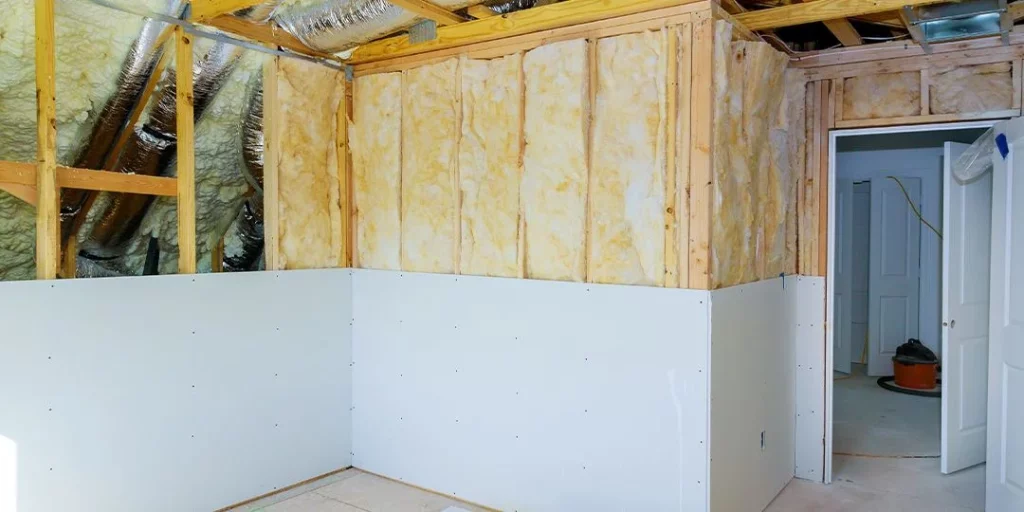
Wall Insulation Installation in Existing Homes
Proper wall insulation installation doesn’t have to mean gutting finished walls. The right method depends on what’s in the cavity now, your wall insulation material options, and whether exterior wall insulation is being added when siding comes off.
Drill and Fill
The Building America Solution Center describes drill and fill as a common, fairly uninvasive method, usually using dense-packed blown cellulose or fiberglass. It also warns that old, deteriorated batts can block the fill, and installers should drill cavities above door headers, above and below windows, and behind cabinets. Missed cavities leave cold or hot spots.
When the Siding Comes Off
Re-siding is the best chance to add wall insulation exterior coverage. On an uninsulated wall, DOE advises blowing insulation into the empty cavity through the sheathing and then adding continuous insulation before the new siding goes on.
Checking What You Have
With the power off, removing an exterior-wall outlet cover sometimes lets you see what’s behind it. Home energy auditors may also use an infrared camera to tell whether walls are insulated.
Exterior Wall Insulation Checklist
- Find out what’s in your walls now (outlet check or infrared scan).
- Look for moisture, leaks or rot first. Don’t bury a wet problem.
- Seal obvious air leaks around outlets, windows and penetrations.
- Compare wall insulation material options against your cavity depth and target R-value.
- Plan continuous exterior coverage if re-siding is coming up.
- Confirm local code requirements before work starts.
- Ask how the wall insulation installation will be checked so every cavity is filled.
Get Help With Your Exterior Walls
If certain rooms run hot in summer or cold in winter, your walls may be letting heat move through faster than they should. Raleigh Excel Spray Foam Insulation can look at your wall assembly and talk through exterior wall insulation options that fit your home and budget. Call (919) 301-9435 or email [email protected] to set up a conversation.
FAQs
Does wall insulation help in summer too?
Yes. The same layer that slows heat leaving in winter slows outdoor heat coming in during summer, so your AC has less heat to remove.
Does insulation stop heat transfer completely?
No. Insulation reduces the rate of heat flow but can’t stop it. More R-value means slower flow, not zero.
Can I insulate existing walls without removing drywall?
Usually. Drill and fill through small holes from outside or inside is the common approach, and the holes get patched afterward.
Is closed-cell or open-cell spray foam better for walls?
It depends on the job. Closed-cell packs more R into a thin cavity but costs more. Open-cell fills and seals well at a lower R per inch.
Sources
- U.S. Department of Energy, Energy Saver: Insulation – Heat flow basics, R-value factors, thermal bridging, continuous insulation and Zone 4 wall recommendations.
- ENERGY STAR: Why Seal and Insulate? – Energy waste from air leaking through outer walls.
- Building America Solution Center: Blown Insulation for Cavities of Existing Exterior Walls – The drill-and-fill method, materials and commonly missed cavities.
- U.S. DOE Building America: Which Spray Foam Is Right for You? – Open-cell and closed-cell spray foam R-values and density.

- How Does Wall Insulation Help Limit Heat Transfer Through Exterior Walls? - October 15, 2026
- How Should Raleigh, NC Property Owners Evaluate Insulation for Long-Term Use? - September 23, 2026
- What Factors Affect Insulation Performance Across Different Parts of a Property? - September 23, 2026