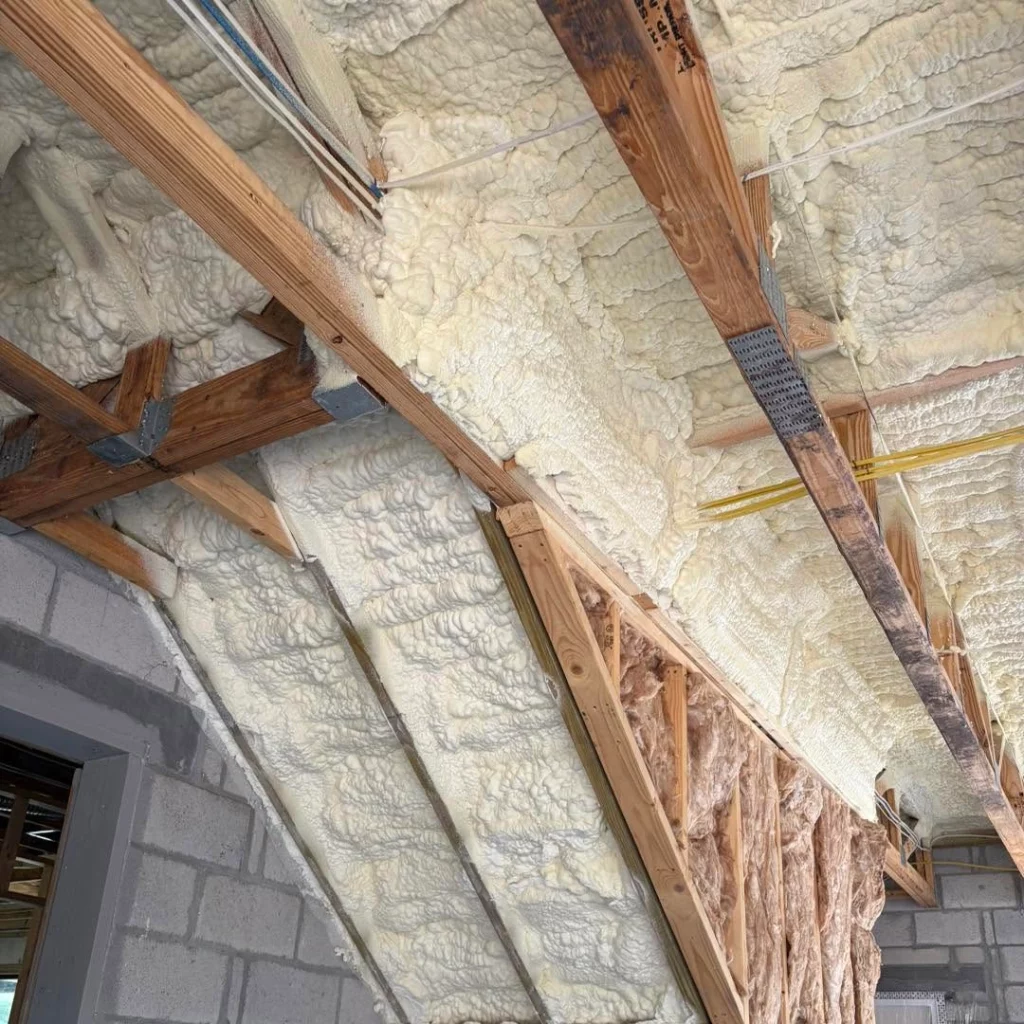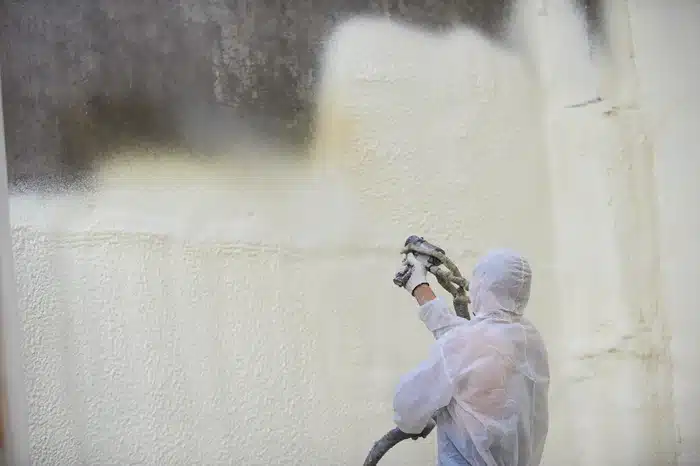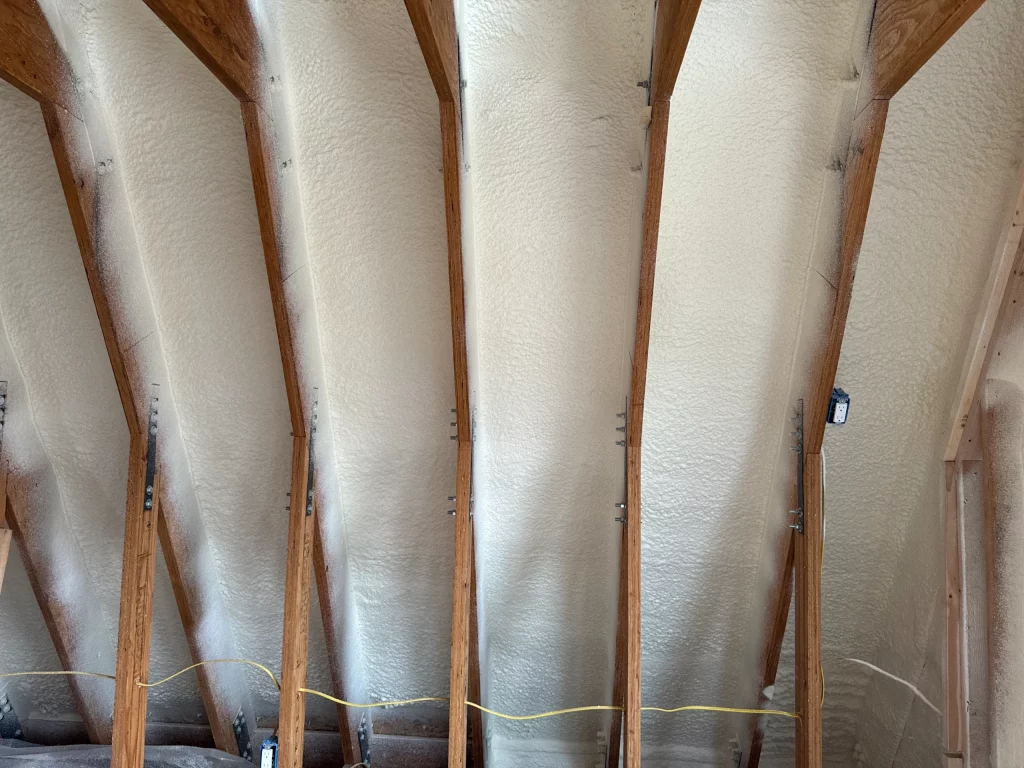



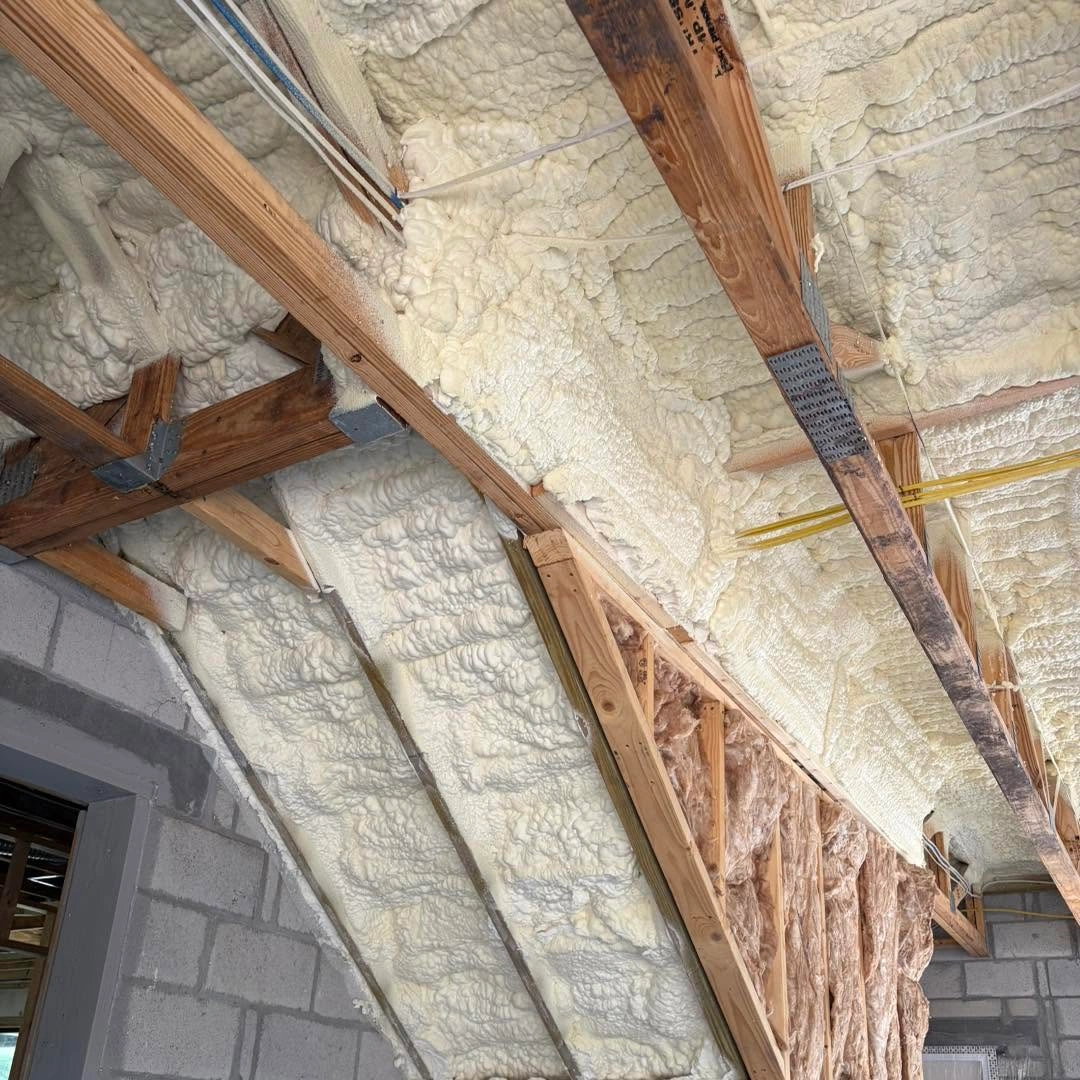
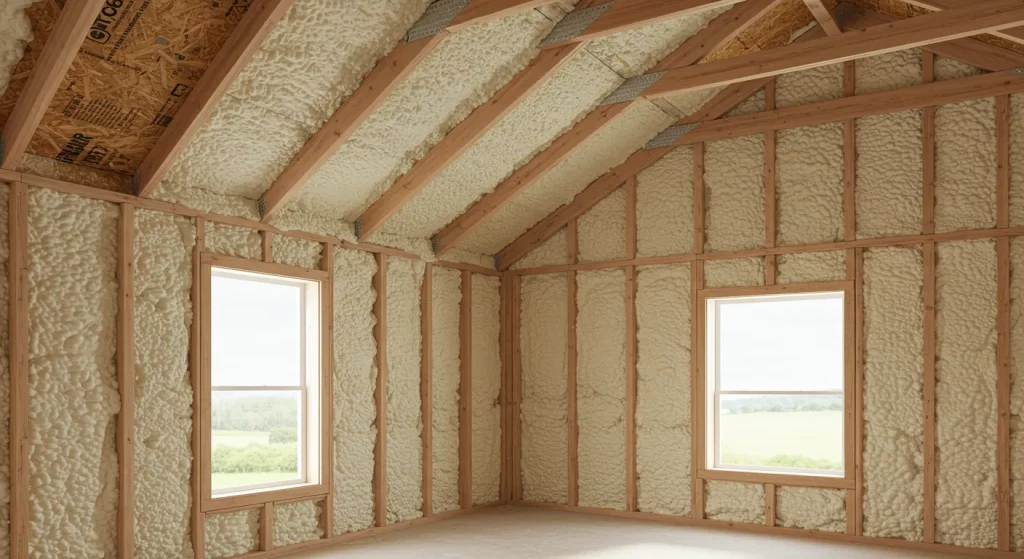
Yes. Spray foam insulation is one of the most effective materials for uneven building sections in Wake Forest, NC, including rim joists, kneewalls, bay window floors, crawlspace walls, and the awkward transitions where an addition meets original framing. Because spray foam starts as a liquid and expands up to 30 to 60 times its applied volume, it fills cracks, crevices, and voids and adheres to irregular substrates that batts and loose fill routinely miss (Wikipedia – Spray foam). The right choice depends on the section involved, the foam chemistry (open cell or closed cell), and the moisture conditions in that part of the structure, and Wake Forest’s humid subtropical climate makes that moisture check especially relevant. Below we explain spray foam insulation unpacked, including where foam performs best around irregular framing, how the two foam types compare, and how we plan the work for homes across Wake Forest, NC.
TL;DR
- Spray foam expands up to 30 to 60 times its liquid volume, filling voids and adhering to irregular surfaces where cut batts leave air paths.
- Open cell foam (about R-3.8 per inch) fits interior uneven cavities, while closed cell foam (roughly R-5 to R-6 per inch) fits rim joists, crawlspace walls, and moisture-exposed zones.
- Department of Energy research attributes roughly 40 percent of a home’s energy loss to air infiltration, and irregular junctions are prime leak points.
- Batts cut around electrical boxes and plumbing allow air to move freely through the cavity; foam seals those same penetrations on contact.
- In humid climates, crawlspace vents can lift relative humidity above 80 percent, which supports mold growth and rot in floor joists.
- EPA guidance calls moisture control the key to mold control and recommends indoor humidity between 30 and 50 percent.
- A 2005 Department of Energy study in the Southeast found sealed crawl spaces used significantly less space conditioning energy than vented ones.
- Foam never fixes a wet assembly. Drainage, leaks, and standing water must be corrected before spraying.
Why Uneven Building Sections Defy Standard Insulation
Irregular sections resist conventional insulation for a simple reason: rigid materials need uniform cavities to perform. Batts are precut blankets that lose effectiveness when compressed, and cutting them to accommodate boxes, pipes, and blocking opens air paths straight through the wall or floor. Those gaps become sites of air infiltration and condensation, and hanging batts under floors between joists is notoriously difficult (Wikipedia – Building insulation materials).
Loose fill conforms better, but it settles, needs containment on sloped or vertical undersides, and cannot bridge gaps between dissimilar framing members like spray foam insulation company applications can. Uneven sections in real homes include rim and sill plates with mechanical penetrations, bay window and cantilevered floor bays open at both ends, stepped foundations where slab meets crawlspace, boxed-out soffits, kneewalls behind bonus rooms, and the mismatched lumber, wiring, and ductwork found where additions join older structures.
How Spray Foam Adapts to Irregular Geometry
Spray polyurethane foam is applied as a two-part liquid that mixes at the gun and expands in place. Open cell foam is specifically noted for its ability to expand during application, filling cracks, crevices, and voids and adhering to irregular surfaces to form an air seal (Wikipedia – Spray foam). Because foam blocks airflow by expanding and sealing leaks, gaps, and penetrations, works well in tight spaces, can be applied in small quantities, and even fills finished-wall cavities through drilled holes without tear-out, it reaches areas other materials cannot (Wikipedia – Building insulation materials).
| Uneven Section | Typical Problem | Foam Advantage | Preferred Type |
|---|---|---|---|
| Rim joists and sill plates | Gaps, bolt holes, utility penetrations | Expands into joints and seals on contact | Closed cell |
| Crawlspace walls | Irregular masonry, old vents, plumbing runs | Continuous layer over uneven masonry | Closed cell |
| Kneewalls and bonus room floors | Shallow, odd-depth bays | Fills variable depth completely | Open cell |
| Bay windows and cantilevers | Open joist bays exposed to wind washing | Blocks airflow through both ends | Closed cell |
| Addition and step-down transitions | Mixed framing ages and sizes | Bridges dissimilar members in one pass | Either |
| Finished walls with blocking | Cavities cannot be opened | Injection through small drilled holes | Injection foam or low-expansion SPF |
Open-Cell vs Closed-Cell for Irregular Areas
| Attribute | Open Cell | Closed Cell |
|---|---|---|
| R-value per inch | About 3.8 | Roughly 5.1 to 6+ |
| Moisture behavior | Porous, allows vapor through | Non-porous, semi-permeable vapor barrier at adequate thickness |
| Structure | Soft when cured | Rigid, adds structural reinforcement |
| Sound control | Strong airborne sound reduction | Moderate |
| Best uneven zones | Kneewalls, interior ceilings, sound-sensitive walls | Rim joists, crawlspace walls, sill plates, cantilevers |
Closed cell foam is the default wherever uneven sections touch soil, masonry, or outdoor air, because it resists water wicking and air movement at modest thicknesses. Open cell earns its place in interior cavities where depth varies and sound control matters.
The Wake Forest Moisture Factor
Wake Forest sits where the North Carolina Piedmont meets the Atlantic Coastal Plain, with a humid subtropical climate: summer highs in the upper 80s to low 90s, rainiest months in July and August, and winter lows in the 30s (Wikipedia – Wake Forest, North Carolina). That mix of heat, humidity, and rain concentrates risk in the uneven, below-grade, and semi-exposed sections of a home, making closed-cell spray foam insulation a practical option for addressing irregular areas and cavities.
Crawlspaces are common here because they are often built where full basements are impractical. In humid regions, outside vents can admit moist air that condenses on cooler surfaces such as ductwork, and relative humidity above 80 percent supports mold growth and rot in wooden joists (Wikipedia – Crawl space). The EPA is direct about the stakes: the key to mold control is moisture control, wet materials should dry within 24 to 48 hours, and indoor humidity should stay below 60 percent, ideally between 30 and 50 percent (EPA – A Brief Guide to Mold, Moisture and Your Home).
Used correctly, foam is part of the fix. Encapsulation combines a ground vapor barrier, sealed openings, insulated walls, and sealed penetrations, and the 2005 Department of Energy field study in the Southeast found that closed crawl spaces significantly reduced space conditioning energy use compared with vented ones (Wikipedia – Crawl space). Used incorrectly, foam can hide a moisture problem, so our process always starts with drainage checks, ground sloping away from the foundation, and leak repair before any spraying begins.
Where Uneven Sections Show Up in Wake Forest Homes
Local housing stock gives this question real weight. Wake Forest grew from about 30,117 residents in 2010 to 47,601 in 2020, after being named one of America’s fastest-growing suburbs in 2007, so the town blends older in-town homes near the Downtown Wake Forest Historic District and the Glen Royall Mill Village with large volumes of newer subdivision construction (Wikipedia – Wake Forest, North Carolina). Older homes bring settled foundations, non-standard framing depths, and retrofitted systems, while newer homes frequently add bonus rooms over garages, step-down great rooms, three-story foyers, and screened porch transitions, all of which create exactly the irregular junctions where air leaks concentrate.
Recommendations by Building Situation
| Situation | Recommended Approach | Key Notes |
|---|---|---|
| Older in-town home with vented crawlspace | Closed cell on crawlspace walls and rim joists, plus ground vapor barrier | Address drainage and standing water first |
| 2000s-era bonus room over garage | Open cell in kneewalls and floor bays | Seal the garage ceiling plane as well |
| Cantilever or bay window floor | Closed cell to block wind washing | Verify sheathing condition before spraying |
| Addition tied into original house | Hybrid: closed cell at slab-to-wood transitions, open cell in cavities | Treat the junction as its own zone |
| Finished walls with odd blocking | Injection foam through drilled holes | Avoids opening finished surfaces |
| Damp or musty crawlspace | Moisture remediation, dehumidification, then encapsulation | Foam follows dryness, never replaces it |
Common Mistakes to Avoid
- Spraying over damp wood or active leaks, which traps moisture against structural members.
- Sealing tightly without planning for ventilation or combustion air in homes with atmospherically vented appliances.
- Skipping the required thermal barrier, since most foams need protection such as drywall with a 15-minute fire rating in living areas.
- Sealing rim joists while ignoring grading and gutter issues that push water toward the foundation.
- Assuming one foam type fits every uneven section instead of matching chemistry to exposure.
Signs You’ve Found the Right Approach
- The assessment includes moisture readings, crawlspace inspection, and a walkthrough of the exact uneven sections, not just square footage.
- The proposal names open cell or closed cell per location, with target thicknesses and the reason for each choice.
- Water management comes before foam, and the team explains why.
- Code items such as thermal barriers and ignition protection are addressed without prompting.
- The scope matches your goals, whether that is even temperatures between rooms, lower humidity, or reduced HVAC runtime.
Get Expert Help With Uneven Building Sections in Wake Forest
Raleigh Excel Spray Foam Insulation helps Wake Forest homeowners seal the irregular sections that standard insulation cannot handle, from rim joists and crawlspace walls to kneewalls and addition transitions. Our team evaluates moisture conditions, recommends the right foam chemistry for each location, and installs to code with clean, documented workmanship. Call us at (919) 301-9435 or email [email protected] to get started.
Your home’s hardest-to-insulate corners are often where the biggest comfort gains are hiding, and we would be glad to show you exactly what is possible.
FAQs
Can spray foam be applied directly to uneven wood framing?
Yes. Foam is sprayed as a liquid, expands into the voids, and adheres to irregular surfaces, which is precisely why it works where batts fail. Surfaces should be dry, clean, and structurally sound first.
Is closed cell or open cell better for a Wake Forest crawlspace?
Closed cell is the standard choice for crawlspace walls and rim joists here because it resists moisture and air movement at modest thickness. Open cell can work in interior floor systems when moisture is fully controlled.
Will foam trap moisture in an uneven wall or floor section?
Not if the assembly is dry and drainage is correct before application. Foam applied over active leaks or damp wood can hide a problem, so we verify moisture conditions first.
How long does work on irregular sections usually take?
It depends on access and total area, but isolated projects such as rim joists or a bay window floor are often completed in a single visit. Whole-crawlspace encapsulation takes longer and includes preparation steps.
Does foam around living areas need a thermal barrier?
In most living spaces, codes require a thermal barrier such as drywall over foam, commonly rated at 15 minutes. Unoccupied areas like crawlspaces follow different exposure rules, which we confirm with local inspection requirements.
Sources
- Wikipedia – Spray foam – Reference covering spray polyurethane foam chemistry, 30 to 60 times expansion, R-values per inch, air sealing behavior, and open cell adhesion to irregular surfaces.
- Wikipedia – Building insulation materials – Overview of insulation types comparing batts, loose fill, and spray foam, including why gaps and cut batts create air infiltration sites and why foam requires thermal barriers.
- Wikipedia – Crawl space – Explanation of crawlspace design in humid climates, condensation and humidity risks above 80 percent, encapsulation methods, and the 2005 DOE Southeast closed crawlspace study.
- EPA – A Brief Guide to Mold, Moisture and Your Home – Environmental Protection Agency guidance on moisture control as the key to mold prevention, 24 to 48 hour drying windows, and indoor humidity targets of 30 to 50 percent.
- Wikipedia – Wake Forest, North Carolina – Local reference on Wake Forest’s humid subtropical climate, Piedmont and Coastal Plain location, rainfall patterns, and housing growth from the historic district through recent subdivisions.