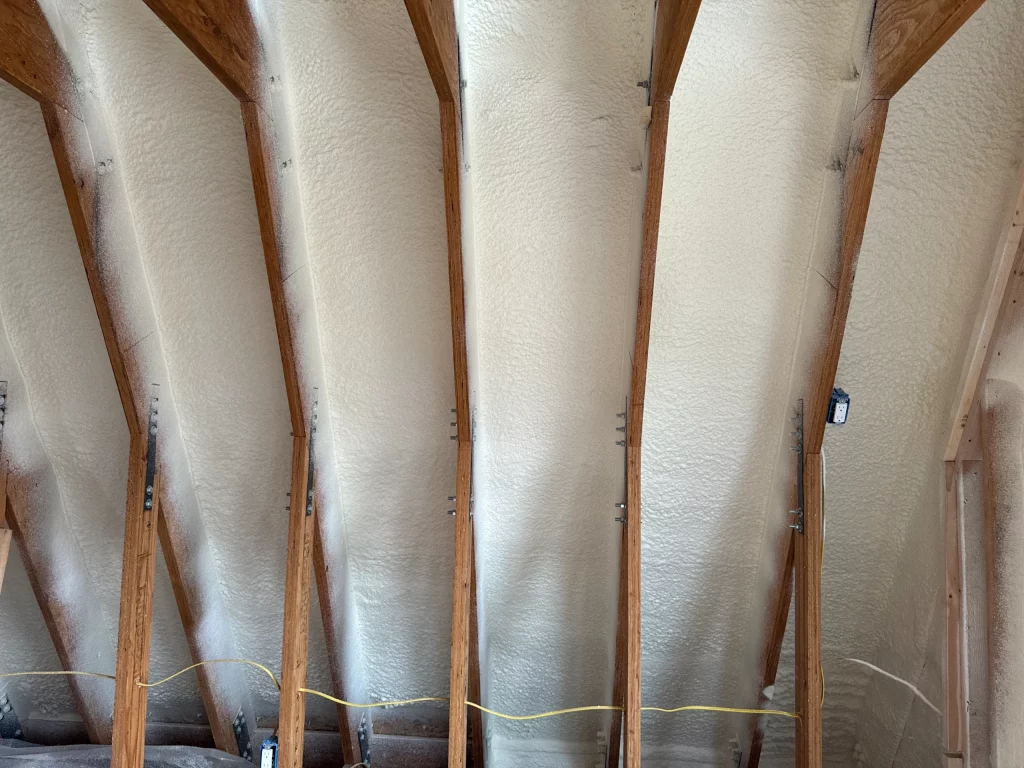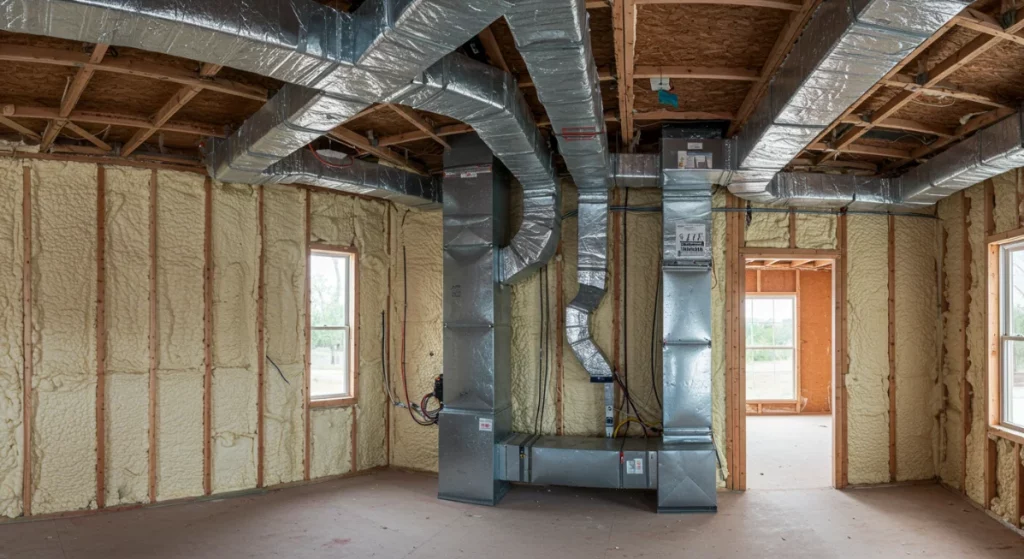



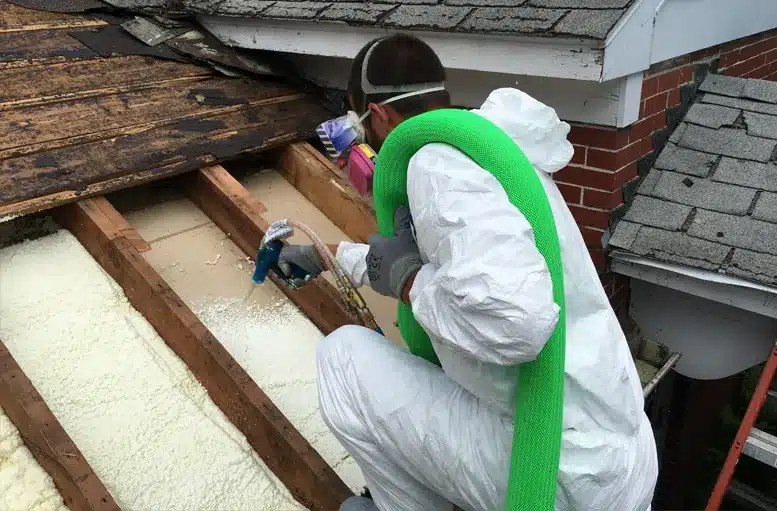
Spray foam roofing answers most common roof surface challenges the same way: by forming a seamless, fully adhered, closed-cell membrane that bonds directly to the substrate it is sprayed onto. In this Complete Guide to Spray Foam Roofing Systems, instead of laying sheets or panels that must be seamed, fastened, and flashed together, spray polyurethane foam (SPF) reacts in place within seconds and expands 20 to 30 times its liquid volume, conforming to drains, curbs, penetrations, and irregular shapes. That single characteristic changes how the roof responds to ponding water, UV exposure, wind uplift, hail, thermal movement, and leak-prone seams. The right choice for your building still depends on substrate condition, drainage design, coating maintenance, and qualified application, and we will walk through each factor below for owners and property managers weighing an SPF roofing system in the Raleigh area.
TL;DR
- SPF roofing is seamless and fully adhered, so there are no membrane seams or fastener rows where leaks typically start, according to the Insurance Institute for Business & Home Safety.
- Roofing-grade foam is dense and durable, roughly 2.5 to 4.0 lb/ft3, with compressive strength above 40 psi and an R-value near 5.5 to 6.5 per inch.
- Applicators can vary foam thickness across the roof, building a drainage plane that corrects low areas without tapered board insulation.
- Bare foam degrades in sunlight, so elastomeric coatings protect it, and recoating is generally needed every 10 to 20 years.
- Wind uplift testing often fails at the substrate rather than the foam, and SPF applied directly to concrete decks has shown tensile failures near 900 psf.
- Hail and debris usually leave cosmetic surface damage that does not leak and can be repaired with sealant.
- Maintained SPF roofs historically exceed 30 years of service, and the Spray Polyurethane Foam Alliance notes 40 or more years with regular care.
- Reflective cool coatings over SPF can reduce peak cooling demand by 11 to 27 percent in air-conditioned buildings, per the U.S. Environmental Protection Agency.
What Makes SPF Roofing Different at the Surface
Polyurethane is a thermosetting polymer made by reacting an isocyanate with a polyol, and in closed-cell form the cells stay intact, producing rigid foam that doubles as insulation and waterproofing, as explained on Wikipedia. On a roof, that foam is spray-applied at a minimum of about one inch, coated with a UV-protective elastomeric layer, and left monolithic, with no sheets to separate and no fasteners to back out. The foam is also self-flashing, meaning it forms its own transition between horizontal and vertical surfaces, which removes a common failure point around parapets and curbs.
How Spray Foam Roofing Handles Each Surface Challenge
Ponding Water and Poor Drainage
Ponding water, standing water beyond what the manufacturer or contract allows, should still be avoided on an SPF roof. What makes spray foam roofing services different is that thickness can be built up in low areas to sculpt a drainage plane toward drains and scuppers, something rolled membranes cannot do without added insulation layers. Random residual water that dries between rains is generally acceptable, but persistent ponding should be addressed with added drains or reshaped foam during installation.
UV Exposure and Heat
Ultraviolet light darkens bare polyurethane foam, makes the surface friable, and slowly erodes thickness, which is why every SPF roof carries a protective coating. Acrylic, silicone, butyl, polyurethane, and polyurea coatings are all elastomeric, stretching to at least twice their length and returning to shape. Light-colored coatings also work as cool roofs, reflecting solar energy and cutting cooling loads, a benefit the EPA documents across low-slope roofing products.
Wind Uplift
SPF is an adhesive material with no fasteners in its attachment, so the foam itself rarely separates from the substrate in a wind event. Wind uplift resistance is typically tested to FM 4474 or UL 580, and the usual failure mode is the substrate or deck connection, not the foam. Applied directly to structural concrete, SPF systems have recorded tensile adhesive failures around 900 psf, a very high result. In recover applications over an older roof, the existing roof’s securement becomes the limiting factor, which is why we evaluate the deck first.
Hail and Wind-Borne Debris
Impact resistance is rated under FM 4470 as moderate hail (MH) or severe hail (SH). Because the foam membrane is at least an inch thick and resilient, hail and wind-borne debris typically leave divots and gouges that do not penetrate to leak. Most minor damage is repaired with compatible sealant or caulk as routine maintenance rather than replacement.
Leaks at Seams, Penetrations, and Flashings
Most low-slope roof leaks trace back to seams, laps, fasteners, and flashing transitions. SPF eliminates those by spraying a continuous surface around pipes, vents, units, and walls. Substrate preparation matters most here, the surface must be structurally secure, dry, and free of oil, grease, and loose debris, or adhesion suffers.
Thermal Movement and Complex Shapes
Thermosetting foam does not melt with heat and flexes with the building instead of pulling joints apart. Domes, sawtooth profiles, and irregular rooftop geometry that frustrate sheet goods are simply sprayed and coated, since the material conforms on contact.
Challenge-by-Challenge Comparison
| Roof Surface Challenge | Typical Single-Ply or Built-Up Response | Spray Foam Roofing Response | Watch-Out |
|---|---|---|---|
| Ponding water | Requires tapered insulation or drains added separately | Foam thickness varied to build drainage plane | Persistent ponding still needs added drainage |
| UV exposure | Membrane facers weather over time | Elastomeric coating sacrificial layer, recoated periodically | Bare foam exposed too long must be repaired |
| Wind uplift | Fasteners and plates are the weak link | Fully adhered, no fasteners, failures usually at substrate | Deck and substrate must be sound |
| Hail and debris | Membrane punctures can leak | Divots usually stay watertight, caulk repair | Severe events need prompt inspection |
| Seams and flashing | Multiple laps and counter-flashings | Seamless, self-flashing transitions | Detail workmanship during install |
| Thermal movement | Elongated seams stress over time | Monolithic surface moves with the deck | Coating must stay elastic and intact |
Maintenance That Keeps Performance Strong
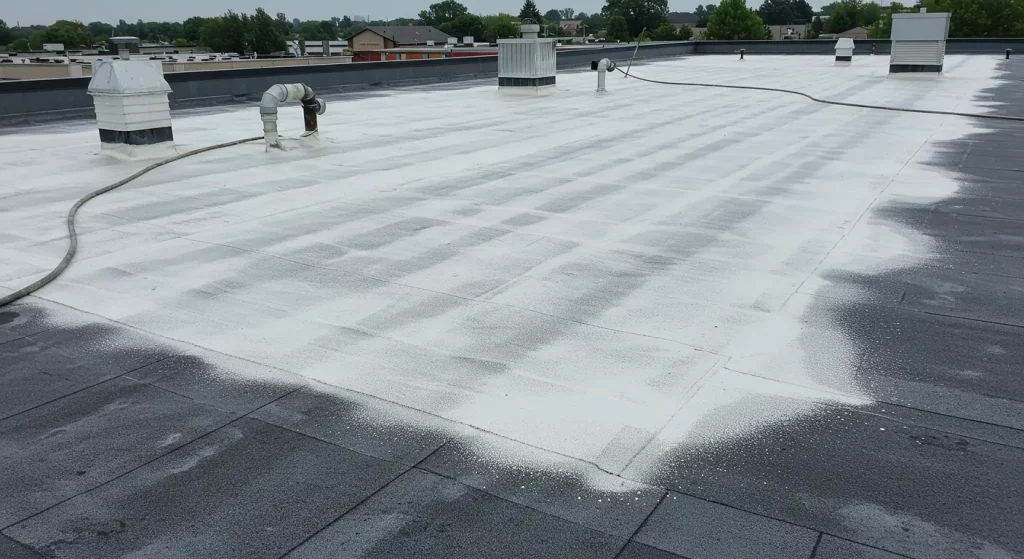
SPF roofs are considered sustainable and renewable. Historical data show maintained SPF roofs exceeding 30 years, with recoating every 10 to 20 years depending on coating type and thickness. The Spray Polyurethane Foam Alliance recommends inspections twice a year, in spring and fall, plus checks after severe weather. Inspections look for coating wear, exposed or cracked foam, pinholes, blisters, and clogged drains. When coating thins from natural aging, the fix is a recoat, not a tear-off.
Application Limits and Safety to Know
SPF components are moisture sensitive and cannot be applied to wet or damp surfaces, and manufacturers set temperature and humidity windows for each product. Wind during application can cause overspray and irregular texture, so masking and scheduling matter. Isocyanates are the reactive raw materials in polyurethane, and the Occupational Safety and Health Administration notes they are respiratory and skin sensitizers requiring exposure controls, which is why trained, equipped applicators should always run the spray rig.
Recommendations by Building and Situation
| Building or Situation | Recommended Approach | Key Notes | Expected Outcome |
|---|---|---|---|
| Flat commercial roof with chronic ponding | SPF with built-up drainage plane and added drains | Evaluate deck condition first | Faster shedding, fewer wet zones |
| Aging built-up roof, tear-off undesirable | SPF recover over prepared existing roof | Existing roof becomes the substrate | Lightweight recover, under 0.5 lb per inch added |
| High-wind exposure | SPF fully adhered, impact and uplift rated assembly | Confirm deck attachment capacity | Uplift resistance limited by deck, not foam |
| Energy-focused retrofit | SPF plus light reflective coating | Sealed thermal layer plus cool surface | Lower cooling demand and tighter envelope |
| Roof with complex geometry or many penetrations | Seamless SPF with self-flashing details | Fewer fabricated flashings | Continuous coverage around penetrations |
Signs You’ve Found the Right Approach
A strong SPF project starts with a deck and substrate evaluation before anyone sprays. You should expect a written plan covering moisture testing, drainage correction, foam thickness targets, coating type and dry film thickness, and a recoating schedule. Clear communication about weather windows, overspray protection, and site safety signals a crew that follows industry practice rather than improvising. Transparency about what SPF cannot fix, such as a failing deck or unaddressed ponding, is one of the best indicators that the recommendation fits your building rather than a one-size answer.
Talk to Our Team About Your Roof Surface
Raleigh Excel Spray Foam Insulation installs and maintains spray foam roofing systems for low-slope commercial and residential roofs across the Raleigh area, from drainage correction to full recover applications and protective coatings. Our team evaluates your substrate, moisture condition, and drainage before proposing thickness and coating specs, so the system you get matches the challenges your roof actually faces. Email us at [email protected] or call (919) 301-9435 to get started.
Every season your roof waits is another round of ponding, UV, and wind working on the surface, so let our crew map the fix while the problems are still small.
Frequently Asked Questions
Can spray foam roofing be installed over an existing roof?
Yes, SPF is widely used as a recover over prepared built-up and modified bitumen roofs. The existing surface must be dry, secure, and free of loose debris or contaminants first.
How does spray foam respond to standing water?
Brief residual water is acceptable, but ponding beyond manufacturer limits should be corrected. Foam thickness can be varied to redirect flow toward drains during installation.
How often does an SPF roof need recoating?
Protective coatings generally need reapplication every 10 to 20 years, depending on coating type, original thickness, and weather exposure between inspections.
Does hail damage mean an SPF roof must be replaced?
Usually not. Hail and debris typically cause surface divots that remain watertight and are repaired with compatible sealant as routine maintenance.
Can spray foam be applied in any weather?
No. SPF cannot be sprayed onto wet surfaces, and temperature, humidity, and wind limits set by the manufacturer must be met for proper adhesion and texture.
Sources
- Insurance Institute for Business & Home Safety, RICOWI Roof Guide: Spray Foam – Technical guide covering SPF roof composition, coatings, wind uplift test results, hail ratings, installation steps, and maintenance timelines.
- Spray Polyurethane Foam Alliance, SPF Roofing Installation and Maintenance – Trade association overview of installation practice, protective coverings, inspection frequency, and expected service life.
- U.S. Environmental Protection Agency, Using Cool Roofs to Reduce Heat Islands – Government resource on solar reflectance, thermal emittance, and measured cooling energy savings from cool roof surfaces.
- Wikipedia, Polyurethane – Reference article on polyurethane chemistry, closed-cell versus open-cell foam structure, and UV effects on the polymer.
- Occupational Safety and Health Administration, Isocyanates – Federal safety resource on isocyanate exposure hazards and controls relevant to spray polyurethane application.